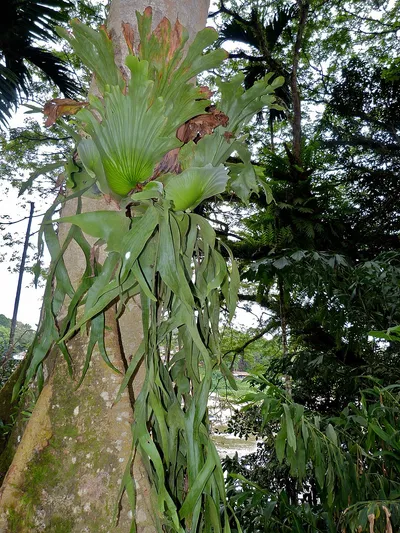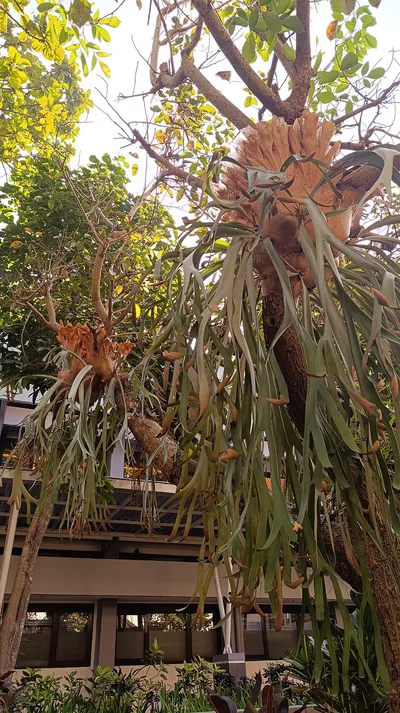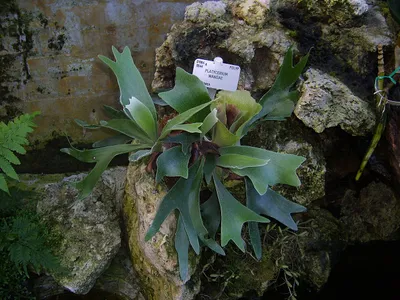
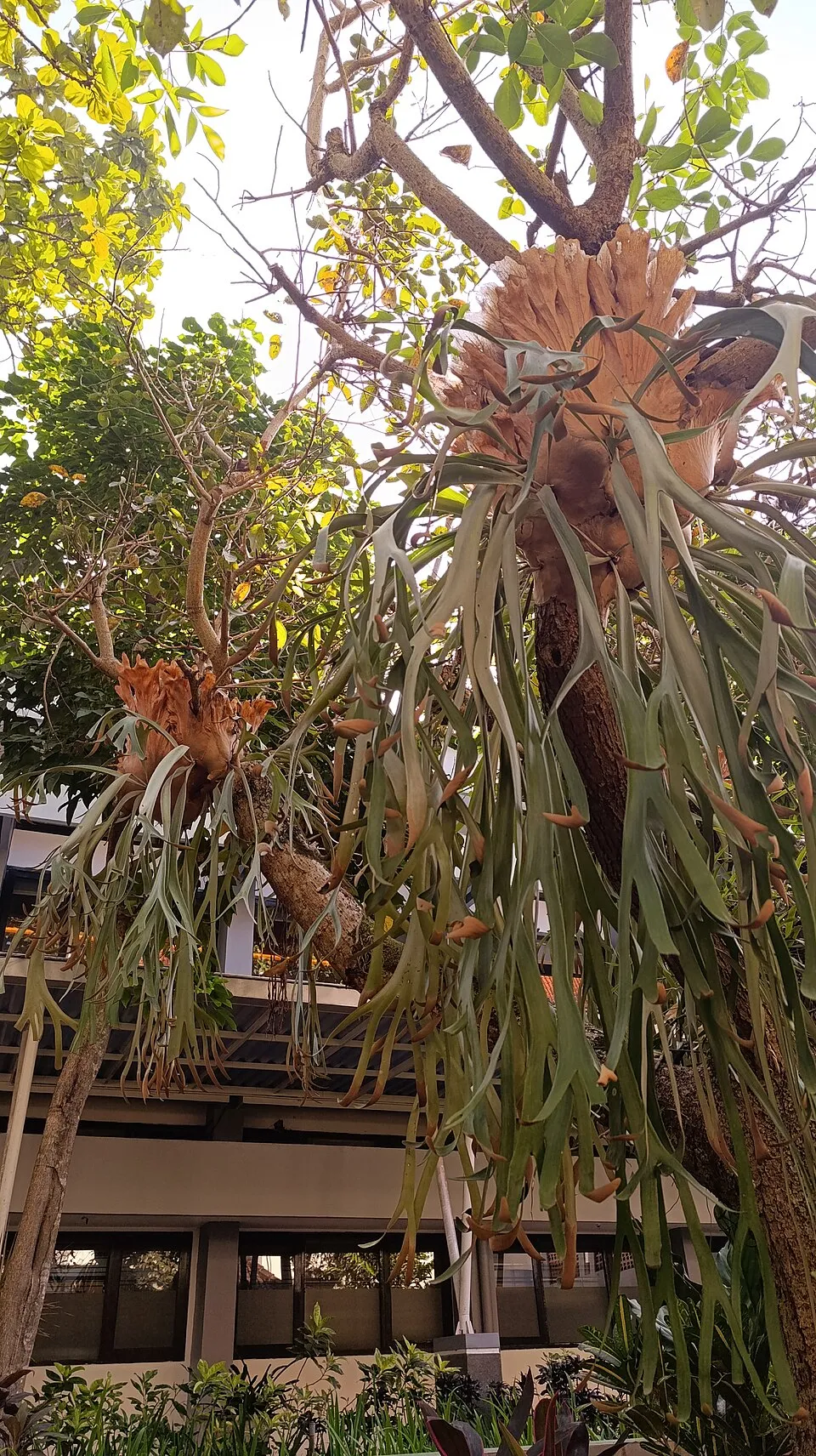
Hybridization has transformed the staghorn fern world from a niche collector’s hobby into a thriving horticultural discipline. By crossing species with complementary traits, breeders have produced plants that combine the beauty of one parent with the hardiness of another. This guide covers the key species traits used in breeding, the mechanics of interspecific hybridization, and the major breeding lines that define modern Platycerium cultivation.
Species Traits in Hybridization
Every fertile frond has two important surface characteristics that breeders select for: the wax layer (cuticle) and stellate trichomes (star-shaped hairs). The fertile frond also expresses two competing aerodynamic traits: wind-catching ability (how well the frond disperses spores) and wind resistance (structural rigidity against breakage).
- Wind-catching is determined by the density of frond forking and the depth of the splits.
- Wind resistance is determined by the strength of the vascular bundles and frond erectness.
The four Australian-clade species used most heavily in hybridization each contribute distinct genetic traits:
P. willinckii — The Fork Specialist
Willinckii is crossed into hybrids to achieve:
- Increased fork density — more fingers, tighter splits
- Strong stellate trichome expression — silvery-white surface
- Crown dominance — willinckii crown traits are genetically dominant in most crosses
- Dwarf potential — willinckii can produce compact offspring
P. veitchii — The Silver Tank
Veitchii contributes:
- Spiny crown — weaker than willinckii crowns but stronger than crownless types
- Intense stellate trichome coverage — heavy white hair
- Wind resistance — upright, rigid fronds with strong vascular bundles
P. bifurcatum — The Workhorse
Bifurcatum provides:
- Extreme stress tolerance — the hardiest Platycerium species
- Fast growth rate — speeds up development of slow-growing hybrid partners
- Wax layer on fertile fronds — waxy cuticle surface
- Upright, wind-resistant fronds — structural rigidity
P. hillii — The Broadleaf Builder
Hillii offers:
- Stress tolerance (though slower-growing than bifurcatum)
- Broad, waxy fertile fronds with strong vascular bundles
- Upright wind resistance — stiff, erect fronds
Bifurcatum Genetic Signature
P. bifurcatum deserves special mention because it is the foundation of most modern breeding programs. Though often overlooked as the “common” staghorn, its genetic contributions are invaluable:
- Strong primary bifurcation: If a hybrid shows a dominant two-fork pattern, bifurcatum genes are almost certainly present (though willinckii also forks, its forks tend to be shallower)
- Semi-erect habit: Moderate erectness, weaker than veitchii but consistent
- Wax cuticle + stellate trichomes: Bifurcatum developed both surface types in response to its variable native environments
- High stress tolerance and fast growth: The genes most valued by breeders
- Crown neutrality: Bifurcatum crown genes generally do not dominate crosses — crown appearance is usually dictated by the other parent. Under certain conditions, wild-type bifurcatum can express crown spines.
Every notable breeder maintains their own bifurcatum gene bank. Well-known cultivars include the standard garden form, ‘Popcorn’ (爆米花), ‘Short Borthong’ (from Wanna/Borthong Garden), ‘Blue Borthong’, ‘Bif Special’ (from Banna), ‘Majus’, ‘Ziezenhenne’, ‘BT Short’, and ‘Tom Crain’.
Interspecific Hybrid Registration
Platycerium x kitshakoodiense
The story of the first formally registered Platycerium hybrid illustrates how serious the field has become. P. x kitshakoodiense is a cross of P. ridleyi x P. coronarium. In 2024, it was formally published in The Plant Review (6(4):59), meeting international naming requirements for interspecific hybrids. The name is now registered in the International Plant Names Index (IPNI).
The breeder, Wanna, spent over a decade supporting this naming effort. The hybrid has been verified through three generations of vegetative propagation with stable trait expression.
Generation Terminology
In Platycerium breeding, generations are counted as follows:
| Term | Meaning |
|---|---|
| F0 | The original discovered plant or original cross parent |
| F1 | Offspring of the original plant / first vegetative generation |
| F2 | Offspring of F1 / second vegetative generation |
| F3 | Offspring of F2 / third vegetative generation (academic naming standard) |
The DW Line (Diversifolium x Willinckii)
DW stands for Diversifolium x Willinckii — a cross between bifurcatum-hillii transitional forms (diversifolium) and willinckii. Because diversifolium carries transitional genes between bifurcatum and hillii, DW offspring display high phenotypic diversity, and the F1 generation shows complex segregation patterns. Many DW crosses are further crossed with willinckii or hillii to refine expression.
Breeders exploit the close evolutionary relationship between bifurcatum and hillii to build complex gene pools. Different Diversifolium base stocks produce different DW expression pathways:
- High erectness (Pegasus direction)
- High whiteness (OMO direction)
- Broad fronds (Blue Moon, Honey Moon direction)
Notable DW Cultivars
- P. Pegasus — upright, densely forked
- P. White Hawk — heavy white trichome coverage
- P. OMO — extreme whiteness expression
Each breeder maintains their own Diversifolium stock — for example, Tonkla works with 3 numbered Diversifolium lines.
The Mt. Lewis Line
Origin
P. Mt. Lewis is a natural hybrid from the Mt. Lewis mountain range in Queensland, Australia. It is believed to be a natural cross of P. bifurcatum x P. hillii (or possibly involving P. grande). Its morphological traits are stably inherited. The breeder Wanna introduced it into cultivation. A naturally occurring tetraploid form of Mt. Lewis has also been discovered.
Lewis Gene Expression
Mt. Lewis carries a distinctive set of dominant traits:
- Prominent raised veins on the back of fertile fronds — extremely strong vein expression
- Relatively thin leaf tissue (compared to veitchii)
- Crown neutrality — Lewis crown genes do not participate in hybrid expression
- Darkening tendency on the upper surface of fertile fronds
- Weak trichome expression — sparse, loosely distributed white hairs
- Incomplete sporangia — spores do not fully cover the tips (“finger-shaped” spore pattern)
- One expression type shows strong willow-leaf form with robust growth
Because Lewis itself is variable, different Lewis stock plants crossed with different partners produce diverse outcomes. Wanna developed her own Lewis hybrids with four phenotypic tendencies:
- Fine fingers, semi-erect, dense forking
- Fine fingers, dark base coloration
- Large size, tall crown
- Compact body with dense forking
Lewis Hybrid Directions
The major Lewis cross directions include:
- Lewis x Veitchii (Rydeen, Kiyohime, Musang King, etc.)
- Lewis x Willinckii (Blue Sapphire, Dwarf Tatsuta direction)
- Lewis x HFG (Waterfall line)
- Lewis x Bifurcatum (Princess Crown, Riverflow)
- Lewis x Hillii (Maserati, etc.)
F1 Crosses — Veitchii Wild AUS Group
The cross P. Mt. Lewis x P. veitchii wild AUS (by Wanna, F2 generation) is one of the most productive Lewis lines. The wild veitchii group divided into two sub-branches:
- P. veitchii wild AUS branch — later developed into the FSQ/HFG crossing direction
- P. veitchii high finger branch — later crossed with HFG and bifurcatum groups
Notable F1 cultivars from this line:
- P. Rydeen (雷电) — Lewis x veitchii wild AUS
- P. Anchor (锚/神兽) — Lewis x veitchii wild AUS
- P. Waterfall (瀑布) — Lewis x veitchii high finger
- P. Kiyohime (清姬) — Lewis x veitchii wild AUS
- P. Musang King (猫山王) — Lewis x veitchii wild AUS
F2 Crosses — FSQ Group
The FSQ branch uses Rydeen as its Lewis F1 base. After Rydeen won awards in 2019, it became an important mother plant for Wanna’s breeding program. Rydeen was crossed with FoongSiQi to produce F3 offspring, including the famous Stardicky (天龙蕨/史迪奇). This branch tends toward medium-to-large size, with both erect and broad-leaf expression types. Fork density and tall crown traits are consistently maintained.
F2 Crosses — HFG Group
The HFG (High Finger) branch uses Wanna’s third-generation crosses to produce highly variable offspring. The most famous is P. Abigail. HFG variation comes primarily from hand-shape changes, with some intergenerational ancestral gene resurgence producing rich expression diversity.
Notable HFG cultivars include: Universe, Abigail, Say-Fa, Moonstone, Vulcan, Wasan, Assanee, Ching Lai (青雷), Chomchan, and Phayu.
F1 Crosses — Bifurcatum Group (Riverflow Series)
The Lewis x bifurcatum direction centers on P. Riverflow (P. Mt. Lewis x bifurcatum #1). This cross extends stress tolerance and forking expression while preparing the genetic base for F2 crosses.
The Riverflow F1 tree includes:
- P. Riverflow — the core cultivar
- Honey Moon — with sub-selections Chao Phraya, Bangpakong, Nan Hybrid
- Hillii Boonrueng — hillii cross direction
- P. Ubon
- P. Princess’s Crown (公主冠) — with selection P. Mayura
- P. Poradok
F3 Crosses — Riverflow Series
Riverflow x Waterfall is one of the most celebrated F2 Lewis crosses. Representative cultivars include P. Pink Moon and P. Serpent (大蛇). Double-Lewis F2 offspring express even stronger Lewis vein traits, with Pink Moon-type transgressive expressions also emerging.
Another F3 branch is Riverflow x Honey Moon, which primarily produces broad-frond types. By late 2024, over 20 cultivars had been named in this series, generally using “River” as a suffix. Most are medium-to-large with many showing white coloration. This formula essentially parallels the DW direction from a different genetic starting point.
Notable cultivars: P. Bang Pa Kong River, P. The Moon In Cotton Candy Sky, P. Krathing (公牛).
Lewis x Willinckii — The Dwarf Tatsuta Direction
When Lewis is crossed with willinckii, the offspring tend to express willinckii-dominant traits while retaining Lewis’s signature raised-vein pattern and incomplete sporangia. The core mother plant for this direction is Dwarf Tatsuta.
Notable cultivars from this line and its sub-branches:
- P. Snow Moon — famous white expression
- P. Selene — elegant elongated fronds
- P. Seven Moon
- P. Blue Ocean
- P. Blue Sapphire — extremely long, cascading fronds
- P. Babe — willinckii genes more dominant in Lewis x willinckii crosses
- P. Narcissus
- P. E.T.
- P. Chubby Monkey (波哥)
- P. Bella
The Schofield Tatsuta sub-branch further refines this direction, producing:
- Mrs. Thip (Schofield Tatsuta)
- Sown Moon
- P. Hunter’s Moon
Bifurcatum x Willinckii Crosses
The direct cross of bifurcatum and willinckii promotes dense forking and semi-erect expression. The representative breeder for this direction is Banna, with notable cultivars including P. Banna A, P. Bif White (白二歧), and P. Little Finger.
F2 Lewis — Other Directions (Hillii and Veitchii)
Lewis crosses with hillii-lineage mothers (paopao, hula hand, hula hoop) produce offspring that lean toward hillii expression, but Lewis’s fork-type gene is highly dominant and reliably contributes dense forking. Breeders Wanna and Tonkla continue to develop this direction, pursuing stronger vein expression.
Notable cultivars: P. Meteor Shower (流星雨, crossed with pewchan, carries veitchii genes, compact size, no F3 continuation yet) and P. Maserati (玛莎拉蒂, P. hillii paopao x Mt. Lewis).
The FoongSiQi (FSQ) Line
Origin
P. FoongSiQi (卷卷) was created by Malaysian breeder Mr. Feng, who began the cross around 2014. FSQ is notable for its curling frond tips and diverse expression. It became a core mother plant in Wanna’s breeding program and has been widely used by other Thai breeders including Nam Fern, NOOK, and PN.
FSQ Expression Types
FSQ offspring segregate into four main expression categories:
- Dense Hand Type — compact, heavily forked fronds with tight finger spacing
- Broad White Vein Type — wide fronds with prominent white vascular expression
- Weak Fork Curling Type — fewer forks with pronounced curling at the frond tips
- Round Leaf Wave Type — rounded, wave-edged fronds
Notable FSQ Cultivars
- P. Ginka — one of the most famous FSQ offspring
- P. FWSQ — variant selection
- P. White Gizmo — white-toned expression
- P. Kungsiqi and P. Kusuma
- P. Cotton Moon and P. Wannasiqi
- P. Moby Dick — large, dramatic fronds
- P. Green Moon and P. Kailas
- P. Snow Wave — white, wavy expression
- P. In Flames and P. Kin-naree
- P. Kin-Norn and P. Little Sis
- P. FSQ Dwarf — compact variant
- P. Delarocha — special selection
FSQ in Hybridization
FSQ serves as a mother plant in several major crosses. Wanna crossed FSQ (via Rydeen) to produce the famous P. Stardicky (天龙蕨/史迪奇). The GGG series derives from Ginka pure spore propagation. P. Thinker Bell is a notable F2 cross of Kin-naree x Schofield Tatsuta.
P. willinckii — Deep Dive
Wild Collection Regions
Willinckii’s natural range spans Java, Bali, and East Timor. Two main locality types dominate the breeding world:
- Bogor Type (West Java): Larger plants with thicker leaves and compact crowns. Bogor wild-collected specimens formed the genetic foundation for many Thai breeding programs. Selective breeding for whiteness produced the White Bogor direction, yielding cultivars like P. Zero, P. White Swan, and P. Copper Will. The Bogor Sudden sub-direction, developed by Mr. Sudden, selects for dense forking and tall crown expression.
- Bali Type: More delicate and ethereal in expression, with finer, more elongated fronds. Generally produces a lighter, more graceful aesthetic compared to the robust Bogor form.
Willinckii Dominant Gene Expression
When used in interspecific crosses, willinckii reliably contributes five dominant traits:
- Crown dominance — willinckii crown genes override most other parents
- Dense forking pattern — multiple, tightly-spaced finger splits
- Strong stellate trichome expression — silvery-white surface
- Frond tip curling tendency — downward or inward curve at maturity
- Compact growth potential — tendency toward smaller body size
Mother Plant Lineage History
The modern willinckii breeding world traces back to wild collections in the 1980s. Over decades of selective breeding, several foundation cultivars emerged:
- P. Aplus — early foundation stock
- P. Eppley — influential mother plant
- P. Dwarf Tatsuta — cornerstone of the Lewis x willinckii direction
- P. Scofield Tatsuta — refined Tatsuta sub-branch (produced Mrs. Thip, Sown Moon, P. Hunter’s Moon)
- P. Miami Tatsuta — another Tatsuta variant
Major Willinckii Breeding Directions
White Willinckii: Selective breeding for maximum trichome density and whiteness, including Moonlight varieties.
Stem Fern’s Series: The Planet and Dragon Ball series from breeder Stem Fern.
Anapat’s Numbered Series: Breeder Anapat maintains 13 numbered willinckii selections, each with distinct expression.
CK’s Mythology Series: Breeder CK developed cultivars named after mythological figures — P. Hydra, P. Leviathan, P. Seth King, and P. Olympus.
Wanna’s Cloud #1 Series: Wanna’s most famous pure willinckii mix-sow formula, combining 8 mother plants: Yellow Moon, Pinkie, Ravana, Phoenix, Special Thin, Cat Hand, Eight, and Prolificacy.
Dwarf Willinckii
Dwarf willinckii has become one of the most active breeding frontiers. Dwarfs arise through two pathways:
- Wild-collected dwarfs: Naturally compact plants found in habitat
- Bred dwarfs: Created through selective intraspecific crossing
Wanna’s Yellow Moon Model illustrates the intraspecific approach: starting from an F0 Yellow Moon, each generation (F1, F2, F3) is selectively bred for compact size while maintaining expression quality. Notable dwarf cultivars from this lineage include P. Kaguya (迦具夜, F1 Dwarf Yellow Moon), P. Moon God (月神, F1), P. Moon Cloud (月云, F2), P. Little Coral (小珊瑚, F2), and P. Snowflake (雪花, F3).
Common dwarf mother plants used in breeding include: Yellow Moon, Blue Queen, Bogo Sultan, Little Crown, Celso x Yellow Moon, Moonlight, Phoenix, Rust #9, Soho, and Watchara.
Other notable dwarf types:
- P. Tiara (侏儒小皇冠) — dwarf Little Crown
- P. Ariel — Yellow Moon x AR cross
- P. Raguel — dwarf from Nook
- P. Elves (侏儒波哥苏丹) — dwarf Bogo Sultan
- P. Streptophylla (电卷烫) — dwarf Blue Queen
- P. Sol — Celso x Yellow Moon cross
Size Control Through Breeding
An alternative to mutation-type dwarfs is breeding-type size control. The representative example is KFL, which uses three mother plants across multiple generations to progressively reduce body size to near-dwarf dimensions. Compared to mutation-type dwarfs, bred dwarfs show more phenotypic variation but better offspring stability — a pattern similar to the “Black Rose” breeding model in other plant groups. Many nurseries now pursue this approach, gradually controlling hand-type (clawed) staghorn fern size to acceptable dimensions while preserving expression quality.
Open Questions About Dwarf Staghorns
- Heritability: Dwarf offspring rate from dwarf parents is significantly higher than from non-dwarf parents, even when ancestral reversion occurs, the dwarf rate remains above baseline.
- Mother plant relationship: Different mother varieties produce different dwarf expressions, but dwarf expression does not closely correlate with the mother plant’s own appearance — you cannot easily identify the mother from a dwarf’s phenotype.
- Size is not the sole criterion: Some small-bodied standard staghorn ferns approach dwarf size without being true dwarfs.
P. veitchii — Deep Dive
History
P. veitchii was first discovered by the British Veitch family nurseries and named in 1874. As a horticultural species, early selective breeding prioritized stress tolerance and growth speed, which came at the cost of reduced crown spine expression.
Market Categories
Three main veitchii types exist in the modern market:
- Horticultural Veitchii — garden-bred silver staghorns (Silver Frond, K Silver, Lisa, etc.). Each Thai nursery breeds its own garden veitchii lines. Pure horticultural veitchii was originally bred in the UK. Key selection criteria include stress tolerance, growth speed, body size, and whiteness.
- P. Veitchii wild AUS — wild-collected Australian veitchii. Distinguished by tall, pointed crown spines. Each nursery (Boonsita, Yot, Rainbow, etc.) maintains its own numbered wild AUS stocks — different vendors’ “P. Veitchii wild #1” are not the same plant.
- P. Veitchii wild HFG (High Finger) — a wild-collected variety with genetic differences from standard wild AUS. Crown spines are similar, but the spore hand shape differs: more distal splitting, more multi-layered short splits. HFG fronds are thinner, with wider crowns. Hard to distinguish from wild AUS in juvenile stage. Spore source traces to Australian Russel Zabel’s mother plant P. Veitchii Dwarf Trevor.
The Auburn River (AR) Story
Wild veitchii populations concentrate in Australia, with the most important region being the Auburn River watershed. DNA sequencing has confirmed clear genetic differences between Auburn River populations and populations outside the watershed (designated P. Veitchii wild AUS).
The strict P. Veitchii wild cv. Auburn River was originally imported from Australia to the United States — a single wild-collected Auburn River specimen, named ‘Auburn River’ to commemorate its origin. Later, Wanna brought it to Thailand and sold side buds to Lisawa, producing the famous 鹿王 (Deer King). The Australian Auburn River veitchii farm uses origin-based naming, designating all Auburn River watershed veitchii as P. Veitchii wild Auburn River (broad AR). They have named individual specimens including Dragon Head (龙首), Water Dragon King (水龙王), and Coral (珊瑚).
AR and wild veitchii offspring show rich variation — crown spine expression often differs from the parent and is not necessarily weaker.
Veitchii Genetic Dominance
- Crown spine genes are not strongly dominant — most interspecific crosses cannot maintain the spiny crown form, though tall crown shape can be expressed
- Frond thickness and leaf-back whiteness are highly dominant — most veitchii crosses maintain excellent whiteness
- Erectness is moderate — shows segregation in crosses (two willinckii x veitchii directions exist: Pewchan and Northern Monkey)
- HFG dense hand expression — good in crosses but with limited data; using Wanna’s HFG crosses as reference, it appears relatively dominant
Veitchii Expression and Care
- Crown spine height is directly related to temperature — above 32 °C, crown growth easily stalls (below 28 °C is optimal for crown development)
- Crown form is linked to genetics, not care practices
- Crown spine expression is linked to plant age — extreme expressions (crown width, split depth) only appear at maturity
- Weaker substrate may allow easier crown flushing
The Celso Tatsuta Case
P. Celso Tatsuta is a remarkable case study. DNA sequencing confirmed it is pure veitchii — not a hybrid. With sufficient growth cycles, Celso does express crown spines and progresses toward dense hand expression. Similar dense-hand expressions have been observed in other pure veitchii offspring, suggesting this trait exists within the veitchii gene pool.
P. hillii — Deep Dive
Core Traits
P. hillii is a waxy-cuticle species with exceptional drought resistance, though it is not highly adaptable to extreme humidity or heat. Key characteristics include:
- Dark coloration with strong, prominent vascular bundles
- Partial stellate trichome expression — some, but not heavy
- Leathery, thick shield fronds with rich sponge-like air space structure for excellent water absorption and retention
- Strongest CAM cycling among all Platycerium species
- Thin sporangia — hillii’s leaf tissue characteristics occupy sporangial space, producing an “encrustation” (缓化) appearance that is not true sporangial encrustation
Hillii is an important independent breeding lineage in Thailand, though development has been slower than other species due to hillii’s long maturation time and naturally large body size. Yot was the fastest-advancing hillii developer until his nursery suffered setbacks in early 2024.
Two Morphological Directions
Hillii cultivars divide into two main frond shape categories:
Round-Leaf Type — broad, rounded fronds:
- P. Hillii Panama — classic round-leaf representative
- P. Hillii Raijin (雷神)
- P. Hillii Hula Hoop (呼啦圈)
- P. Hillii Dragon (深绿龙) — extreme vein expression (“Dragon Scale”)
Pointed-Hand Type — narrower, more forked fronds:
- P. Hillii Pao Pao — one of the two most important hillii mother plants
- P. Hillii Aor Chao 16 (Yot’s hillii mix sporeling no. 16) — the other key mother plant, with excellent stellate trichome expression
- P. Hillii Mio, P. Hillii Rod Pattinson
Special expressions include “dwarf” hillii (relatively small, like FSQ dwarfs): P. Hillii Dwarf Vandaka, P. Hillii cv. Fumi, and Dwarf Hillii Zijie (侏儒深绿子杰).
The KK Series (Kiss or Kill / Kill or Kiss)
The KK series is a hillii intraspecific cross between Dragon and Pao Pao:
- Kiss or Kill (Pao Pao as mother) — tends toward pointed-hand expression
- Kill or Kiss (Dragon as mother) — tends toward round-head expression
Notable cultivars: Kiss or Kill 1, 2, 4, 6, 11; Kill or Kiss 3, 5.
Hillii Interspecific Hybrids
Hillii has been crossed with several other species:
- P. Flamenco (弗拉明戈) = P. Hillii Mio x P. coronarium
- P. Diamond Snow (雪钻) = P. Lemoinei x P. Hillii Pao Pao
- P. Excellence (卓越) = P. willinckii x P. Hillii
- P. Maserati (玛莎拉蒂) = P. Hillii Pao Pao x Mt. Lewis
- P. Wave Maker (造浪者)
Hillii Genetic Dominance in Crosses
- Strong vein expression — highly dominant, participates reliably in most crosses
- Influences shield frond form — typical expression is DW-style crown
- High gene stability — once a hillii cross succeeds, hillii traits rarely revert in F2–F3 generations (typical examples: Woot9 and FSQ)
- Weak stellate trichome expression — but easily enhanced when crossed with strong-trichome partners, producing stellate expression in offspring
- Natural erectness — inherently upright fronds with strong heritability
P. superbum and P. coronarium in Breeding
Superbum and Coronarium Relationship
P. superbum and P. coronarium are closely related species with a natural hybridization rate exceeding 80%. As single-bud species, superbum was among the earliest Platycerium to enter modern breeding programs. Both species display rich natural locality variation, with enormous phenotypic differences between regional populations.
In Thai nurseries, major breeders have specialized:
- PN focuses on superbum
- Tonkla focuses on coronarium
- Wanna’s representative is the superbum x coronarium hybrid direction (亚皇)
Superbum Breeding
Superbum selection targets two main axes:
- Leaf shape: narrow-leaf vs. round-leaf forms
- Body size: dwarf vs. compact forms
In superbum breeding, body size is relatively stable across generations, but leaf shape stability is poor — especially encrustation and round-leaf expression. PN’s breeding program (nano, saman, thin frond, pakarang lines) demonstrates systematic intraspecific crossing with controlled expression percentages.
Notable types: narrow-leaf superbum, dwarf silver-leaf superbum, dwarf dense-leaf superbum, erect-leaf compact, and Monkey King (美猴王).
Coronarium Breeding
Due to its wide distribution, coronarium has abundant natural subspecies. The primary breeding direction is dwarf coronarium — dramatically smaller than traditional 2-meter coronarium specimens, making them suitable for home cultivation.
Notable dwarf coronarium cultivars:
- Philippine Dwarf Coronarium (from Wanna)
- Thinthin (小精灵) — dwarf coronarium from Tonkla
- Koala (考拉) — dwarf curly-leaf coronarium from Tonkla
Major Thai Breeding Nurseries
Thailand is the global epicenter of Platycerium hybridization. Thai nurseries broadly fall into three categories:
- Closed-system breeders — use their own mother plants exclusively, run multi-generational spore programs, and develop independent lineages (Wanna, Yot, Banna, Stem Ferns, CK, KFL).
- Spore-factory breeders — operate open-source breeding at scale, accept outside mother plants, and accumulate vast genetic libraries (Nook, KHAOKHO).
- Collectors and hunters — do not breed extensively themselves but curate selections from other nurseries, sometimes commissioning spore factories to propagate their collected mother plants (Woot, TK).
Wanna
The most prolific and influential Thai breeder. Wanna started early and has explored nearly every lineage — including rare interspecific crosses no one else has attempted. Her breeding logic is highly rigorous, focused on interspecific hybridization with stability testing for all new varieties.
Core lineages: Lewis series, FSQ series, willinckii series (Yellow Moon, Weiwei Moon, Little Moon, Cloud Series, Sea Series), DW series (Oh My God, Blue Moon, Honey Moon), single-bud series (Philippine Dwarf Coronarium, thin-leaf Asian King), hillii series (Storm AU Compact, Sattahip from Yot, HIPS), AR and HFG.
Yot
Known as the “tank-top uncle” (背心大叔). Military background, one of the earliest breeders. Many famous cultivar lines originated from Yot’s nursery. Unfortunately, the nursery suffered a major setback, leaving very few mother plants.
Key series: Y-series mix (Jenny, Blue Queen, Yellow Corn…), hillii mix (Fujin/Wind God, Raijin/Thunder God, Aor Chao 16, Mrs. X…), silvery dwarf mutants, P. willinckii High Shield.
Banna
Banna insists on using only his own works as breeding mother plants — a distinctive philosophy that produces deeply developed lineages, particularly in willinckii-veitchii and bifurcatum directions.
Key lines:
- Willinckii-veitchii: Northern Monkey, Monkey North High Crown, Monkey Mountain, Cosmo, Monkey King…
- Hillii: Dragon, Plump
- Bifurcatum x willinckii cross series: Banna A, Little Finger, Bif White (白二歧), Sea Elephant…
Stem Ferns
Inherited genetic material from the breeder JR. Strong in JR Lemon x willinckii crosses and pure willinckii directions. Stem Ferns has transitioned from open-source to independent closed-system breeding. The “Three Pillars” — Pigeon, Rust, and Phoenix — are core cultivars from which many additional works and dwarfs have been derived.
Key lines: JR Lemon x willinckii, Dragon Ball series, Star Wars series, Planet series, Star series, Steam, Predator.
Tonkla
A Thai wealthy family with academic training. Tonkla has a highly independent breeding philosophy, completing all programs using proprietary logic and methodology.
Key lines: Pewchan series (F2, F3, F4, F2 Compact), Coronarium series (White, Koala, Thinthin), Bambi mix, Unicorn mix, dwarf willinckii (Kawah Ijen, Wind Bell), DW (XOXO, Hanabi), hillii (Kiss or Kill, Kill or Kiss).
CK
An emerging nursery that was hit hard in summer 2024 — all spore seedlings died, leaving only side buds. CK has an independent creative vision, with one direction focused on hillii development.
Key series: Star series (Broad-Brim Star, Sextant), Mythology series, Flower Language series (all from a single mother plant, named by the owner, with spectacular offspring segregation).
Nook
The largest early Thai spore factory. The actual breeder is Noppadon, with sales managed separately. As an early open-source spore factory, Nook accumulated an enormous mother plant library. The breeding approach is open and exploratory, expected to develop further in the compact willinckii direction.
Key lines: Willinckii (Dwarf Nook, Blue Queen, Soho, SP.A, Fishbone…), DW and willinckii-veitchii (White Crow, White Bat, Blue Monkey, White Wing, Snow White), hillii (Storm, Dragon Scale).
KHAOKHO
The breeder Lisa runs an open-source nursery producing highly uniform, stable cultivar lines. KHAOKHO has a distinctive set of mother plants named after family members, plus mother plants collected from various sources. Currently pursuing Banna A crosses and spiny-crown + ultra-high-density hand expression.
Key lines: Starlight series (Starlight, Starshine, Kaika), Family series, Tatsuta series, LISA crosses, Banna A crosses, White House.
Nam Ferns
One of the earliest nurseries. Classic works include the Lion Egret and Yeewa. Nam Ferns primarily breeds using interspecific crosses (a distinctive approach) and has produced dwarf expression in Pegasus x Silvery Dwarf crosses.
Key lines: Yeewa and crosses, Lion Egret and crosses, Pegasus series, wild veitchii.
PN
PN’s actual breeding output is modest in volume but highly focused on superbum — the single-bud direction. Their superbum collection is extensive. Willinckii and veitchii lines are comparatively smaller.
Key lines: Superbum (Nano, Coral/Pakarang, Sanma…), willinckii (Moonlight, Blue Elf, Seagull, Good Luck, P. willinckii cv. Blue Boy), coronarium (Dragon Tree).
KFL
A biology professor with an independent breeding philosophy centered on multi-generational selective breeding. KFL has developed compact willinckii to F3 generation with excellent expression. The key difference between bred dwarfs and mutation-type dwarfs is sustainability and iterability.
Key series: Tukii series. (Note: domestically sourced “Tukii #1” spores may not be authentic.)
Other Notable Nurseries
- Anapat: Maintains 13 numbered willinckii selections. Miki series.
- Little Ferns: Blue Queen and Blue Queen crosses.
- Boonsita: Early breeder. Uses number-based naming. Many nurseries have used her mother plants.
- Borthong Garden: Connected to Wanna’s early work.
- WOOT: One of Thailand’s earliest collectors (works in a hospital). Focuses on collecting over breeding, propagating spores from collected mother plants. Famous Woot-numbered series (Woot9, Woot161). Rich early-era collection of claw-silver types and early breeder works (White Oat, JR Lemon crosses, Indo series, 3 King).
- BKKilf: Early friend of Wanna. Manager Benz collected nearly all of Wanna’s early premium pieces — now effectively a “second Wanna” mother plant library, including varieties whose original Wanna mother plants have died. Recently pivoting to active breeding, focusing on willinckii direction.
- TK: Essentially a hunter — curates elite sporophyte selections from multiple nurseries (Nook, Nam Ferns, KK, PN). TK represents the best picks from each nursery. Has few self-bred varieties (focused on willinckii). As a hunter, TK has also preserved many early mother plants.
- CNX: Spore propagation using early-era mother plants. Watchara.
Hybridization and Selection Theory
What to Select For
In Platycerium breeding, selection criteria fall into two categories:
1. Rare gene expression — future uniqueness:
- Dwarfism (naturally compact body)
- Recessive gene expression (traits that appear rarely in offspring)
- Pathological gene expression — cresting (缓化), petrification (石化), fishbone patterns (鱼骨)
2. Target gene expression — future aesthetics:
- Tall crown with dense hand
- White coloration (trichome intensity)
- Erectness, wide hand, or thin hand forms
Willinckii x Veitchii — Genotype Analysis
The willinckii x veitchii cross (commonly called “claw-silver” / 爪银) is one of the most important hybrid combinations. Understanding the interplay of dominant and recessive traits from each parent is critical for targeted selection:
Veitchii’s recessive contribution:
- Spiny crown type — crown spine expression is a recessive veitchii trait; it does not reliably carry through in most crosses
- Compact form is harder to achieve — with veitchii participation, dwarf types tend to have thinner spore leaves, more sparse branching, and wider forking splits
Willinckii’s recessive contribution: 3. Ultra-high erectness — appears in some offspring but is not the dominant willinckii trait
Combined expression: 4. Increased leaf thickness from veitchii 5. Narrower hands from veitchii participation — select for wide-hand expression in claw-silver types, or curled hand forms
Ideal phenotype from willinckii x veitchii: Compact body, spiny crown type, semi-erect form, high branching density. Expression closer to willinckii hand type.
Cross Direction Matrix
Veitchii has been crossed with multiple partners. Here is how it interacts with each:
| Cross | Selection Strategy |
|---|---|
| Veitchii x Bifurcatum | Has spiny crown (not rare), erectness (not rare). Select for: more compact, wide-hand, whiter, white-veined |
| Veitchii x Lewis | Wide-handed, curled, darker, whiter. Wide hands are rarer in this cross |
| Veitchii x Hillii | Hillii’s shield frond gene is very dominant. Select as close to veitchii expression as possible, but hands tend toward hillii |
| Veitchii x FSQ | FSQ’s wide-leaf type is dominant. Select thin-leaf. Cross for silver leaf-back and erectness |
Willinckii x Willinckii — Intraspecific Selection
Pure willinckii crosses require a different selection mindset:
- Consider body type and dwarf ratio of the mother plant
- Expect mother–offspring phenotype divergence — if the mother is wide-handed, select thin-handed offspring; if the mother is thin-handed, select wide-handed offspring
- Abandon base-type thinking — do not try to reproduce the mother. Instead, select for target expression: dense, wide, white
- Dwarf selection criteria — not all dwarf methods are equal:
- Dwarf-yellow selection is not universally applicable
- True dwarfs must be compact — shorter petioles with tighter petiole arrangement (related to keel growth point)
- Dwarf leaf thickness and whiteness bring greater light resistance, higher light saturation point
- Dwarfs must have adequate forking depth — shallowly forked dwarfs are less desirable
Hillii Direction — Intraspecific and Interspecific
Pure hillii mix:
- Selection factors: body type, forking depth (most hillii don’t fork strongly), leaf color depth, vein and texture feel
- Juvenile hillii forking is unstable — as a drought-resistant species, temporary forking changes may occur when co-cultivated with other varieties
Hillii crosses:
- Select offspring with both parents’ traits expressed
- Consider the chloroplast DNA inheritance (maternal) when choosing which species serves as the mother
- Select for maximum divergence from hillii expression — whiter, more forked, or thinner than the hillii parent
Lewis Direction — Cross Behavior
Lewis interacts differently with each crossing partner:
| Cross | Dominant Expression | Rare/Desirable Traits |
|---|---|---|
| Lewis x Bifurcatum | Stronger venation | Wide hand expression (rare) |
| Lewis x Willinckii | Lewis expression is weak; phenotype leans toward willinckii | Lewis-type vein expression (rare) |
| Lewis x Hillii | Hillii’s wide-leaf type dominates | Thin, dark, refined expression (rare) |
| Lewis x Veitchii | Thick, erect fronds | Wide hand expression (rare) |
| Lewis x Superbum | Erectness, outward curl | — |
Analytical approach: For any cross formula, trace it back to the native species’ base lineage expression, then evaluate gene dominance and phenotype. Examples:
- Little Lanna = veitchii x willinckii
- Rydeen = veitchii x Lewis
- Rydeen x Snow Moon: Contains bif (erectness, bifurcation, venation), hillii (wax layer, erectness, venation), unknown (strong stellate trichomes, spiny crown), willinckii (crown type, high branching, stellate trichomes)
- Big Moon x Waterfall: Willinckii x Mt. Lewis x veitchii
Key Takeaways for Aspiring Breeders
- Know your parent traits: Every cross is a conversation between two genetic profiles. Understand what each species contributes before planning a cross.
- Bifurcatum is underrated: Its stress tolerance and growth speed are indispensable foundations.
- Lewis is uniquely versatile: As a natural hybrid itself, Mt. Lewis brings complex, layered genetics that produce diverse and often surprising offspring.
- Generational depth matters: The most interesting cultivars often emerge in F2 and F3 generations, where recombination and ancestral gene resurgence create novel expression.
- Variation is the norm: Even sibling seedlings from the same cross can look dramatically different. Selection — not just crossing — is where great cultivars are found.
- Willinckii is the fork specialist: Its dense forking and crown dominance make it one of the most influential parents, while the dwarf willinckii frontier is expanding rapidly through systematic intraspecific crossing.
- Veitchii brings silver and structure: Though its crown spines are not strongly dominant in crosses, veitchii’s whiteness and frond thickness are reliably inherited. The Auburn River lineage represents some of the most valued genetics in the hobby.
- Hillii is the sleeper powerhouse: Its strong vein expression, gene stability, and natural erectness make it invaluable in crosses, despite its slow maturation.