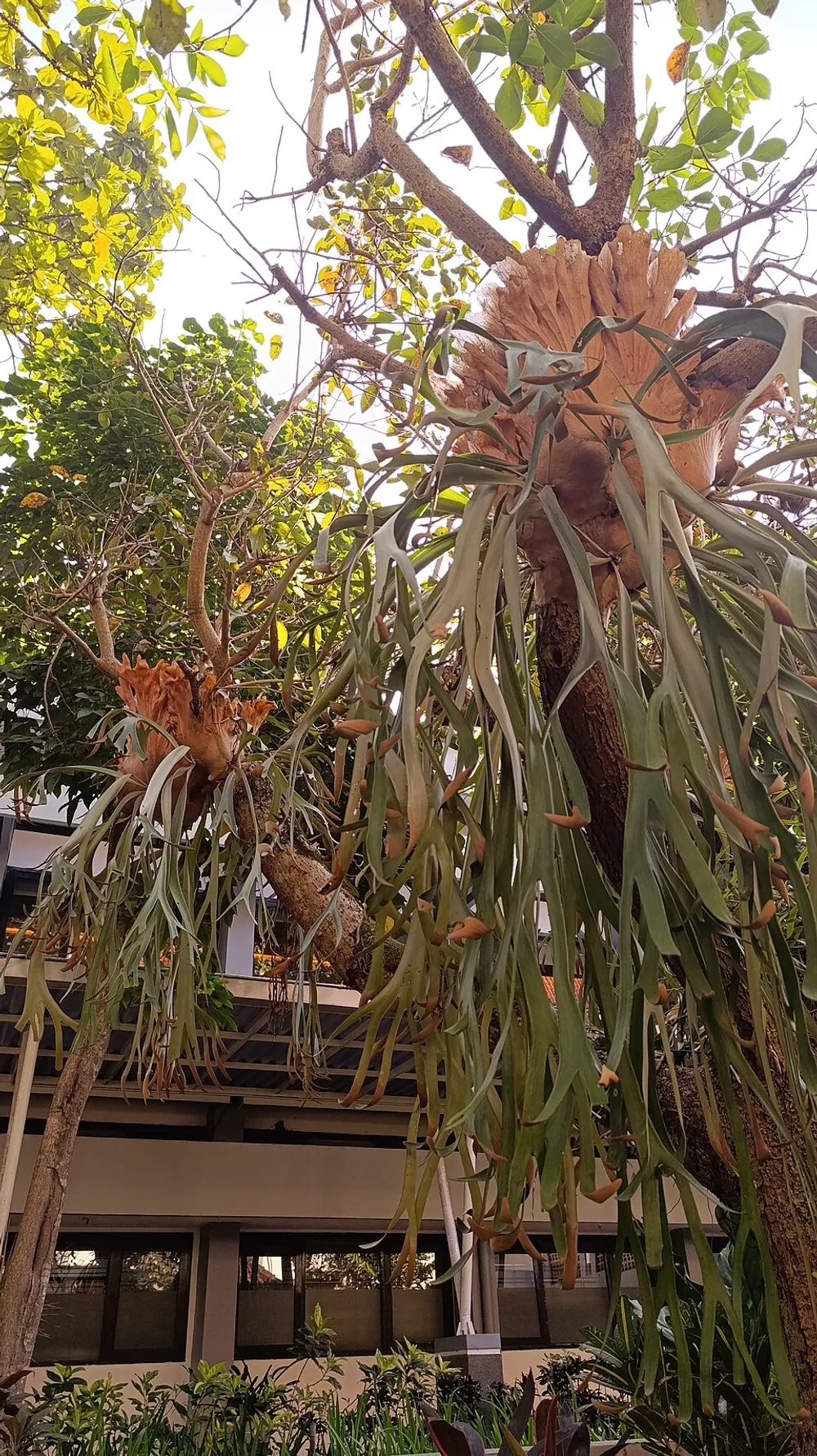
Most named “willinckii” on the market are true selections of one species — but at least seven of the most-searched names are hybrids, not willinckii at all. This guide identifies 18 named forms by frond shape, size and origin, then separates the hybrids and the trade names that cannot be verified.
Looking for a specific name? Jump straight to the cultivar identification table, the hybrids sold as willinckii, or names we could not verify.
The species name is frequently misspelled willinkii (missing the second “c”), and Chinese-language sellers list it as 爪哇鹿角蕨 — “Java staghorn fern”. All refer to the same plant, Platycerium willinckii.
Which Platycerium Willinckii Do I Have?
Work down the frond column — width and forking pattern identify a willinckii faster than colour, which shifts with light levels.
| Cultivar | Fertile fronds | Size | Origin / notes | Tier |
|---|---|---|---|---|
| Standard (Bali type) | Long, fine forking; moderate silver | Full | The wild baseline | Entry |
| Bogor type | Broader, more upright posture | Full | Named for Bogor Botanical Gardens, Java | Entry |
| Jade Girl | Tight, neat forking; heavy silver | Compact | The classic “silver bomb” | High |
| Jade Girl Dwarf | As Jade Girl, shorter | Dwarf | Sporeling selection | High |
| Smurf | Very narrow tips, blue-green tint | Full | Distinctive colouring | High |
| Spur | Spurred growth points; fronds split unusually early | Full | Sculptural; a collector prize | Very high |
| Bacteria | Extremely fine, almost grass-like | Full | Indonesian selection, rare in the West | High |
| Masayu | Split tips, pronounced veining, heavy trichomes | Dwarf-ish | Indonesian; fronds curl as spores mature | High |
| Nano | Standard shape at half scale | Dwarf | Small-space friendly | Moderate |
| Silky White | Smooth, even coat — reads pure white | Full | One of the most requested silvers | Very high |
| Snow White | Broad, bright white cast; less pendulous | Full | Often confused with Silky White | High |
| Celso Tatsuta | Wide fronds, heavy silver | Full | Japanese collector selection | High |
| Watchara | Fine “fishbone” lobing, dense and compact | Dwarf | Thai selection, named for its selector | High |
| Jenny | Delicate, multi-layered; tips curl into fist-like hooks | Compact | Record auction price on release; very scarce | Very high |
| Yellow Moon | Luminous yellow cast rather than silver | Full | Moon series; colour selection | Very high |
| Yellow Moon Dwarf (HHR Totoro) | As Yellow Moon, compact | Dwarf | Sporeling selection; prices above standard Yellow Moon in Thailand, Taiwan and Hong Kong | Very high |
| Konayuki | Fine, pale, powdery coat | Compact | Japanese name meaning “powder snow” | Moderate |
| Pearl Queen | Graceful elongated fronds, silvery-green | Full | Softer tone than Silky White | Moderate |
The Moon series is a family rather than a single plant — alongside Yellow Moon it includes Weiwei Moon, Little Moon, and the Cloud and Sea series. If a seller offers “a Moon”, ask which one.
For the cross-species picture — which named forms across the whole genus are true selections and which are not — see the Platycerium cultivar directory.
Jade Girl vs Bacteria
These two get compared more than any other willinckii pair, and the distinction is simple once you know it. Look at frond width, not colour.
| Jade Girl | Bacteria | |
|---|---|---|
| Frond width | Broad ribbons | Thread-fine, almost grass-like |
| Forking | Tight, neat, regular | Loose, irregular, many splits |
| Silver | Heavy, dense | Present but less dominant |
| Silhouette | Full and layered | Airy, wispy |
| Availability | Widely propagated | Rare outside Indonesia |
Both are true willinckii and take identical care. If a plant sold as Bacteria has broad fronds, it is almost certainly not Bacteria.
Names Sold as Willinckii That Are Not Willinckii
This is where the money gets wasted. Several of the most-searched “silver Platycerium” names are hybrids with willinckii as one parent — sold side by side with true selections, often without the distinction being made clear.
| Name | What it actually is | Care difference |
|---|---|---|
| OMG | DW line (P. diversifolium × P. willinckii) | Slightly more heat-tolerant |
| White Hawk | DW line, sibling of OMG | Slightly more heat-tolerant |
| OMO | DW line | As above |
| Pegasus | DW line | As above |
| Snow Moon | Lewis × willinckii, dwarf direction | Compact; wants slightly higher humidity |
| Blue Moon | DW series — despite the Moon name, not a willinckii selection | Treat as a hybrid |
| Mew | Hybrid selection | Check parentage with the grower |
| Silver Frond | Not a cultivar — a trade description applied inconsistently, sometimes to P. veitchii | Verify what you are actually buying |
The practical rule: if a name is not in the identification table above, ask for the parentage before paying a cultivar premium. A hybrid is not worse than a pure willinckii — several are more vigorous — but it should not be priced as a rare willinckii selection.
Names We Could Not Verify
Some names circulate in listings and search results with no traceable origin, no consistent description, and no grower attribution. As of September 2026 we could not verify the following as distinct, stable willinckii cultivars:
- Jynx
- Golden Boy
- White Gizmo
- Platinum — appears to be a descriptive adjective, not a cultivar
- Jewel — same; used loosely for heavily silvered plants
That does not prove they are fake. It means no seller should charge a rare-cultivar premium for them without showing you the parentage or the original selection. If you own one of these under a confident label, treat the name as provisional.
Is It a True Willinckii at All?
Before chasing a cultivar name, confirm the species. Willinckii is regularly confused with two relatives:
| P. willinckii | P. bifurcatum | P. veitchii | |
|---|---|---|---|
| Fertile fronds | Long, pendulous, narrow, deeply forked | Shorter, broader, upright to arching | Upright, stiff, held vertically |
| Silver coat | Heavy trichomes | Light, mostly green | Heavy, but on upright fronds |
| Habit | Drapes downward | Bushy, spreading | Erect, star-shaped |
| Shield fronds | Tall, ridged crown | Rounded, flat | Rounded with pointed lobes |
If the fronds hang down in long silver ribbons, you have willinckii. If they stand up stiffly and are still silver, you have P. veitchii. If they are short, broad and green, you have P. bifurcatum. For the full genus picture, see the species comparison guide.
Do Cultivars Need Different Care? No.
Every true willinckii selection takes the same care. The differences are cosmetic. For the species itself — native range, wild habitat and how it sits in the genus — see the P. willinckii species profile. What matters is that willinckii is a montane plant, not a lowland tropical one — wild populations sit at 600–1,500 m where nights are cool — so it wants a drier cycle than most staghorns.
| Parameter | Requirement |
|---|---|
| Light | Bright filtered light — no direct afternoon sun |
| Watering | Let the top centimetre of sphagnum dry between waterings — roughly every 7–10 days in summer, 14–21 in winter |
| Humidity | 50–70% |
| Temperature | 18–26°C ideal; stress above 32°C and below 12°C |
| Mounting | Board, cork bark or basket — multi-bud, forms colonies |
| Fertilizer | Balanced liquid at half strength every 2–3 weeks, March–October |
| Difficulty | Intermediate |
Three things actually move the needle:
- Light drives the silver. Trichomes are a sun-management adaptation — brighter light (within reason) produces a denser coat. Greening new growth means light, not nutrition. See the light requirements guide.
- Never water over the fronds. Overhead water physically washes trichomes off, and existing fronds never re-silver — only new growth comes in fresh. Water the root ball at the base of the shield fronds.
- Underwater rather than overwater. Most willinckii deaths are crown rot from tropical-staghorn watering frequencies applied to a montane species. Coming from P. ridleyi, expect to water about half as often.
Heavily silvered cultivars — Jade Girl, Smurf, Spur, Silky White — benefit from slightly higher light than the standard form to hold their trichome density.
Willinckii is a multi-bud species: it produces pups and builds a colony over time. Leave them attached for a fuller display, or divide using the pup separation guide.
Willinckii’s Role in Hybridization
Willinckii is arguably the most important parent in modern Platycerium breeding. Its fine forking, dense trichomes and draping habit make it the go-to species for crosses aimed at visually striking offspring:
- DW line (P. diversifolium × P. willinckii) — produced OMG, White Hawk, OMO and Pegasus
- Lewis × willinckii — yielded the dwarf Tatsuta direction, including Snow Moon
- Widespread informal grower crosses across Indonesia, Thailand and Taiwan
This is precisely why so many willinckii names exist, and why so many of them turn out to be hybrids on inspection.
Why These Plants Cost What They Do
The willinckii cultivar scene is riding a broader shift. The Garden Media Group’s 2026 Garden Trends Report named houseplants one of the fastest-growing collectible categories of any kind, with 41% of Gen Z now identifying as plant collectors rather than casual owners. Staghorns sit at the centre of that: they are slow to propagate, visually dramatic, and carry named provenance in a way most houseplants do not.
Practically, that means two things. Prices for genuinely scarce selections like Jenny and Yellow Moon Dwarf reflect real propagation bottlenecks, not just hype — but it also means unverifiable names get attached to ordinary plants because the premium is there to capture. Provenance is the whole game. Buy from growers who can tell you where the plant came from.
Indonesia remains the centre of selection work; the Bogor Botanical Gardens has exhibited Platycerium as part of its collection programme, and several trade names — the Bogor type among them — trace back to that region.
For the wider collectible picture across the genus, see the collectible staghorn ferns guide.
Starting Out
If you are buying your first willinckii, start with a standard Bali type or a Jade Girl. Both are forgiving, widely available, and visually rewarding enough that you will understand the appeal within one growing season. Save Spur, Bacteria, Silky White and anything in the Moon series for after you have a year of willinckii behind you — not because their care is harder, but because paying collector prices before you can identify what you are holding is how people get sold a hybrid at a selection price.