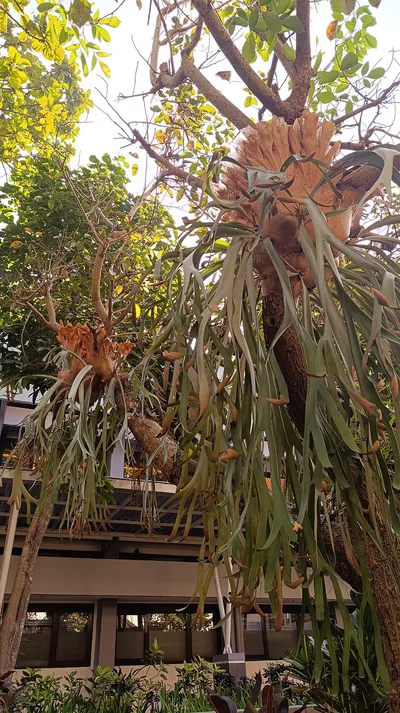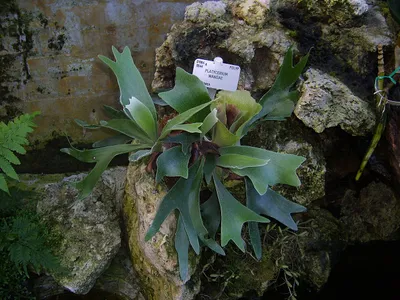
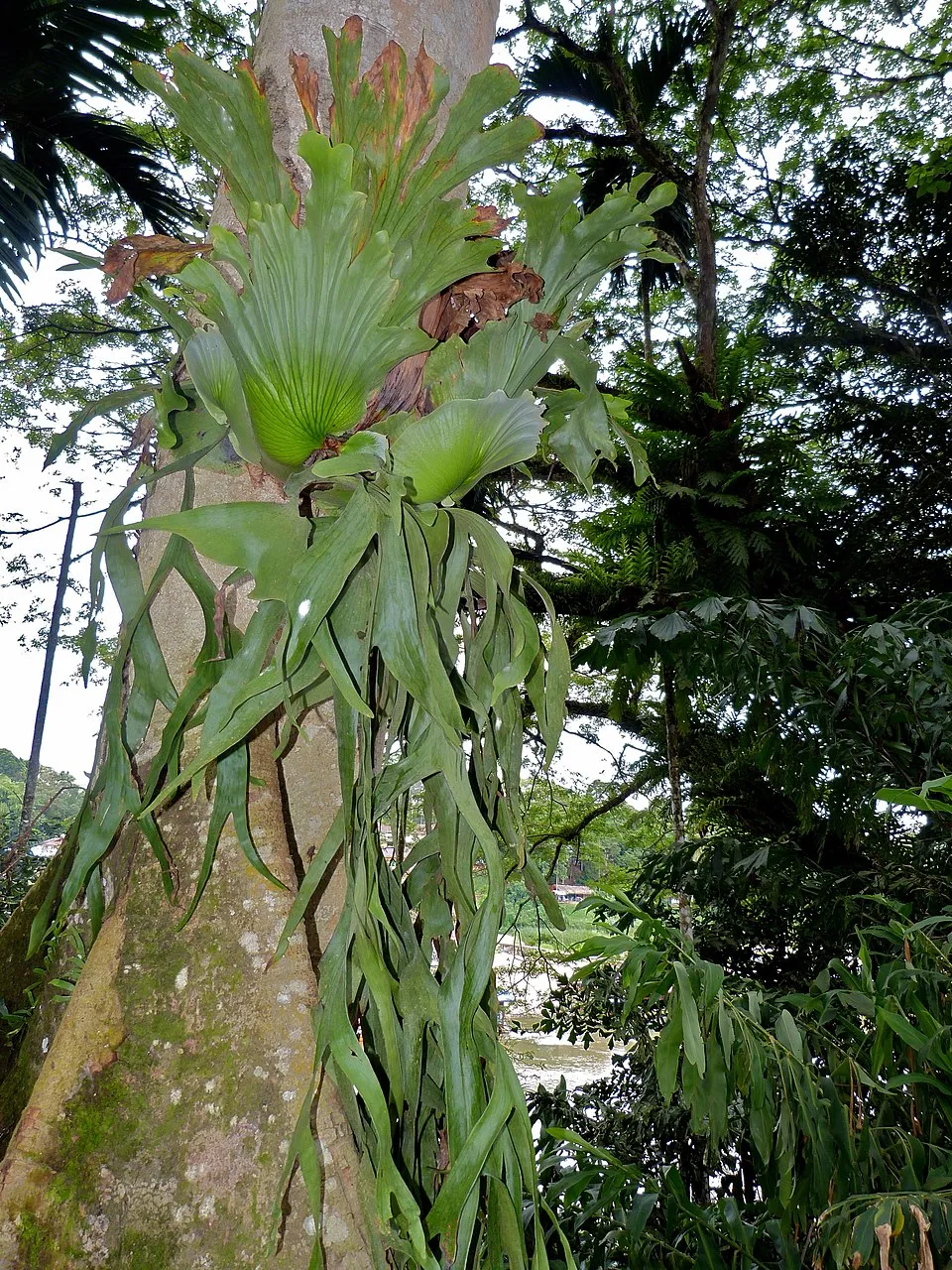
The genus Platycerium contains 18 recognized native species distributed across the tropics of Asia, Australia, Africa, Madagascar, and South America. Despite their diversity, all staghorn ferns share the same fundamental body plan: shield fronds for protection and storage, fertile fronds for reproduction, and epiphytic roots for attachment.
This guide organizes every species by its geographic origin and evolutionary lineage.
Phylogenetic Classification
In 2006, Kreier & Schneider published a landmark DNA study comparing chloroplast nucleotide sequences across all Platycerium species. Their analysis split the genus into two major evolutionary clades:
- Clade A (Africa–Madagascar): Contains species native to Africa, Madagascar, and South America. This clade further divides into a tropical African branch (2 species) and an East African–Madagascar branch (4 species).
- Clade B (Asia–Australia): Contains the P. bifurcatum group and the Southeast Asia–New Guinea–Australia group. The bifurcatum group includes P. bifurcatum, P. hillii, P. veitchii, and P. willinckii. The broader group (~7 species) includes P. coronarium, P. grande, P. holttumii, P. ridleyi, P. superbum, P. wallichii, and P. wandae.
Platycerium andinum, the sole American species, is placed within the Africa–Madagascar clade on the molecular tree but shows no close affinity to any known African or Malagasy species — likely a relic of ancient Gondwanan distribution.
Southeast Asia
Southeast Asian species split into two sub-regions: the Indochina Peninsula (mainland) and the Malay Archipelago (islands).
Indochina Peninsula
Standard subtropical climate with high rainfall. Native species concentrate in the mountain regions of Thailand, Myanmar, and Cambodia.
Platycerium wallichii — Butterfly Staghorn
- Range: Northeastern India, Myanmar, Yunnan (China)
- Climate: Subtropical with distinct dormancy periods
- Key traits: The only Platycerium native to mainland China. Enters dormancy in response to both high and low temperature extremes — a unique adaptation among staghorn ferns. Closely related to P. holttumii. Single-bud type.
Platycerium holttumii — Holttum’s Staghorn
- Range: Indochina Peninsula (western mountains), elevation 0–700 m
- Climate: Tropical rainforest, understory
- Key traits: Large species with a dormancy-like mechanism similar to P. wallichii, though not temperature-driven. Produces a fixed two cycles of growth per year. Closely related to P. wallichii.
Platycerium coronarium — Crown Staghorn
- Range: Widely distributed across Southeast Asia — Indochina Peninsula, Malay Peninsula, and Philippines
- Climate: Tropical, heat-tolerant
- Key traits: One of the most widespread Platycerium species. Regional populations show considerable morphological variation. Very closely related to P. ridleyi. Produces massive, cascading fertile fronds.
Malay Archipelago
Tropical rainforest and tropical monsoon climates with high rainfall. Core species are found on Sumatra, the Philippines, and Java.
Platycerium ridleyi — Ridley’s Staghorn
- Range: Malay Peninsula, Sumatra (lowland plains)
- Climate: Tropical lowland, heat-loving, intolerant of cold (declines below 18 °C)
- Key traits: Lives in association with ants. Produces a distinctive “spore spoon” — sporangia fixed at the first fork of the fertile frond that eject spores when mature. Multiple subspecies exist. Closely related to P. coronarium. Single-bud type.
Platycerium wandae — Queen Staghorn
- Range: Eastern and western mountains of New Guinea
- Climate: Two-season tropical, heat-tolerant, highland-adapted, light-tolerant
- Key traits: A giant species — one of the largest in the genus. Primary distribution in New Guinea. Has a dwarf form known as the “curly-leaf queen.” Multi-bud type.
Platycerium grande — Giant Staghorn
- Range: Philippines, elevation 0–500 m
- Climate: Tropical, heat-tolerant
- Key traits: Often confused with P. superbum but is a distinct species with close affinity to superbum. True tropical species.
Platycerium willinckii — Java Staghorn
- Range: Java, Bali, East Timor (mountainous terrain)
- Climate: Tropical rainforest, but its specific range results in average annual temperatures of 18–26 °C
- Key traits: Extremely variable — locality forms include Bali and Bogor types. Renowned for its dense forking pattern and stellate trichomes. A key parent in modern hybridization programs. Multi-bud type.
Australia
All four Australian species belong to the P. bifurcatum complex within Clade B. They share close evolutionary relationships.
Platycerium superbum — Staghorn Fern (Australian Giant)
- Range: Western side of Australia’s Great Dividing Range
- Climate: Heat-tolerant, low-rainfall areas (~700 mm/year)
- Key traits: The only single-bud species native to Australia. A giant fern reaching impressive size. Located on the drier western slopes, so water demand is moderate despite heat tolerance. Produces 2–4 fronds per year. Dwarf cultivars have been developed. Elevation 0–750 m.
Platycerium veitchii — Silver Staghorn
- Range: Queensland, Australia — primarily on rocks and sparse tree branches
- Climate: Semi-arid subtropical, very high light tolerance
- Key traits: Grows lithophytically (on rocks) as well as epiphytically. Native habitat receives only ~700 mm annual rainfall. Dense white trichomes collect atmospheric moisture to compensate. No tall tree canopy overhead, so it tolerates and even prefers intense direct light. Closely related to P. hillii.
Platycerium hillii — Green Staghorn
- Range: Northeastern Australia (also subspecies found in Africa)
- Climate: Subtropical to tropical
- Key traits: High stress tolerance and upright growth habit. Fronds have prominent, robust vascular bundles. Highly drought-tolerant. Closely related to P. veitchii. Multi-bud type.
Platycerium bifurcatum — Common Staghorn
- Range: Eastern Australia — hills and low mountains along the coast
- Climate: Subtropical monsoon, humid; partially in tropical rainforest zones
- Key traits: The most widely cultivated Platycerium worldwide and the earliest species to be horticulturally developed. Extremely resilient. Wild populations show high variability across different climate zones. Closely related to both P. hillii and P. veitchii, with hillii being the closer relative. Multi-bud type.
Africa
African species divide into two groups: Central African species and Madagascar species.
Central Africa
The Congo River basin and surrounding foothills are the core habitat, with tropical savanna climate conditions.
Platycerium elephantotis — Elephant Ear Staghorn
- Range: Congo River basin, first discovered in Angola
- Climate: Subtropical savanna with distinct wet/dry seasons
- Key traits: Broad, undivided fertile fronds resembling elephant ears — unique among Platycerium. Has an intense dormancy mechanism — can fully desiccate in winter and regenerate in spring. Low water needs in cool/dry season; adapts to abundant moisture when warm. Notable hybrids include “An Xiang” (elephantotis x andinum) and “Xiang Zhua” (elephantotis x willinckii).
Platycerium stemaria — Triangle Staghorn
- Range: West-central Africa, Congo River basin, tropical rainforest near the Atlantic
- Climate: High humidity, high temperature, moderate light tolerance
- Key traits: Split crown form. Epiphytic in rainforest with tall canopy shade. Adapted to consistently high humidity.
(Note: Platycerium angolense Welw. is sometimes listed as a separate species in this region but is generally considered synonymous with or very closely related to P. elephantotis.)
Madagascar
Madagascar’s eastern island geology creates unique, isolated habitats with high species endemism.
Platycerium madagascariense — Madagascar Staghorn
- Range: Central Madagascar forests
- Climate: Tropical forest, ant-associated
- Key traits: The smallest native Platycerium species. Weak water demand — adapted to 700–1,500 m highland conditions. Heat-intolerant. Lives in symbiosis with ants. Distantly shares ancestry with the Australian clade from ancient evolutionary times. The hybrid “Snow Ape” (P. APE = wild veitchii x madagascariense) leverages this relationship.
Platycerium alcicorne — Round Shield Staghorn
- Range: Dual populations — East African mainland form and Madagascar southern form
- Climate: Dry/wet seasonal, dormancy-adapted
- Key traits: Sister group to the Madagascar endemics. Two distinct populations: the African form has a waxy cuticle with no stellate hairs; the Madagascar form has dense, highly branched trichomes for wind resistance and moisture retention. Fertile fronds have a strong sponge-like tissue structure. Enters dormancy in dry season and develops shallow-lobed crowns for better water storage. Wavy-edged fertile fronds catch air currents for spore dispersal.
Platycerium ellisii — Ellis’s Staghorn
- Range: Mangrove tidal zones, western Madagascar
- Climate: High humidity, salt-spray tolerant
- Key traits: Specialized for coastal mangrove habitat. Long-term exposure to salt spray. Fertile fronds have dense trichomes on both surfaces and no forking — adaptations to prevent salt accumulation. Shield fronds lack a crown (crownless form), similar to P. alcicorne.
Platycerium quadridichotomum — Four-Fork Staghorn
- Range: Western Madagascar
- Climate: Dry/wet seasonal with dormancy
- Key traits: Adapted to the dry, deciduous forests of western Madagascar. Enters dormancy in the dry season. Develops shallow-lobed crown for water storage. Wavy fertile frond margins catch air currents for spore dispersal. Endemic to Madagascar.
The Americas
Platycerium andinum — Andean Staghorn
- Range: South American Andes — scattered populations in Peru and Bolivia
- Climate: Montane, mountain-attached
- Key traits: The only Platycerium native to the Americas. An epiphyte in mountain habitats with heavy white trichome coverage for UV protection and dew collection. Displays the strongest stellate trichome expression of any Platycerium species. Fertile frond forking is relatively weak. Phylogenetically placed in the Africa–Madagascar clade despite geographic isolation — a Gondwanan relic.
Quick Reference: All 18 Species by Region
| Region | Species | Common Name | Bud Type |
|---|---|---|---|
| SE Asia — Indochina | P. wallichii | Butterfly Staghorn | Single |
| SE Asia — Indochina | P. holttumii | Holttum’s Staghorn | Single |
| SE Asia — Indochina | P. coronarium | Crown Staghorn | Multi |
| SE Asia — Malay | P. ridleyi | Ridley’s Staghorn | Single |
| SE Asia — Malay | P. wandae | Queen Staghorn | Multi |
| SE Asia — Malay | P. grande | Giant Staghorn | Single |
| SE Asia — Malay | P. willinckii | Java Staghorn | Multi |
| Australia | P. superbum | Staghorn (AU Giant) | Single |
| Australia | P. veitchii | Silver Staghorn | Multi |
| Australia | P. hillii | Green Staghorn | Multi |
| Australia | P. bifurcatum | Common Staghorn | Multi |
| Africa — Central | P. elephantotis | Elephant Ear Staghorn | Multi |
| Africa — Central | P. stemaria | Triangle Staghorn | Multi |
| Madagascar | P. madagascariense | Madagascar Staghorn | Single |
| Madagascar | P. alcicorne | Round Shield Staghorn | Multi |
| Madagascar | P. ellisii | Ellis’s Staghorn | Single |
| Madagascar | P. quadridichotomum | Four-Fork Staghorn | Single |
| Americas | P. andinum | Andean Staghorn | Single |