Overview
The smallest native Platycerium species, endemic to central Madagascar’s highland forests at 700–1,500 m elevation. Belongs to Clade A (Africa–Madagascar), though it distantly shares ancestry with the Australian clade from ancient evolutionary times.
Bud type: Single-bud.
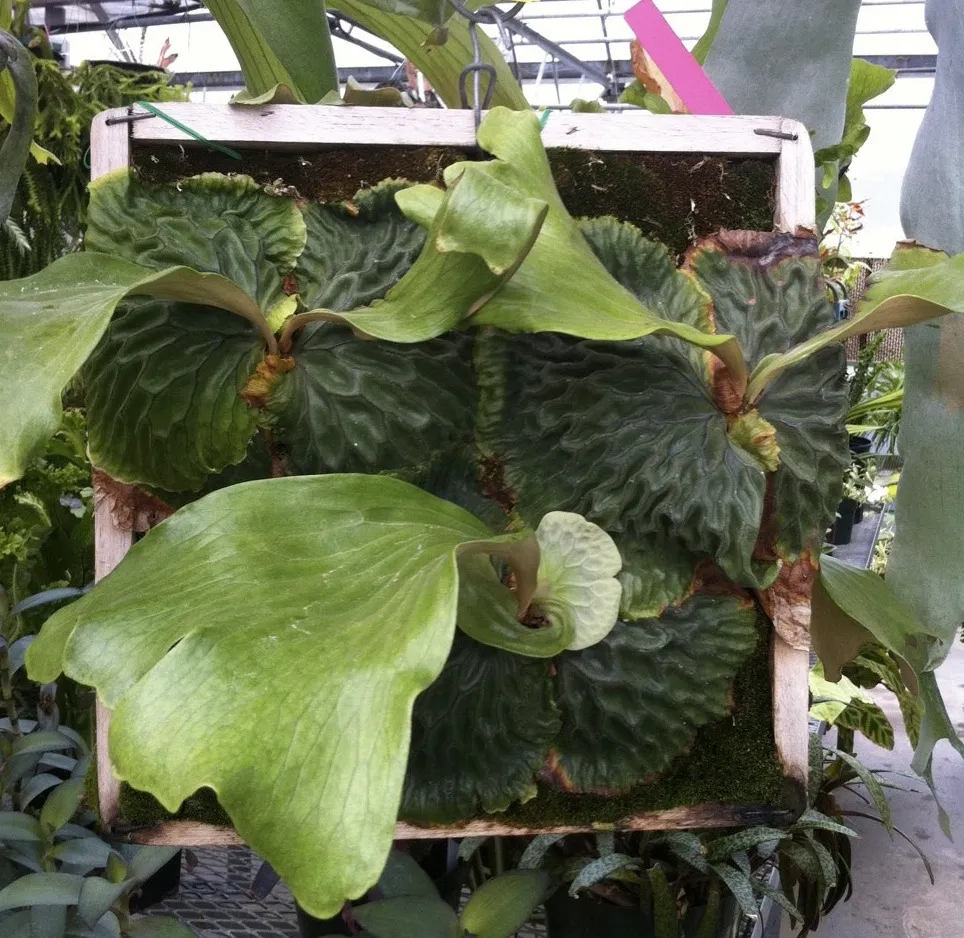
Key traits: Famous for its deeply ridged, waffle-like shield fronds — a structure designed to house symbiotic ant colonies within the chambers formed by the ridges. Lives in obligate symbiosis with ants in the wild. Weak water demand reflects its highland habitat. Critically heat-intolerant — this is the primary challenge in cultivation, as temperatures above 28°C cause rapid decline. Requires strict moisture monitoring without overwatering. The hybrid “Snow Ape” (P. APE = wild veitchii × madagascariense) leverages the unique genetic traits of this species. Notoriously difficult for beginners due to its narrow temperature and moisture tolerances.
Range: Central Madagascar — highland forests at 700–1,500 m elevation. Cool, humid conditions.
Care Tips for P. madagascariense
P. madagascariense is widely considered one of the most challenging Platycerium species to grow. Its narrow temperature tolerance and strict moisture requirements make it a true test of skill.
Light: Medium indirect light. Avoid both direct sun (which adds heat stress) and deep shade (insufficient for healthy growth). Morning light from an east-facing window or a position with consistent ambient brightness is ideal. Too much light compounds the heat problem.
Watering: Keep moist but never saturated — a razor-thin balance. P. madagascariense has low water demand compared to tropical lowland species, but it cannot tolerate drying out either. Water lightly and frequently, monitoring the medium daily. Overwatering leads to rot; underwatering leads to desiccation. The weight test is essential for this species.
Temperature: 15–25°C is the safe range. This is the critical factor: temperatures above 28°C cause rapid decline and can be fatal within days during a heat wave. Night temperatures of 15–18°C are ideal and natural for a highland species. Air conditioning or a cool grow room is necessary in warm climates. P. madagascariense is not suitable for tropical lowland growing without climate control.
Humidity: 60%+ at all times, combined with good air circulation. High humidity helps moderate temperature fluctuations and supports the delicate frond tissue. A cool greenhouse or climate-controlled display case is the most reliable setup.
Mounting: Small board or cork bark slab. As the smallest Platycerium species and a single-bud type, P. madagascariense does not require much space. Use a fast-draining but moisture-retentive medium — fine sphagnum moss works well. See our mounting guide.
The Waffle-Pattern Shield Fronds
The deeply ridged, waffle-like texture of P. madagascariense’s shield fronds is not just decorative — it serves a critical ecological function. In the wild, the chambers created by the ridges house colonies of symbiotic ants. The ants provide nutrients (through waste deposits) and protection, while the plant provides shelter. This obligate mutualism means wild specimens depend on ants for nutrition. In cultivation, without ants, supplemental fertilizing becomes more important to compensate for the missing nutrient source.
Frequently Asked Questions
Why is P. madagascariense so difficult to grow? The primary challenge is heat intolerance. Most Platycerium species are tropical and handle warmth easily, but P. madagascariense is a highland species evolved for cool conditions (15–25°C). Temperatures above 28°C cause rapid, often irreversible damage. This makes it unsuitable for most home environments without air conditioning or dedicated cooling.
What is P. APE (Snow Ape)? P. APE is a hybrid of wild P. veitchii × P. madagascariense. The hybrid combines the hardiness and trichome coverage of P. veitchii with the unique character of P. madagascariense. P. APE is significantly easier to grow than pure P. madagascariense, making it a more accessible way to enjoy this species’ genetics.
Does P. madagascariense need ants in cultivation? No — the ant symbiosis is not required for survival in cultivation. However, without ants providing nutrients, you should fertilize regularly during the growing season. Use a diluted balanced fertilizer at quarter strength.
Is P. madagascariense the smallest Platycerium? Yes — it is the smallest native species in the genus. Mature specimens are typically only 20–30 cm across, making it manageable in terms of space, even though it is extremely demanding in terms of growing conditions.
Need specialized care for this specimen? Check our cultivation guides for mounting, watering, and pest control techniques.