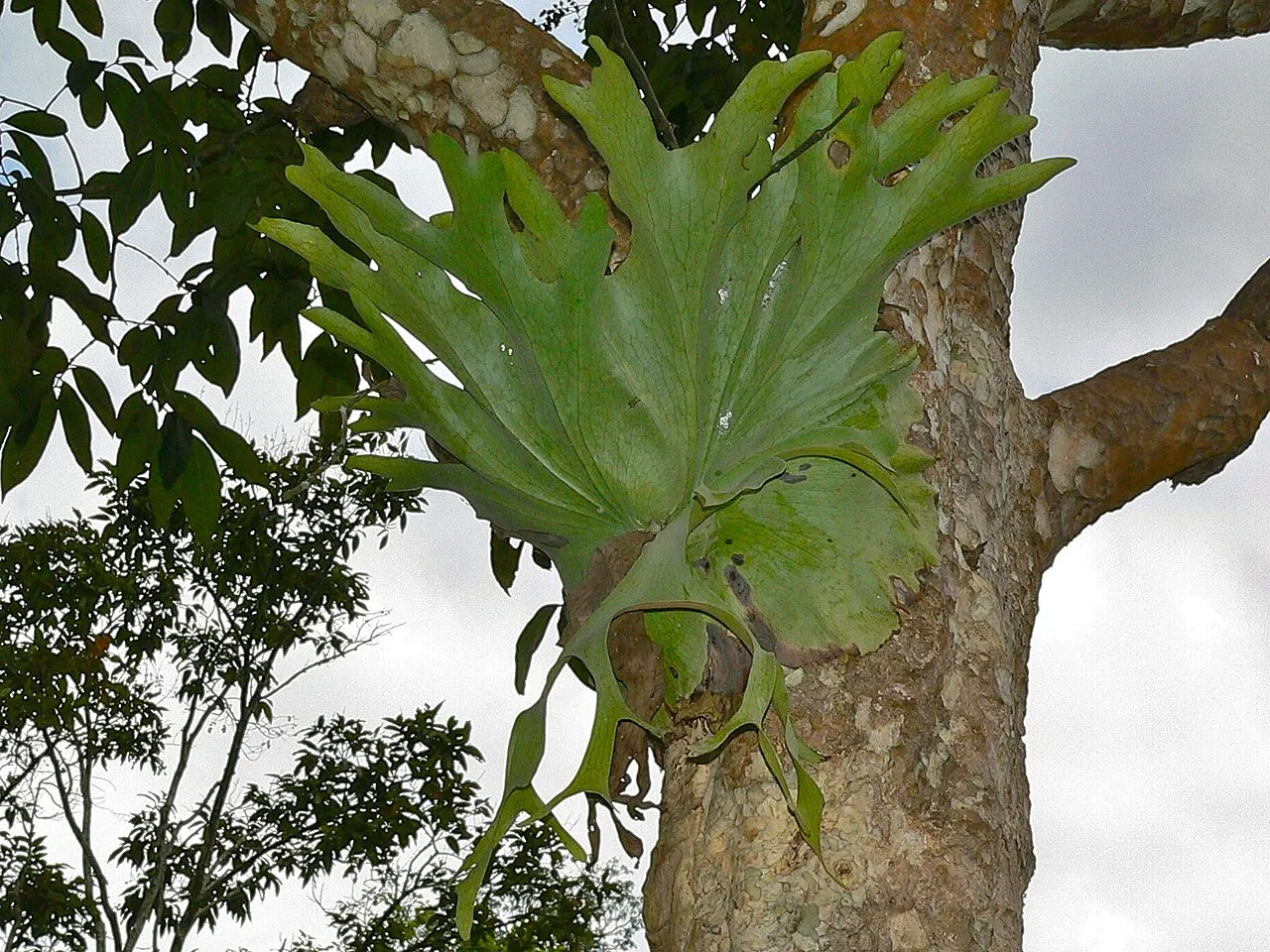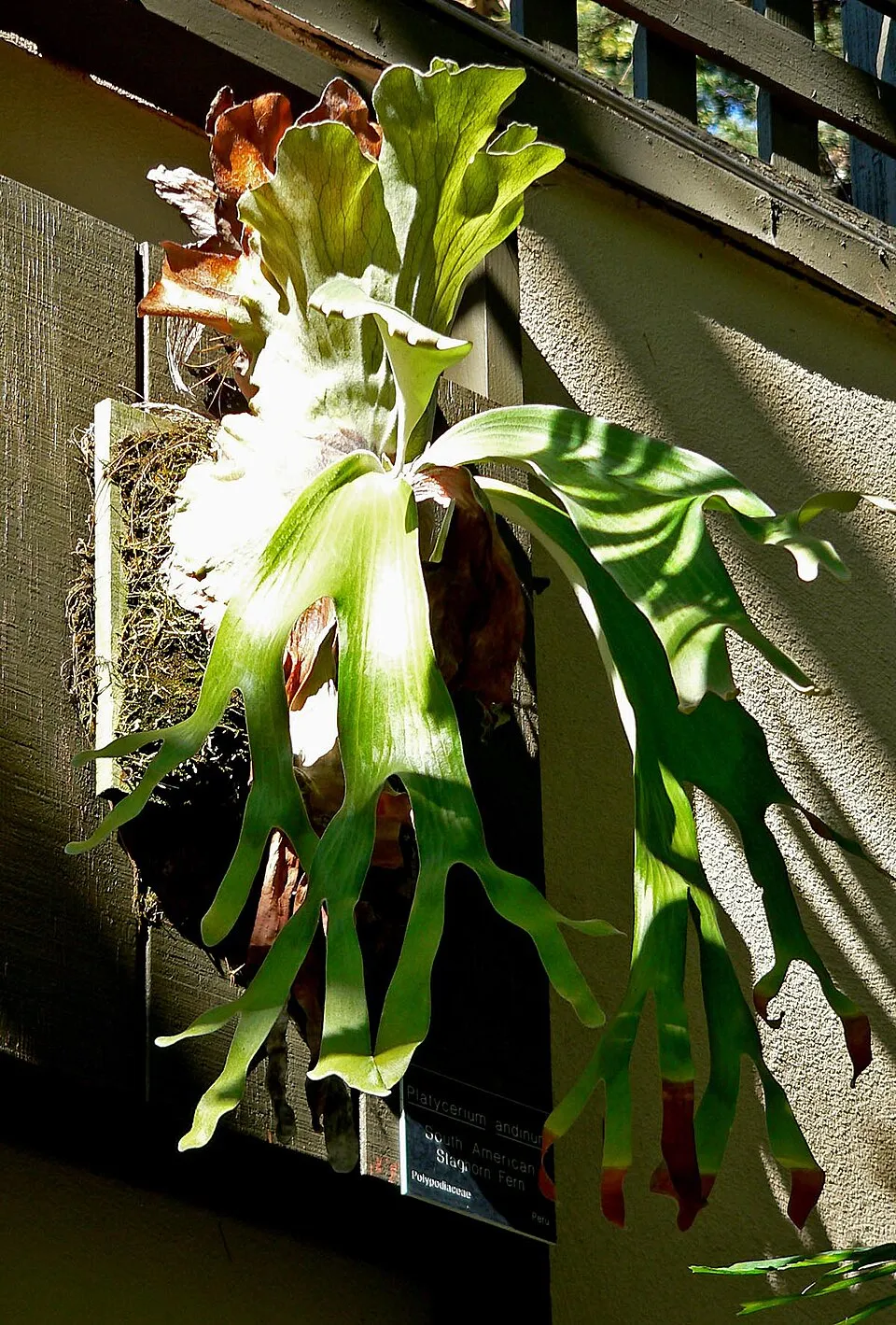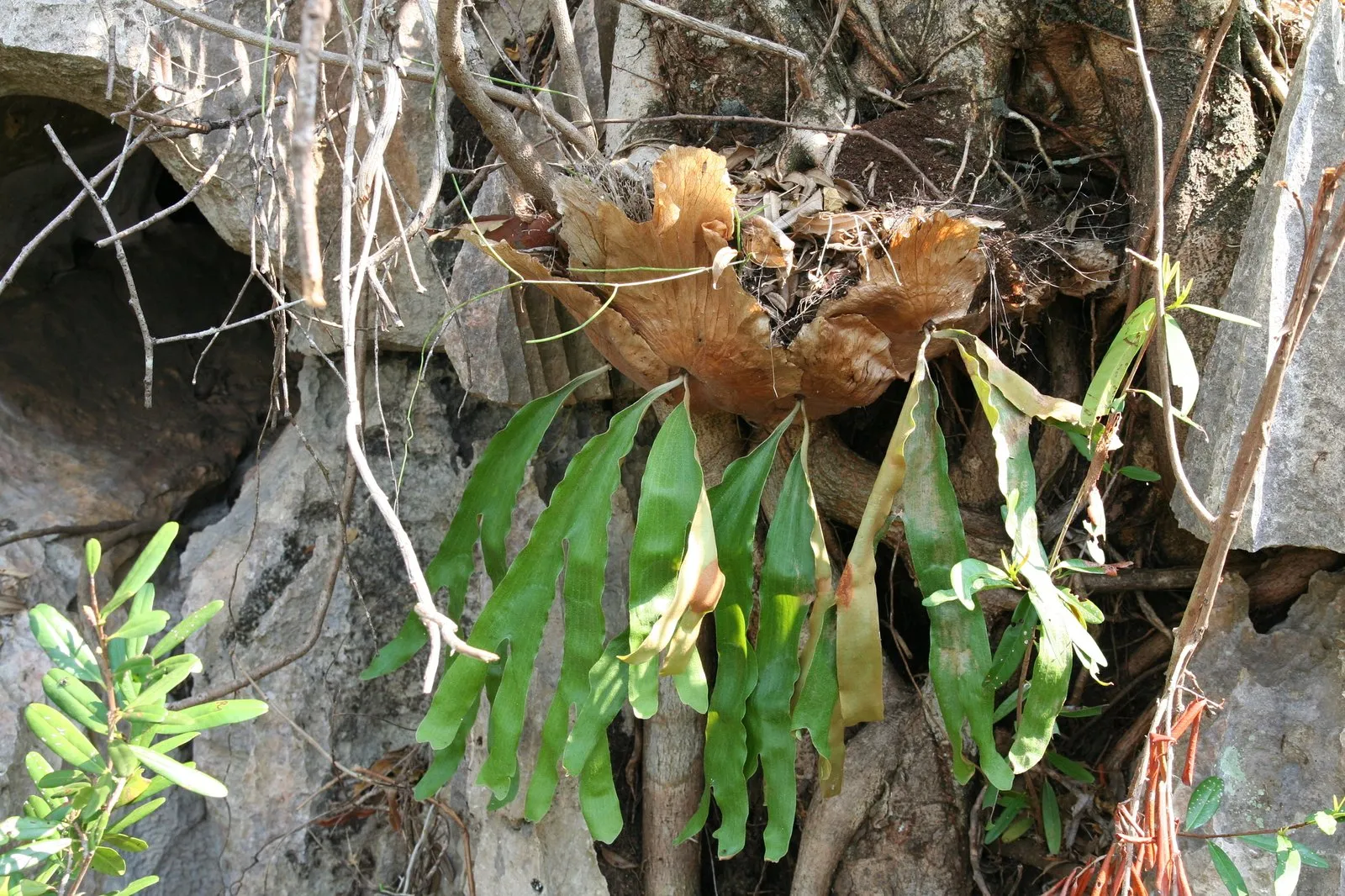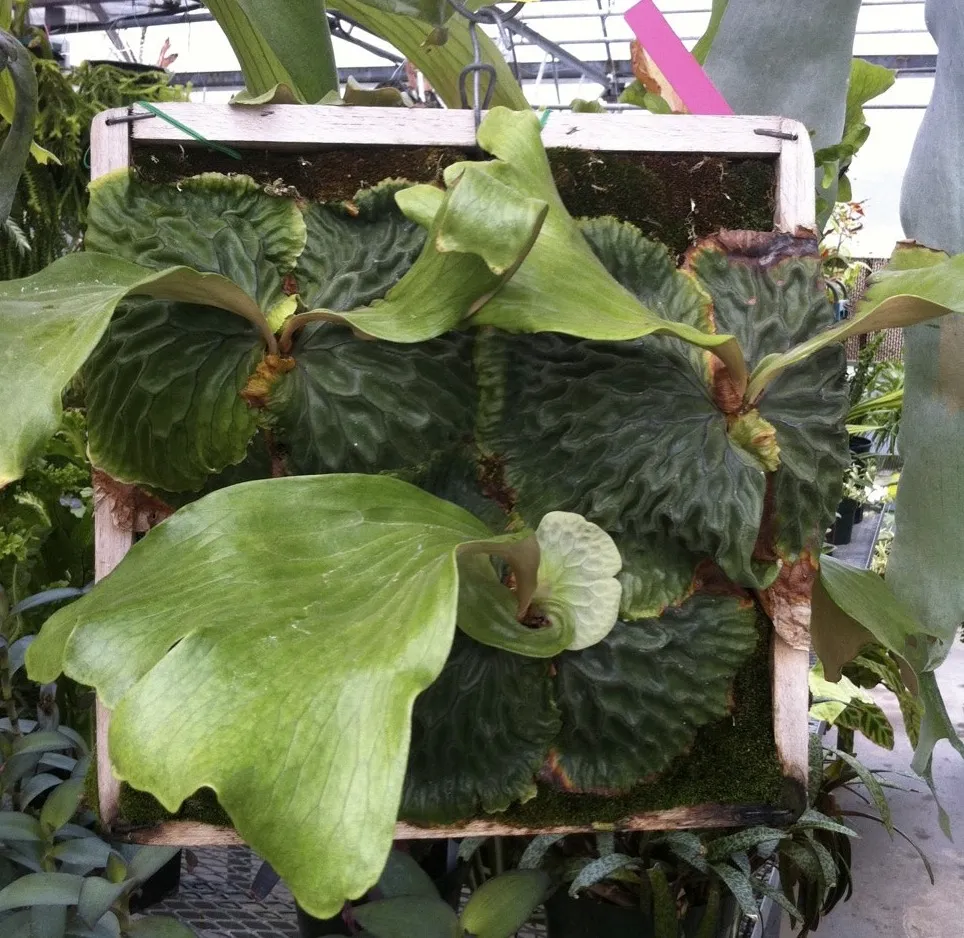
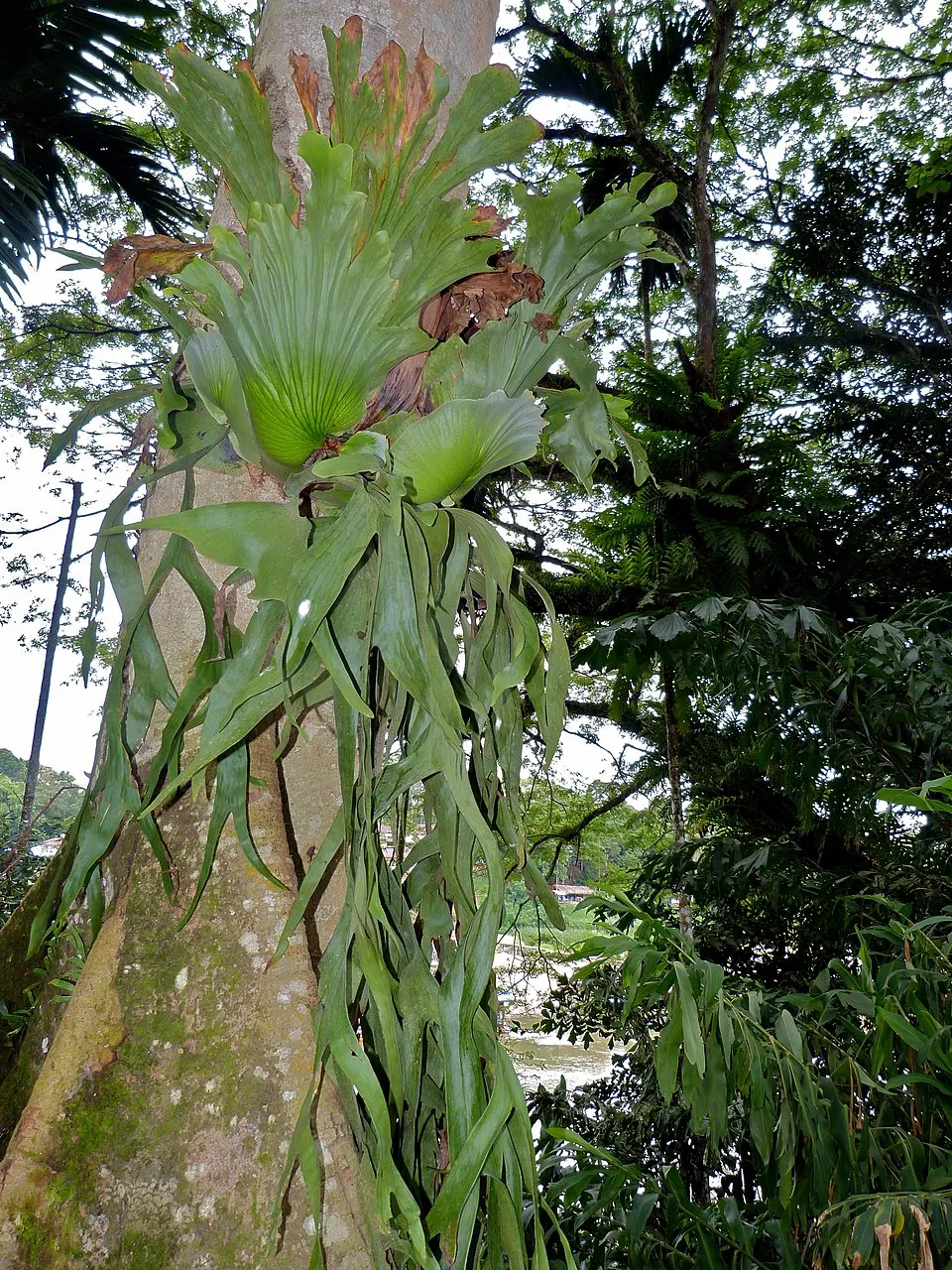
One of the most widespread Platycerium species, distributed across the Indochina Peninsula, Malay Peninsula, and the Philippines. Belongs to Clade B (Asia–Australia), very closely related to P. ridleyi.
Bud type: Multi-bud.
Key traits: Forms a massive crown-shaped nest of shield fronds, with pendulous fertile fronds that can reach extraordinary lengths — cascading several meters in mature specimens. Regional populations show considerable morphological variation due to the species’ wide distribution. Heat-tolerant and adapted to tropical conditions. Requires excellent air circulation and consistent moisture. Its size and dramatic form make it one of the most impressive Platycerium species for display, but it demands significant space and warm, humid conditions.
Range: Widely distributed — Indochina Peninsula, Malay Peninsula, and Philippines. Tropical climates.
How to Identify P. coronarium (and Tell It From P. ridleyi)
Look at the fertile fronds first: on P. coronarium they hang down, often a metre or more, and each carries its spores on a separate kidney-shaped lobe near the frond base. P. ridleyi holds its fertile fronds stiffly upright, with oval spore lobes. These two are the only Platycerium with stalked, separate spore lobes, which is why they get confused in the trade.
| Feature | P. coronarium | P. ridleyi |
|---|---|---|
| Fertile fronds | Long, narrow, forked, hanging | Shorter, antler-like, held upright |
| Spore lobe | Semi-circular to kidney-shaped | Oval to elliptic, sometimes lobed |
| Shield fronds | Tall, lobed at the top, form an open basket or crown | Entire (unlobed), deeply embossed veins, press into a tight ball |
| Growth habit | Multi-bud, forms clusters of plants | Single-bud, grows as one plant |
| Mature size | Very large; fertile fronds to 2–3 m | Much smaller and more compact |
The basket of lobed shields is where the “crown” in the name comes from. If you’re unsure, check two or three of these features together. Frond width varies between plants and isn’t a reliable test on its own. The fertile-lobe and shield-frond distinctions follow the key published in the American Fern Journal (1982) and the Malaysia Biodiversity Information System species note.
Young plants
Seedlings and small divisions have no fertile fronds yet, so the hanging-frond test doesn’t work. At that size the shield is the better clue: lobed edges at the top point to P. coronarium, a smooth rounded shield with raised veins points to P. ridleyi. Buy small plants from a seller who states the species, and keep that label with the plant until it produces its first fertile frond. Fern’s plant profile has a source field for that, so the seller’s name and locality stay with the plant.
Hybrids with P. ridleyi
The two species also hybridise. A Thai hybrid was published in 2024 as Platycerium × kitshakoodiense (Kew POWO). A plant that shows a mix of the features in the table above may be this hybrid.
P. coronarium From the Philippines, Thailand and Malaysia
P. coronarium grows wild from Myanmar and Thailand through the Malay Peninsula to Borneo, Java and the Philippines. In Peninsular Malaysia it is now considered rare because of habitat loss and collecting. Many plants in the trade are labelled by locality: “Philippines”, “Thailand”, “Malaysia”. These are origin labels, not separate species or registered cultivars. Plants from across this wide range differ in frond length and shield lobing, but they all have the hanging fertile fronds and kidney-shaped spore lobe described above. Care is the same for every locality. Lowland tropical origin means warmth and humidity matter more than which country the plant came from.
For other species names and trade labels, see the Platycerium cultivar and trade-name guide and the full species comparison.
Care Tips for P. coronarium
P. coronarium is a statement plant for experienced growers with space and tropical conditions. Its cascading fertile fronds can reach 2–3 meters, creating a living chandelier effect.
Light: Bright filtered light. Tolerates more light than P. ridleyi but avoid direct midday sun.
Watering: Keep the root ball consistently moist but never waterlogged. Excellent drainage is essential. Water 2–3 times per week in warm weather, reducing in cooler months. Use the weight test as a guide.
Temperature: Tropical warmth — minimum 20°C, ideal 25–32°C. Does not tolerate cold and will decline rapidly below 15°C.
Humidity: 60%+ is essential. This species needs consistently high humidity and good air movement. A greenhouse, covered tropical patio, or large indoor space with a humidifier works best.
Mounting: Due to its massive size, P. coronarium is best grown on a large tree, a heavy-duty wire basket, or a reinforced board mount. Mature specimens can weigh 30 kg or more. See our mounting guide.
Frequently Asked Questions
How long do the fertile fronds get? In ideal conditions, fertile fronds can cascade 2–3 meters (6–10 feet). Even in cultivation with limited space, expect fronds over 1 meter on a mature plant.
Is P. coronarium the same as P. ridleyi? No — they are closely related but distinct. P. coronarium is multi-bud with hanging fertile fronds and kidney-shaped spore lobes; P. ridleyi is single-bud with upright fertile fronds, oval spore lobes and cabbage-like shield fronds. P. coronarium grows much larger.
Is “Platycerium coronarium Philippines” a different plant? No. “Philippines” is a locality label for plants collected or propagated from Philippine stock. It is the same species as Thai or Malaysian P. coronarium, with the same care needs.
Can I grow P. coronarium indoors? Difficult unless you have a very large, warm, humid space. Most successful indoor growers use greenhouses or large grow rooms. The size and humidity requirements make it impractical for typical home environments.
Does P. coronarium produce pups? Yes — it is multi-bud and produces offsets. Pups can be separated once they have 2–3 fronds, but be careful not to damage the main plant during division. See our pup division guide.