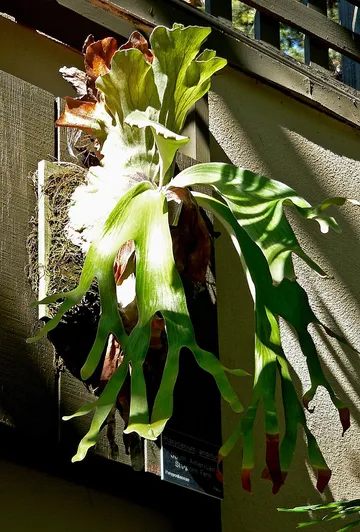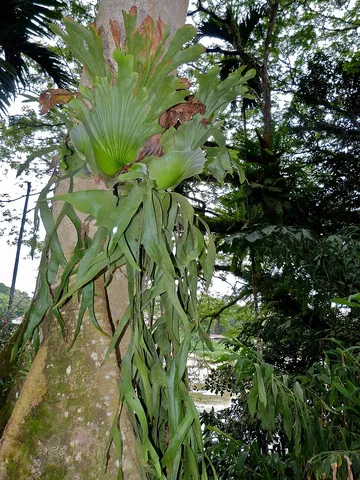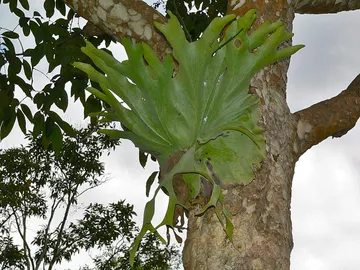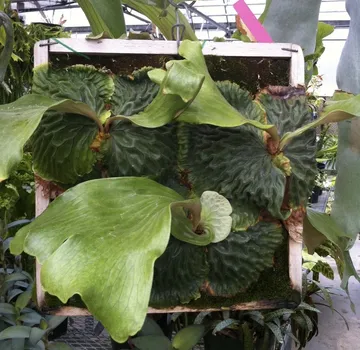
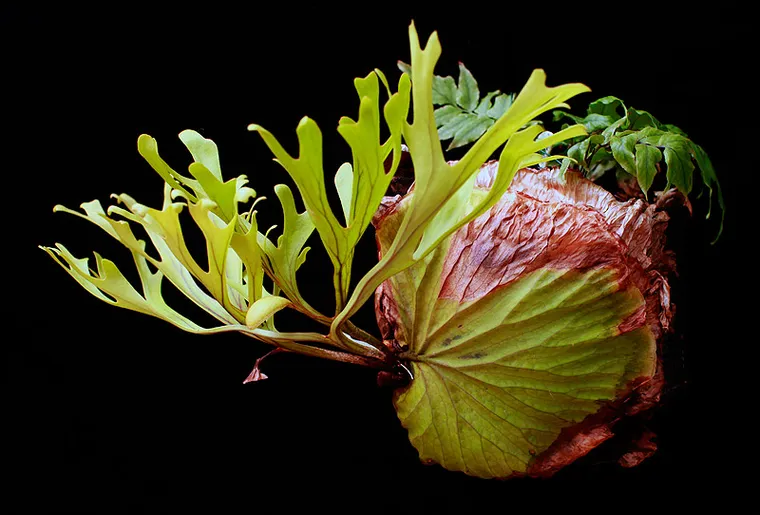
Famous for its distinctive cabbage-like shield fronds, this species is native to the lowland plains of the Malay Peninsula and Sumatra. Belongs to Clade B (Asia–Australia), closely related to P. coronarium.
Bud type: Single-bud.
Key traits: Lives in association with ants — the tightly overlapping shield fronds create chamber-like spaces that house ant colonies. Produces a distinctive “spore spoon” — sporangia are fixed at the first fork of the fertile frond and eject spores when mature, a mechanism unique among Platycerium. Multiple subspecies exist across its range. A heat-loving species that is intolerant of cold — performance declines noticeably below 18°C. Requires excellent drainage and air circulation; root rot is the primary cause of failure in cultivation.
Range: Malay Peninsula, Sumatra — tropical lowland plains. Heat-loving, cold-intolerant.
Care Tips for P. ridleyi
P. ridleyi is considered an advanced species due to its strict requirements for heat, humidity, and drainage. However, growers who nail these conditions are rewarded with one of the most architecturally striking staghorn ferns.
Light: Bright indirect light. Avoid direct sun, but do not keep it in deep shade — insufficient light causes leggy growth and weak shield frond development.
Watering: This is where most growers fail with P. ridleyi. The key rule is excellent drainage above all else. Water thoroughly when the moss is dry, but ensure water drains away completely within minutes. Never let the root ball sit in standing water. The weight test is critical — wait until the mount feels genuinely light before watering again.
Temperature: Minimum 18°C at all times. Growth slows significantly below 20°C and stops below 18°C. Ideal range is 24–32°C. Cold damage is irreversible.
Humidity: 60–80% is ideal. P. ridleyi comes from lowland tropical rainforest and needs consistently high humidity. A greenhouse, terrarium, or humidifier setup is often necessary in temperate climates.
Mounting: Cork bark or tree fern slab with a thin layer of sphagnum moss. The mount must allow excellent air circulation around the root ball. Wire basket mounting also works. Avoid packed, dense moss that retains too much moisture. See our mounting guide.
Frequently Asked Questions
Why are the shield fronds shaped like a cabbage? The tightly overlapping, ridged shield fronds create chambers that house symbiotic ant colonies in the wild. The ants bring in organic matter (leaf fragments, insect parts) that decomposes and feeds the fern. In cultivation, you can mimic this by tucking slow-release fertilizer pellets behind the shield fronds.
Why does my P. ridleyi keep dying? The most common cause is root rot from poor drainage or cold exposure. Ensure the root ball dries out between waterings, maintain temperatures above 18°C, and provide maximum airflow. If you see the growing point turn soft and dark, rot has set in and is usually fatal.
Is P. ridleyi rare? It was rare in cultivation 10 years ago, but tissue culture and spore propagation have made it more available. Expect to pay a premium compared to common species, but it is no longer unobtainable.
Can I grow P. ridleyi at home without a greenhouse? Yes, if your home stays above 18°C year-round and you can maintain 60%+ humidity near the plant. A bathroom with a bright window, a humidifier in a warm room, or a grow tent with supplemental lighting all work.