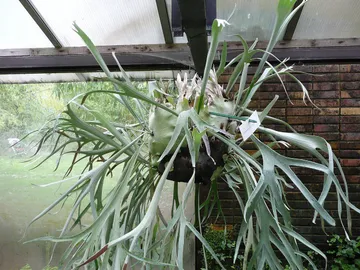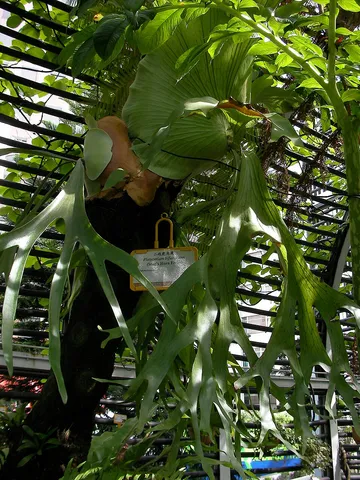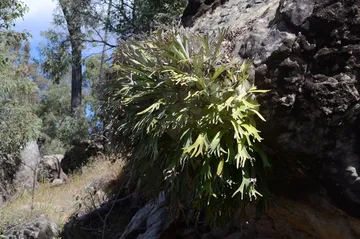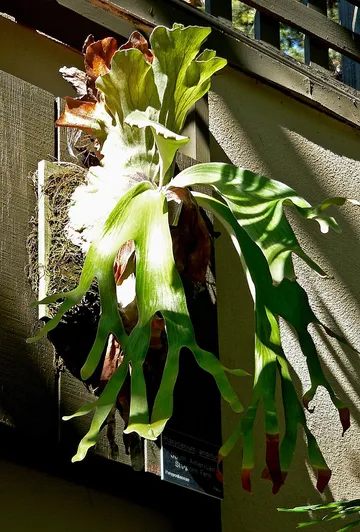
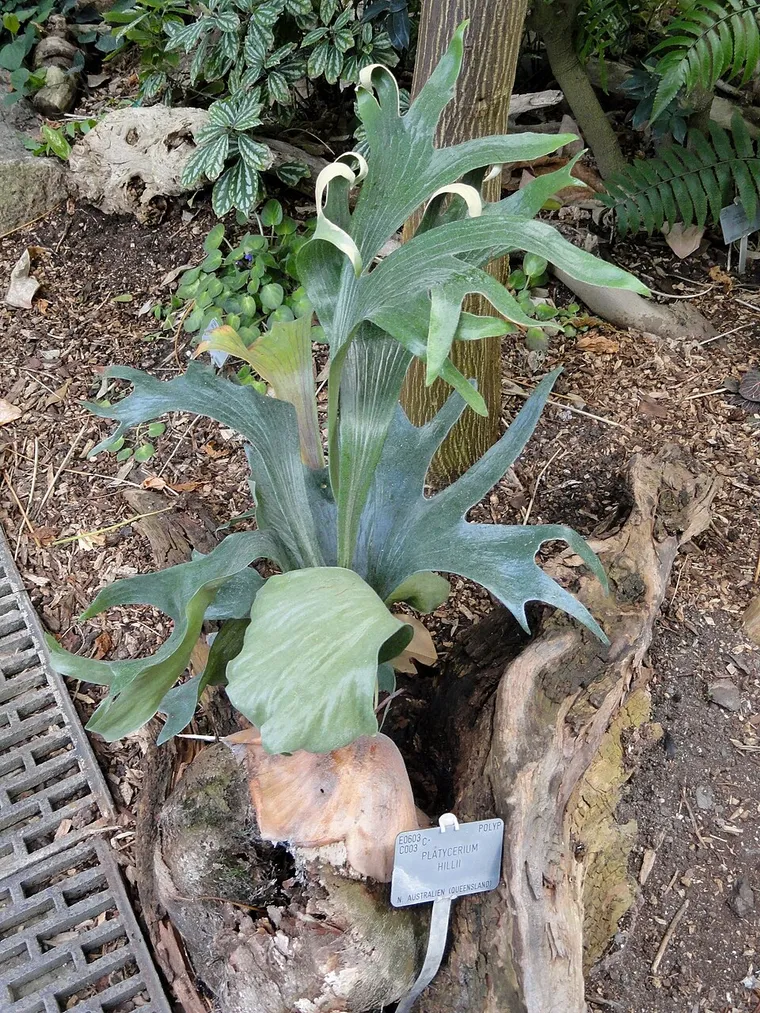
A tough, compact species from northeastern Australia with an upright growth habit. Belongs to Clade B (Asia–Australia) within the P. bifurcatum complex, most closely related to P. veitchii.
Bud type: Multi-bud.
Key traits: High stress tolerance and strong, upright frond posture distinguish this species. Fertile fronds feature prominent, robust vascular bundles visible through the green tissue. Highly drought-tolerant and adaptable to a range of light conditions. Its compact size and resilience make it a beginner-friendly species. In hybridization, P. hillii contributes structural rigidity and stress tolerance. Also found in some African subspecies, suggesting a wider historical distribution.
Range: Northeastern Australia — subtropical to tropical zones. Some subspecies reported in Africa.
Care Tips for P. hillii
P. hillii (commonly called the elkhorn fern in Australia) is nearly as easy as P. bifurcatum, with a slightly more compact and upright growth habit.
Light: Bright filtered light. Tolerates a range from partial shade to bright indirect — similar to P. bifurcatum but performs best with a bit more light.
Watering: Drought-tolerant. Allow the medium to dry between waterings. In summer, every 7–10 days; in winter, every 14–21 days. The weight test is the most reliable guide.
Temperature: Hardy to about 5°C, which is less cold-tolerant than P. bifurcatum (hardy to -2°C). In frost-free subtropical climates (USDA zones 9b–11), it thrives outdoors year-round.
Humidity: 40–60% is sufficient. Like other Australian species, it handles average household humidity without problems.
Mounting: Board mounting is ideal for P. hillii’s compact size. Cedar or cork bark, with a sphagnum moss bed. See our mounting guide.
Staghorn vs Elkhorn: The Naming Confusion
In Australia, P. hillii is called the elkhorn fern, while P. bifurcatum is the staghorn fern. Outside Australia, both species (and the entire genus) are called “staghorn ferns,” causing widespread confusion. The key visual differences:
- P. hillii has narrower, more deeply forked fronds — more “elk antler” shaped
- P. bifurcatum has broader, shallower-forked fronds — more “stag antler” shaped
- P. hillii tends to be greener with less trichome coverage
For a detailed comparison, see our Staghorn vs Elkhorn Fern guide.
Frequently Asked Questions
Is P. hillii the same as elkhorn fern? In Australia, yes — P. hillii is the species commonly called “elkhorn fern.” Outside Australia, the term “elkhorn” is sometimes applied to P. bifurcatum as well. Botanically, they are distinct species.
Is P. hillii good for beginners? Excellent. It is one of the easiest species alongside P. bifurcatum and P. veitchii. Its compact size makes it manageable for indoor growing.
How big does P. hillii get? Smaller than P. bifurcatum — individual plants typically reach 40–60 cm across. Colonial clusters on trees can be larger but remain more compact than bifurcatum colonies.
Does P. hillii produce pups? Yes — it is multi-bud and produces offsets freely, though somewhat less prolifically than P. bifurcatum. Pups can be divided and mounted independently once they have 2–3 fronds. See our pup division guide.