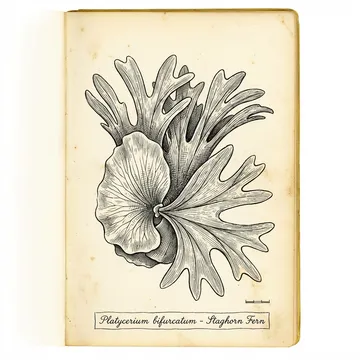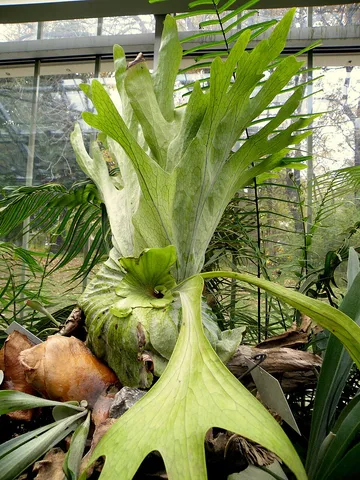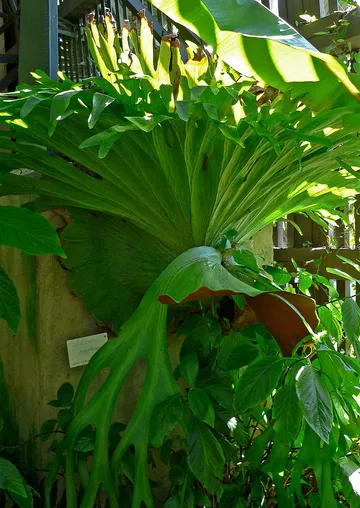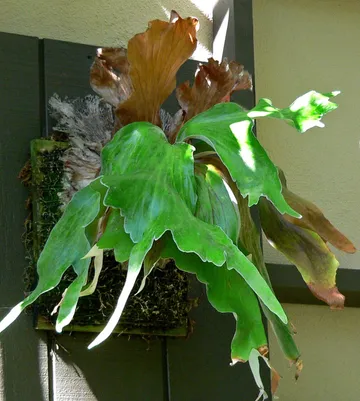
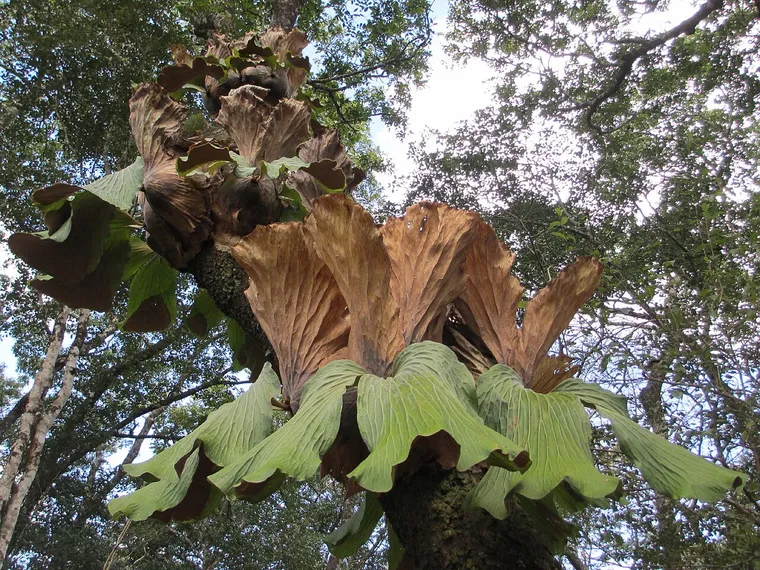
The elephant staghorn fern is the one Platycerium with no antlers. Sold as elephant ear fern, elephant ear staghorn fern, elephant ear elk fern or simply elephantotis, it grows broad undivided paddles 60–90 cm long instead of forked horns — and it needs a genuine dry-season rest from September to March that no other common staghorn does.
A distinctive species from the Congo River basin, first discovered in Angola. Belongs to Clade A (Africa–Madagascar) in the tropical African branch.
Bud type: Multi-bud.
Key traits: Broad, undivided fertile fronds that resemble elephant ears — completely unique among Platycerium, which typically have forked “antler-like” fronds. Has an intense dormancy mechanism: the plant can fully desiccate during the dry winter season and regenerate in spring, similar to resurrection plants. Low water needs in the cool/dry season; adapts to abundant moisture when warm. The subtropical savanna climate of its native habitat has distinct wet/dry seasons that must be replicated in cultivation.
Range: Congo River basin, first discovered in Angola — subtropical savanna with distinct wet/dry seasons.
Is an Elephant Ear Fern the Same as an Elephant Staghorn Fern?
Yes — when the plant in question is a fern. All of these names point at the same species, Platycerium elephantotis:
| Name you will see | What it refers to |
|---|---|
| Elephant staghorn fern | P. elephantotis — the usual shop name in the US |
| Elephant ear staghorn fern | Same plant; the longer, more common written form |
| Elephant ear fern | Same plant, when sold in a fern or Platycerium context |
| Elephant ear elk fern / elk staghorn | Same plant; “elkhorn” is the Australian word for staghorn |
| Elephantotis / P. elephantotis | The species epithet used on its own by collectors |
| 象耳鹿角蕨 | The Chinese name — literally “elephant ear staghorn fern” |
The one name that does not mean this fern is “elephant ear plant.” That almost always refers to Alocasia or Colocasia — a thick-stemmed tropical with arrowhead leaves grown from a tuber, not a fern and not an epiphyte. If the plant you are looking at has a stem coming out of soil, it is an Alocasia. If the leaves emerge from a flat papery shield pressed against a board or tree, it is this staghorn. For the other names in the trade, see the staghorn fern common-name decoder.
Within the genus, the species most often confused with it is P. wallichii, which also has wide fronds but divides them at the tips. P. elephantotis never divides at all.
Platycerium Elephantotis vs Neptune, var. mammuthus and the Hybrids
The names attached to this species in the trade are a mix of one true variety, several hybrids, and one hybrid that is routinely mislabelled as the species itself.
| Name | What it is | How to tell |
|---|---|---|
| P. elephantotis (standard) | The species | Fertile fronds broad and never divided at the tip |
| var. mammuthus | Large-form selection of the species | Same undivided shape, broader and longer; same care, bigger board |
| ”Neptune” | P. stemaria × P. elephantotis hybrid | Broad fronds from the elephantotis side, but shallowly forked tips from stemaria |
| ”An Xiang” | elephantotis × andinum hybrid | Narrower fronds with some antler tendency |
| ”Xiang Zhua” | elephantotis × willinckii hybrid | Inherits silver trichomes from willinckii |
Elephantotis vs Neptune is the comparison that matters. Neptune is a hybrid of this species, not a form of it, and photos of the two look almost identical because Neptune inherits the paddle-shaped frond. The tell is the tip: pure P. elephantotis never splits. If a plant sold to you as elephantotis shows any forking at the frond tip, it is Neptune or another hybrid — see P. stemaria for where that forking comes from.
The difference that actually costs plants is dormancy. P. stemaria is a wet-forest species with no dry rest, so Neptune wants steadier year-round moisture than the pure species. That generalises to every hybrid on the table: they carry a weaker dormancy requirement, which makes them more forgiving but also means the September-to-March taper below should not be applied without checking the parentage. Ask the seller what the cross is. For why these named forms carry the prices they do, see the cultivar identity guide.
Care Tips for P. elephantotis
The most important aspect of P. elephantotis care is respecting its seasonal rhythm. Everything else is ordinary staghorn care; the timing is what kills it.
| Season | Water | Fertilizer | What the plant does |
|---|---|---|---|
| Spring (Mar–May) | Resume gradually as new growth appears | Restart at quarter strength | Breaks dormancy, pushes new fronds |
| Summer (Jun–Aug) | Keep the medium consistently moist | Every 3–4 weeks, half strength | Peak growth |
| Autumn (Sep–Nov) | Taper sharply — the critical handover | Stop by mid-September | Sheds older fertile fronds |
| Winter (Dec–Feb) | Near-dry; a light misting every 3–4 weeks at most | None | Dormant — little to no visible growth |
Watering: Do not cut water off in one step. From early September, lengthen the interval by roughly 50% every two weeks until you are down to a monthly light watering by late November. The most common way growers kill this species is watering it through dormancy on a normal staghorn watering schedule.
Light: Filtered to bright indirect light. The broad, thin fronds scorch faster than any other staghorn’s — no direct sun. Water the root ball rather than the fronds, since water pooling on a flat paddle invites fungal spotting.
Temperature: 15–35°C. Tolerates a wider range than most tropical Platycerium due to its savanna origin. The cool/dry period can go as low as 12°C only if kept dry — cold and wet rots the crown. See the temperature tolerance guide for the rest of the genus.
Humidity: 50–70% during the growing season. During dormancy, low humidity is preferred, not just tolerated — do not run a humidifier for a dormant elephantotis.
Mounting: Board or basket mounting both work. Allow for 60–90 cm of frond drop and keep the sphagnum pad lean, since a thick moss pad holds moisture into the dry season. See the mounting guide. Because it is multi-bud, it forms colonies over time — see separating staghorn fern pups.
Growth rate: Slow and in bursts — two to four new fertile fronds per growing season on an established plant, three to four years before a young plant’s first full-size fronds. Pushing water and fertilizer during dormancy causes root rot, not growth.
Frequently Asked Questions
Why are the fronds not forked like other staghorn ferns? P. elephantotis is unique in having broad, undivided fertile fronds. This is an adaptation to its savanna habitat — the large, flat surface area maximizes light capture during the short growing season. It is the most morphologically distinct Platycerium species, and large flat paddles are a sign of a healthy mature plant, not a deformity.
My P. elephantotis looks dead — is it? Possibly not. During its dry dormancy, P. elephantotis can look completely desiccated — fertile fronds yellow and drop, sometimes all of them, and the shield fronds go papery. This is normal. Resume watering when temperatures warm up, and new growth should emerge within a few weeks. If the base is firm and the bud point is not mushy, the plant is alive. If the base is black and soft rather than dry and papery, that is root rot from watering through dormancy.
Is P. elephantotis good for beginners? It is medium-difficulty. The main challenge is providing the seasonal wet/dry cycle. Growers accustomed to consistent year-round watering may overwater during dormancy, causing rot.