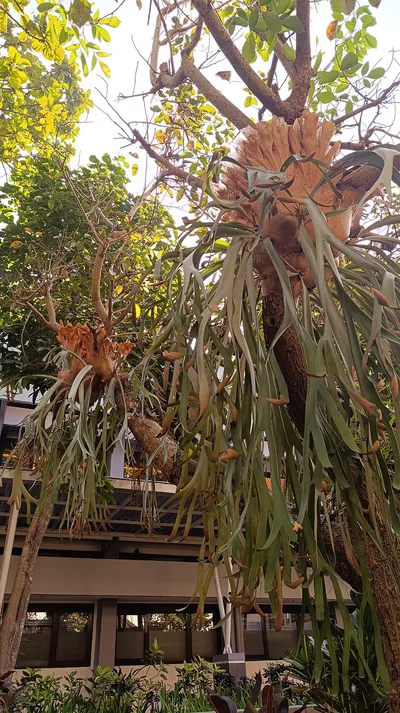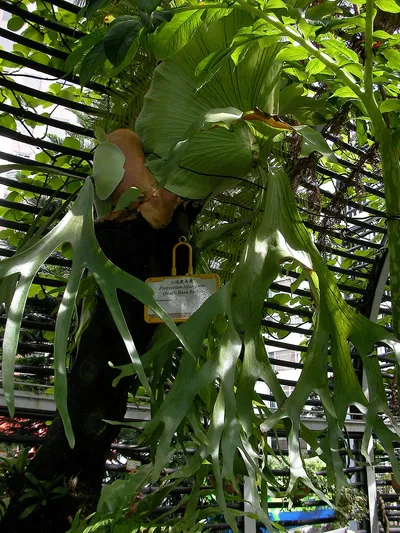
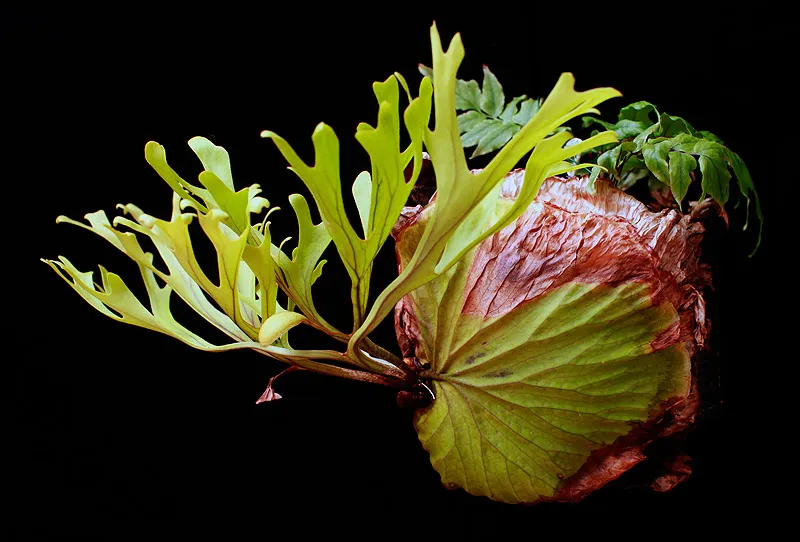
Platycerium ridleyi is the species that separates casual growers from dedicated collectors. Known as the “King of Staghorn Ferns,” it produces architectural cabbage-shaped shield fronds unlike anything else in the genus — tight, ridged, overlapping layers that create a sculptural masterpiece on any wall.
But ridleyi has a reputation. It’s the species people kill more often than they grow successfully. The root cause is almost always the same: too much moisture combined with too little airflow. Master those two variables, and ridleyi becomes far more manageable than its reputation suggests.
This guide covers everything from basic survival to cultivar selection, drawn from the latest growing techniques shared by specialist growers and the broader Platycerium research community.
Quick Care Reference
| Parameter | Requirement |
|---|---|
| Light | Bright indirect — no direct sun |
| Watering | When moss surface begins to dry — never bone dry |
| Humidity | 60–80% relative humidity |
| Temperature | 24–32°C ideal, never below 18°C |
| Airflow | Critical — gentle fan 24/7 |
| Mounting | Vertical, growth point at 12 o’clock |
| Fertilizer | Slow-release pellets under shield fronds |
| Difficulty | Advanced |
The #1 Rule: Airflow Over Everything
If you take one thing from this guide, let it be this: airflow matters more than watering frequency for P. ridleyi.
Most staghorn ferns tolerate still air reasonably well. Ridleyi does not. Its tightly layered shield fronds trap moisture between the overlapping plates, and without air movement, that trapped moisture breeds fungal rot that kills the growing point — often before you realize anything is wrong.
Indoors, place a small oscillating fan near the plant, running at low speed 24/7. In a grow cabinet, install computer fans for continuous air exchange. On a wall mount, ensure the plant isn’t tucked into a corner where air stagnates.
High humidity + stagnant air = rot. High humidity + moving air = a thriving ridleyi.
Light Requirements
P. ridleyi grows in the canopy of lowland tropical forests in Malaysia and Sumatra. It wants bright indirect light — more than many other staghorn species, but never direct sun.
- Ideal: East-facing window or a position near a south-facing window with sheer curtains
- Grow lights: 200–400 PPFD for 12 hours daily. LED panels work well in grow cabinets. See our lighting guide for setup details
- Too little light: Causes weak, elongated shield fronds that don’t form the characteristic tight cabbage shape
- Too much direct sun: Scorches the fronds, especially the pale new growth
The shield fronds should form tight, compact layers. If they’re stretching outward and loose, the plant needs more light.
Watering: The Critical Balance
Here is where most ridleyi deaths originate. The species sits in an unusual middle ground — it needs consistent moisture but cannot tolerate standing water or waterlogged substrate for even a short time.
The Rules
- Water when the sphagnum surface begins to dry — not when it’s bone dry, not when it’s still wet. The sweet spot is barely starting to feel lighter
- Soak briefly (5–10 minutes), then drain completely. The mount should stop dripping within a few minutes
- Mount vertically with the growth point at strict 12 o’clock position — gravity pulls water away from the crown, the most rot-susceptible area
- Never mist the shield fronds — water trapped between the layered plates promotes rot
Unlike P. willinckii or P. bifurcatum, which tolerate drying out between waterings, ridleyi is surprisingly sensitive to drought. The sphagnum should never go completely crispy.
For general watering principles that apply across all Platycerium species, see our watering guide.
[!IMPORTANT] If you see the growing point (the fuzzy bud at the center) turning soft or dark, stop watering immediately. This is the early stage of crown rot and is often fatal. Improve airflow and let the mount dry before resuming a lighter watering schedule.
Temperature
P. ridleyi is a lowland tropical species with zero cold tolerance. This is non-negotiable:
| Temperature Range | Effect |
|---|---|
| 24–32°C (75–90°F) | Ideal — active growth |
| 18–24°C (64–75°F) | Slow growth, still healthy |
| Below 18°C (64°F) | Growth stops, stress begins |
| Below 15°C (59°F) | Cold damage — often irreversible |
Compare this to P. bifurcatum, which survives brief frosts, or P. veitchii, which handles temperatures down to 0°C. Ridleyi is at the opposite end of the spectrum.
Practical tip: In temperate climates, the danger zone is winter nights. If your home drops below 18°C at night (common when heating switches off), consider a small space heater on a thermostat near your ridleyi. For comprehensive winter strategies, see our winter care guide.
Humidity
Target 60–80% relative humidity consistently. Brief dips to 50% are tolerable, but prolonged dry air causes frond tip browning and stunted shield frond development.
Proven setups for ridleyi humidity:
- Grow cabinet with fans: The gold standard — sealed environment with controllable humidity and forced airflow. Most successful ridleyi growers eventually move to this setup
- Bathroom mount: If your bathroom has a window with bright indirect light, the ambient humidity from showers works well
- Humidifier + fan: A good mid-range solution for a living room. Point the humidifier output toward the plant, and position a fan to keep air moving
- Grouping plants: Multiple ferns and tropical plants together create a shared humidity microclimate
For more indoor humidity strategies, our indoor care guide has detailed solutions.
Mounting: Why Orientation Matters
Standard board mounting works for ridleyi, but orientation is everything. The growth point must sit at the 12 o’clock position (top of the mount) so that:
- Water drains downward, away from the crown
- Shield fronds layer naturally with gravity
- The “ant chambers” between shield fronds don’t fill with standing water
Recommended Mounting Materials
| Material | Pros | Cons |
|---|---|---|
| Cork bark slab | Excellent drainage, natural look | Can be expensive for large slabs |
| Tree fern slab | Holds some moisture, roots grip well | Degrades over time |
| Hardwood plank (cedar/oak) | Durable, rot-resistant | Heavier on the wall |
| Wire basket | All-around airflow | Less dramatic display |
Substrate: Use a thin layer of long-fiber sphagnum moss — just enough to hold moisture, not so much that it stays waterlogged. A 1–2 cm layer is plenty. Less moss = faster drying = less rot risk.
For step-by-step mounting instructions, see our mounting guide.
The Ant Connection
In the wild, ridleyi’s tightly layered shield fronds create hollow chambers that house symbiotic ant colonies. The ants bring in organic debris — leaf litter, insect parts — which decomposes inside the chambers and feeds the fern. It’s a brilliant evolutionary partnership.
In cultivation, you can mimic this nutrient delivery by tucking 3–5 slow-release fertilizer pellets (Osmocote 14-14-14) under the shield fronds every 6 months. This feeds the plant at the exact spot where it naturally receives nutrients. For more on fertilizer options, see our fertilizer guide.
Popular Ridleyi Cultivars
The ridleyi cultivar scene has expanded dramatically, with Thai and Malaysian growers selecting stunning varieties. Here are the most sought-after forms:
| Cultivar | Key Features | Collector Value |
|---|---|---|
| Standard | Classic cabbage shields, moderate spore spoons | Baseline — widely available |
| Dwarf Silver | Compact shields (~25 cm max), silver trichomes, Southern Thailand origin | High — perfect for small spaces |
| Pakarang (Coral Form) | Fertile fronds fork into fine coral-like projections | Very high — the “holy grail” for ridleyi collectors |
| Wide Frond | Broader, flatter fertile fronds than standard | Moderate — distinctive display |
| Coral | Similar to Pakarang, highly branched fertile fronds | High — dramatic texture |
| Slender Form | Narrow, elongated fertile fronds | Moderate — elegant silhouette |
The Pakarang cultivar deserves special mention. Named after the Thai word for “coral,” its fertile fronds branch into intricate, finger-like projections that create a dense, mesmerizing texture. It’s widely considered the ultimate ridleyi form among collectors.
Dwarf Silver is the most practical choice for home growers. Its compact size (shield fronds max out around 25 cm / 10 inches) makes it manageable in grow cabinets, and the silvery trichome coating adds visual interest.
All cultivars share the same care requirements — the differences are cosmetic.
Common Problems and Solutions
Crown Rot (the big one)
Symptoms: Growing point turns soft, dark, mushy. Often accompanied by a sour smell.
Cause: Water pooling around the crown due to poor orientation, overwatering, or stagnant air.
Fix: If caught early, stop watering, maximize airflow (add a direct fan), and let the mount dry thoroughly. If the growing point is completely soft, the plant is likely lost. Prevention is always better — maintain strict vertical mounting and constant airflow.
Brown Frond Tips
Cause: Low humidity (below 50%) or irregular watering.
Fix: Increase ambient humidity and maintain a consistent watering schedule. See our brown tips guide for a full diagnosis.
Scale Insects
Scale is the most common pest for ridleyi, especially hidden under the shield fronds where sprays can’t reach.
Fix: Systemic insecticide granules (imidacloprid) applied to the sphagnum moss are more effective than contact sprays. Check under shield fronds regularly during watering. Our pest control guide covers identification and treatment options.
Weak or Loose Shield Fronds
Cause: Insufficient light. The tight, compact cabbage shape requires adequate brightness.
Fix: Move to a brighter spot or add a grow light. Shield fronds grown under low light won’t retroactively tighten, but new growth will improve.
Where Ridleyi Fits in the Genus
P. ridleyi belongs to Clade B (Asia–Australia) alongside species like P. coronarium, P. willinckii, and P. bifurcatum. A 2026 Royal Society study on Platycerium colony development explored how these epiphytic ferns grow in colonial structures — though ridleyi is notably a single-bud species, meaning it does not produce offsets (pups) like the multi-bud P. willinckii or P. bifurcatum.
This single-bud habit has a practical consequence: propagation is by spore only, making ridleyi slower to multiply and contributing to its higher price. For an overview of propagation methods, see our propagation guide. For the full genus context, our species guide covers all 18 recognized Platycerium species.
Is Ridleyi Worth the Challenge?
Absolutely — if you approach it with the right expectations. P. ridleyi is not a plant you set on a shelf and forget. It asks you to pay attention: to airflow, to moisture levels, to temperature. In return, it gives you something no other houseplant can — a living sculpture that looks like it belongs in a natural history museum.
If you’re new to staghorn ferns, start with P. bifurcatum and our beginner care guide to learn the fundamentals. Once you’re comfortable with epiphyte care — mounting, the weight test, reading shield frond health — you’ll have the skills to give ridleyi the attention it demands.