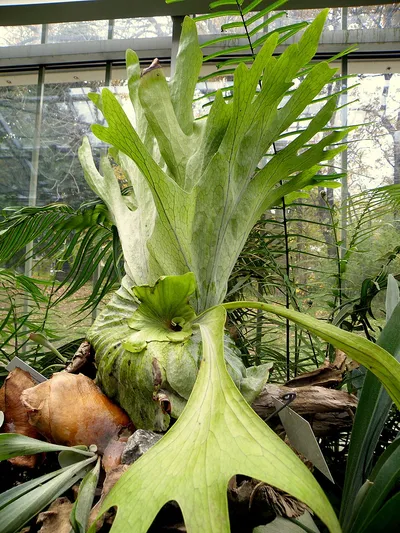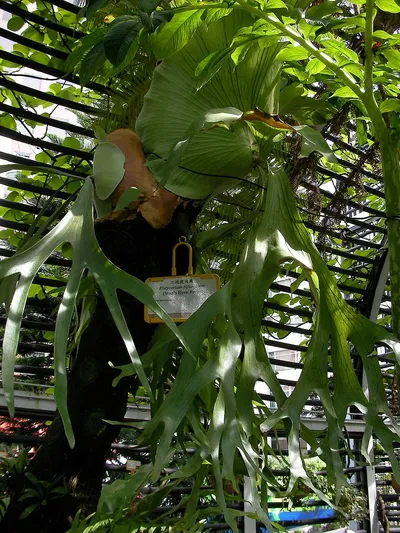
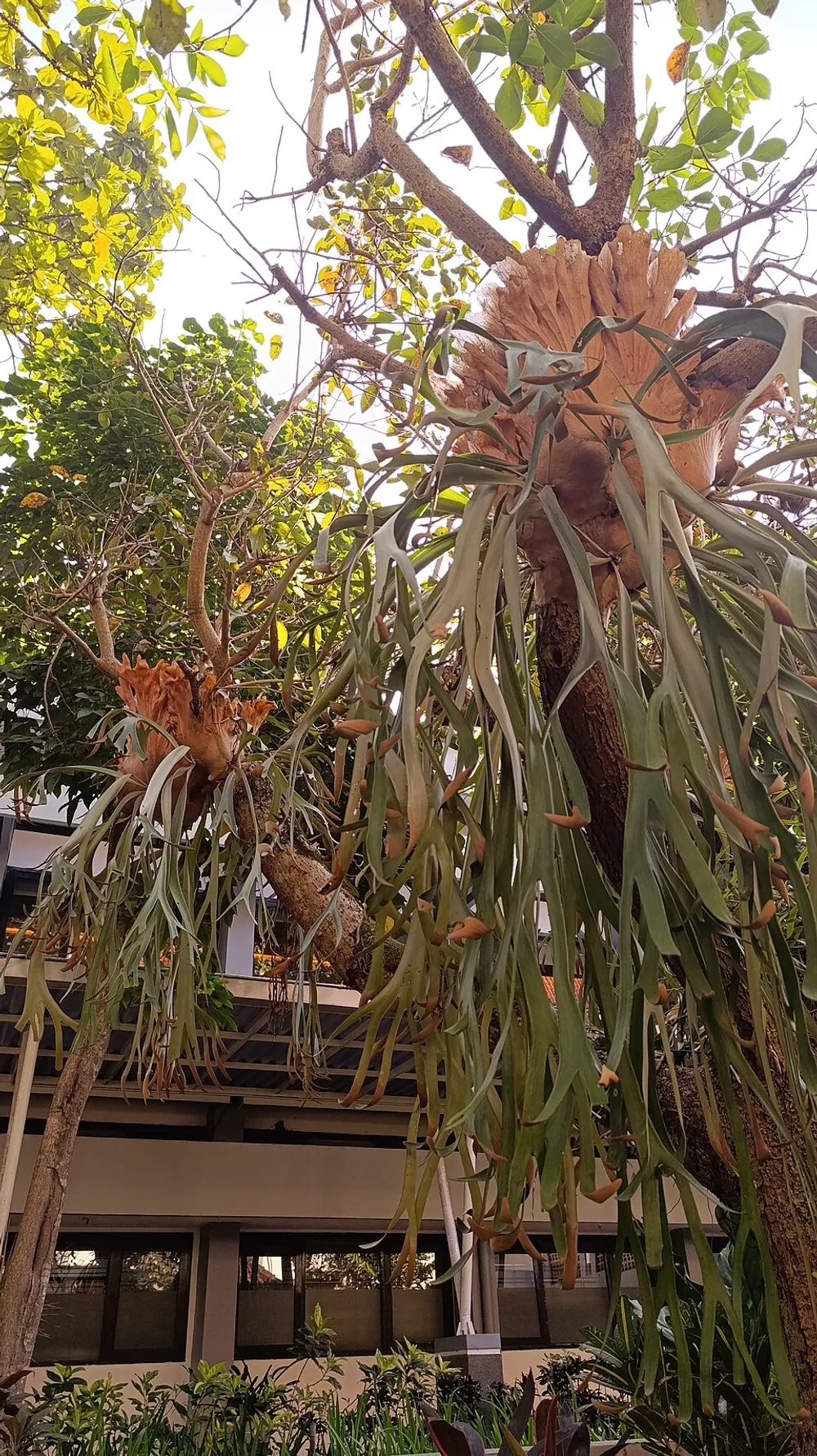
You can propagate a staghorn fern two ways: by dividing a pup (a mountable plant in 4–8 weeks) or by sowing spores (12–18 months). Leaf cuttings and rooting in water do not work — a cut frond has no growing point and will never form roots. Which method you use depends almost entirely on your species: the common “social” staghorns make pups, while the solitary giants can only be grown from spores.
This page is the decision guide. Once you know your route, the step-by-step detail lives in our pup separation guide and our spore propagation guide.
Staghorn Fern Propagation Methods Compared
| Method | Does it work? | Time to a mountable plant | Difficulty | Best time | Result |
|---|---|---|---|---|---|
| Pup division | Yes — the standard method | 4–8 weeks to root on a new mount | Easy | Late spring – early summer | Exact clone of the mother |
| Spores | Yes — the only option for solitary species | 12–18 months | Hard (sterile technique, patience) | Sow any time indoors | New seedlings, some variation |
| Tissue culture | Yes, in a lab | 6–12 months | Commercial only | — | Mass-produced clones |
| Leaf / frond cutting | No | Never roots | — | — | Frond dies |
| Rooting in water | No | Never roots; pups rot | — | — | Rot |
For almost every home grower the answer is division. Spores are a project for collectors, or the only path if you own one of the species that never makes pups.
Which Method Fits Your Staghorn?
Look at the base of your plant first. If there are small, separate rosettes of fronds pushing out from under the brown shield fronds, you have pups and you can divide. If your fern is a single large rosette with no offsets after several years, it is almost certainly a solitary species.
| Your species | Makes pups? | Propagation route |
|---|---|---|
| P. bifurcatum, P. veitchii, P. hillii, P. willinckii, P. stemaria | Frequently | Pup division |
| P. alcicorne, P. elephantotis | Occasionally | Division when a pup appears, otherwise spores |
| P. grande, P. superbum, P. ridleyi, P. wandae, P. coronarium | Rarely or never | Spores only |
Not sure which species you have? Our staghorn species comparison walks through the identification features. The solitary species are also the ones that command collector prices, precisely because they can’t be multiplied by simple division — see collectible staghorn ferns.
How to Propagate Staghorn Fern Pups
A pup is ready to separate when it passes three checks: it is at least 10 cm (4 in) across, it has its own brown shield frond, and you can see the short rhizome joining it to the mother. Miss any one of those and the pup is still living off its parent — leave it another two to three months.
The short version of the process:
- Water the mount the day before, so the moss and roots are pliable rather than brittle.
- Cut through the connecting rhizome with a blade sterilized in isopropyl alcohol, keeping as much of the pup’s root mass and shield as you can. Never cut into the mother’s main shield.
- Mount the pup straight away on a small board with a pad of damp sphagnum behind it, tied over the shield edge, not across green tissue.
- Keep it in bright, indirect light with high humidity and hold off on fertilizer for about six weeks, until you see a new frond.
The full walkthrough, including aftercare and what goes wrong after division, is in how to separate staghorn fern pups. For board, wire and moss choices, see how to mount a staghorn fern.
How to Propagate a Staghorn Fern From Spores
Spores form as a brown, velvety coating on the underside of the tips of mature antler fronds — it is not a disease, and the brown tips guide shows how to tell spore patches from real damage. Collect the dust onto white paper, sow it thinly on sterilized sphagnum or peat in a sealed clear container, and keep it warm under bright light.
What follows takes patience: a green film of gametophytes at 1–3 months, the first tiny true fronds at 4–8 months, and a plant large enough to mount at 12–18 months. P. bifurcatum and P. veitchii are the easiest species to start with; P. ridleyi is notoriously hard outside a lab. The complete protocol, including contamination control, is in our spore propagation guide.
Can You Propagate a Staghorn Fern From a Leaf or in Water?
No — and this is the most common propagation mistake with staghorns, usually because the plant looks like it should behave like a pothos or a begonia.
- A single frond won’t root. Staghorn fronds grow from a rhizome with a growing point at its tip. A cut antler frond, or a broken-off piece of shield, has neither, so it cannot make roots or new fronds no matter how long it sits in moss or soil.
- Water propagation fails twice over. A frond in a jar simply rots. A real pup placed in water fares no better: staghorns are epiphytes whose roots need air as much as moisture, and roots kept submerged suffocate and rot — the same process described in our root rot guide.
- “Cuttings” sold online are pups. If a listing offers a staghorn cutting and it has a small shield frond and roots, what you’re buying is a divided pup — which is fine, it’s just not a cutting.
If you want another plant and yours has no pups, the realistic options are waiting (healthy social species usually start offsetting within a year or two), sowing spores, or buying a pup.
When to Propagate: Spring for Pups, Any Time for Spores
Division works best from late spring to early summer, when the mother is actively growing and night temperatures stay above about 15 °C (59 °F); the pup then has a long warm season to root onto its new mount. From October through February, most cultivated staghorns in temperate climates slow to near-dormancy and cuts take weeks longer to heal, so it’s better to mark the pups you want now and divide them next spring. Growers in the tropics, or with a warm greenhouse, can divide year-round.
Spores don’t follow that calendar. Sown indoors under a grow light in a sealed container, they germinate whenever you start them, which makes autumn a good time to collect ripe spores from this year’s fertile fronds and begin a batch over winter. For general background on the genus and its growing conditions, the University of Florida’s IFAS staghorn fern guide is a reliable reference.