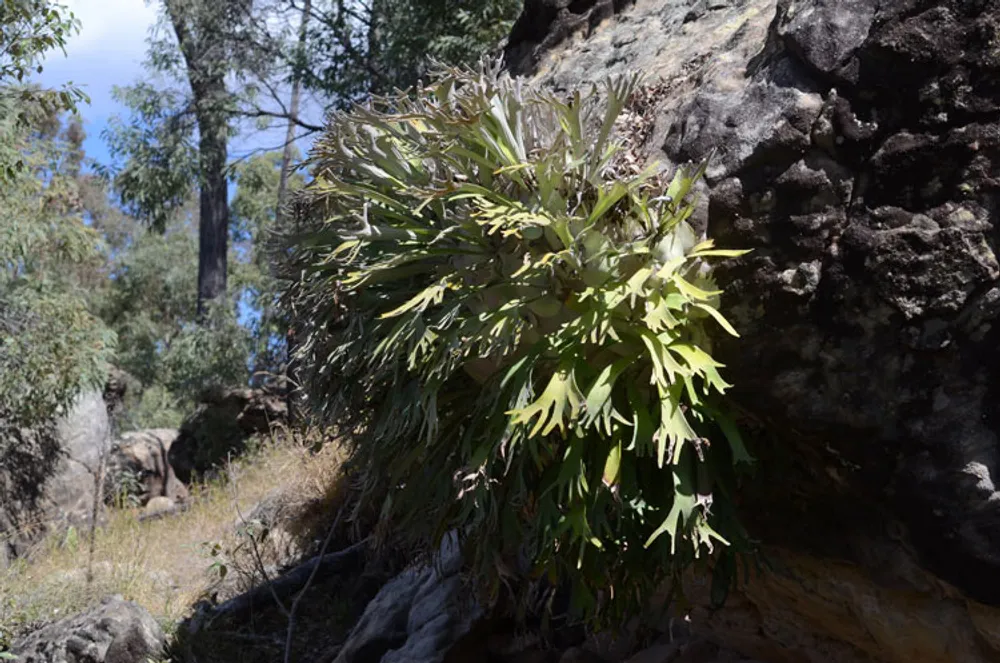
If the fronds stand straight up, end in narrow fingers, and are so furred with white hairs that you can’t see the veins underneath, it’s Platycerium veitchii. Most named “forms” of it are wild collections or trade descriptions rather than bred cultivars. ‘Auburn River’ is a place and ‘Silver Frond’ is an adjective. ‘Lemoinei’ may not be pure veitchii at all.
That matters because veitchii is sold under more names than almost any other staghorn fern, and one of those names (“silver”) also gets put on P. willinckii, a species that needs the opposite care. This page does the identification first, then sorts every veitchii name that people actually search for, then gives the care.
How to Identify Platycerium Veitchii (vs Bifurcatum, Hillii and Willinckii)
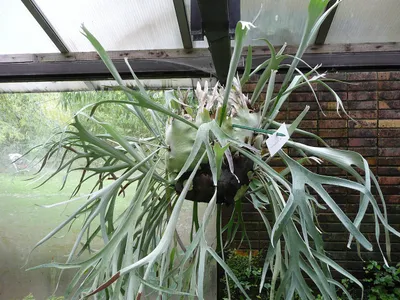
P. veitchii, the silver staghorn or silver elkhorn fern, sits in the same P. bifurcatum complex as three look-alikes. All four are multi-bud species that pup freely, so the number of crowns tells you nothing. Use these traits instead:
| Trait | P. veitchii | P. bifurcatum | P. hillii | P. willinckii |
|---|---|---|---|---|
| Fertile frond posture | Stiffly upright, points at the sky | Arching to drooping | Upright, short and stout | Long and pendant, hangs down |
| Frond tips | Narrow, finger-like | Broader, blunt forks | Broad, blunt, few forks | Many fine, narrow strap-like segments |
| Underside hairs | Dense white felt, veins hidden | Sparse, veins visible | Sparse, dark green, veins prominent | Dense and silvery, but on hanging fronds |
| Overall colour | Silver-grey to near white | Mid green | Dark glossy green | Silver-green |
| Old shield frond colour | Dries pinkish-grey | Dries coppery brown | Brown | Brown |
| Native range | Semi-arid Queensland rock outcrops | Coastal eastern Australia | Northeastern Australia | Java, Bali, East Timor |
| Sun tolerance | Highest in the genus | Moderate | Moderate to high | Low: bleaches and burns |
The two checks that settle almost every case:
- Posture. Upright plus silver means veitchii. Hanging plus silver means willinckii. That single distinction prevents the most expensive mix-up in the trade.
- The underside. Flip a fertile frond. If you can trace the veins, it isn’t veitchii. The Australian fern key on Lucid uses the same test: dense stellate hairs “obscuring venation” on veitchii and visible veins on bifurcatum.
A veitchii that has gone green and floppy is usually an under-lit veitchii, not a different species. The silver felt thickens in bright light and thins in shade. See why veitchii loses its silver below before assuming you were sold the wrong plant.
For the species’ place in the genus, see the P. veitchii species page and the side-by-side Platycerium species comparison.
Platycerium Veitchii Named Forms: Auburn River, Lemoinei, Lisa, Wild and More
Start with the fact that changes how you read every listing: the genus has almost no formally registered cultivars. Nearly every name below is a wild locality, a grower selection or a sales description. Two plants sold under the same name can differ, and the same plant can be sold under three names.
| Name | What it actually is | How to recognise it | Care difference |
|---|---|---|---|
| ’Auburn River’ | Wild collection from the Auburn River area, Queensland | Compact, very silver, dense forking | Slightly more shade-tolerant |
| Wild / Wild AUS | Wild-origin Australian stock, not one clone | Variable; high vigour | None |
| ’Lemoinei’ (French staghorn) | Old European selection, possibly a willinckii hybrid | Tall, narrow, upright, greener than typical | Acclimate to sun more slowly |
| ’Lisa’ | Grower selection | Wider, blunter frond tips | None |
| ’Braam’ | Grower selection | Broader shields, heavy silver | None |
| ’Sherry 12’ | Numbered grower selection | Narrow upright habit | None |
| ’High Finger’ | Sales description of a form | Extra-long, narrow upright “fingers” | None |
| ’Pumilum’ | Dwarf form | About half size at maturity | Slightly more sun-sensitive |
| ’Silver Frond’ / “silver” | Trade description only | Any veitchii with dense trichomes | None, if it is veitchii |
| ’Akki’ | Hybrid (veitchii silver × wild) | Extreme trichome density | None |
| Living Lace™ ‘Ribbon Dance’ | Proven Winners 2026 release | Cascading, ribbon-like habit | None |
Platycerium veitchii ‘Auburn River’
This is the most-searched veitchii name and the most misunderstood one. ‘Auburn River’ is not a bred cultivar. It is wild P. veitchii named after the Auburn River watershed in Queensland, the heart of the species’ range. A single wild-collected plant exported to the United States was given the locality name, and offsets from it later spread through Thai growers into the global collector trade. Growers report that Auburn River populations are genetically distinct from veitchii outside the watershed. That distinctness, plus compact, heavily silvered growth, is why it has become the most traded veitchii name of 2025–2026 and a parent on one side of many new hybrids.
Two practical points for buyers:
- Offsets vs sporelings. An offset (pup) of a documented Auburn River plant is a clone. An “Auburn River sporeling” is a seedling, and seedlings vary. Pay clone prices only for clones.
- Hybrids carry the name too. Crosses such as Auburn River × Mt. Lewis (a bifurcatum line) are sold with “Auburn River” in the label. They are not veitchii.
Silver, Silver Frond and “silver staghorn fern”
These three searches are the most common confusion around the species:
- “Silver staghorn fern” is the common name of the species itself. Every true veitchii is a silver staghorn.
- “Silver Frond” is a description, not a distinct plant. There is no genetic ‘Silver Frond’ line you can count on inheriting.
- The trap: some vendors attach “Silver Frond” to silvery P. willinckii forms instead. Willinckii wants shade and humidity, and full-sun veitchii care will slowly cook it. Check the posture test above before you pay.
Lemoinei, the French staghorn fern
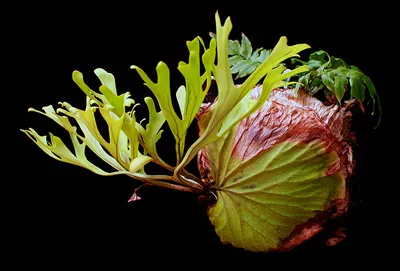
‘Lemoinei’ honours Victor Lemoine, whose nursery in Nancy, France introduced it in the 19th century, which makes it one of the oldest named staghorn selections. It is sold as P. veitchii ‘Lemoinei’, but it is noticeably greener and more vigorous than wild veitchii, and some growers suspect P. willinckii in its ancestry. That has not been genetically confirmed. In practice it grows like veitchii, but its thinner silver means it scorches more easily when moved into full sun. “French Silver” is used loosely for both ‘Lemoinei’ and any silvery veitchii, so ask which one the seller means.
The same naming problem runs through the whole genus. The Platycerium cultivar directory sorts 38 of the most-searched names into real selections, hybrids, trade descriptions and species, and the willinckii identification guide does the same for the silver look-alike.
Platycerium Veitchii Care: Sun, Water and Cold
The species comes from rocky outcrops in semi-arid Queensland, where rain averages about 700 mm a year (about a third of what P. ridleyi gets in Borneo), winter nights fall below 5°C and there is no canopy overhead. It grows on bare rock as readily as on bark. The white felt that makes it identifiable is the same adaptation that makes it easy: it reflects UV, gathers dew and slows water loss.
| Parameter | Requirement |
|---|---|
| Light | Bright filtered light up to 4–6 hours of direct sun (acclimated) |
| Watering | Deep soak when the mount feels light: roughly 7–14 days in summer, 3–4 weeks in winter |
| Humidity | 20–60%; tolerates very dry air |
| Temperature | 28°F (−2°C) brief minimum to 100°F (38°C) |
| USDA zones outdoors | 8b–12, with frost cloth in cold snaps |
| Mount | Cork bark, cedar or oak board, or natural rock |
| Difficulty | Easy, the most forgiving Platycerium after bifurcatum |
Light. Veitchii deepens its silver in bright light. Indoors, give it a south or west window or 12–14 hours under a grow light at 200–400 PPFD. Outdoors, morning sun with dappled afternoon shade is ideal, and a fully acclimated mature plant takes 6+ hours. Acclimate over two weeks: start with one hour of morning sun and add an hour every 2–3 days. An indoor-wintered plant will scorch in one unfiltered June afternoon. If it already has, see sunburn and heat stress.
Water. A standard tropical Platycerium schedule overwaters this species. Lift the mount and water only when it feels noticeably light. Then soak deeply, 15 minutes submerged, because the species evolved for infrequent heavy rain, not constant misting. The general watering schedule guide covers technique.
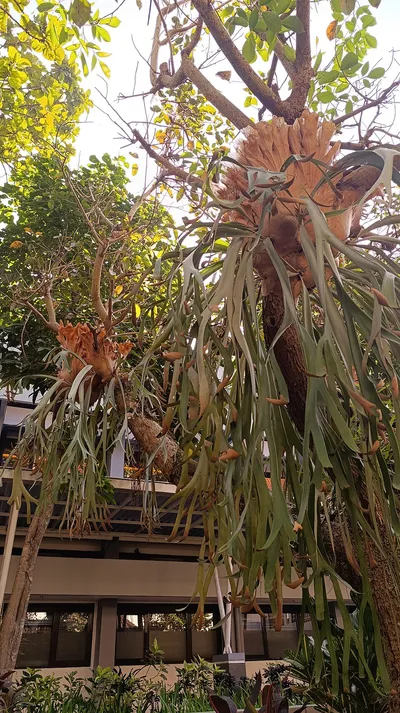
Cold, and what to do this fall. Veitchii is the one staghorn you do not need to rush indoors at the first cool night of autumn. Mature, dry-rooted plants survive brief dips to 28°F (−2°C), and UF/IFAS lists it with P. bifurcatum as safe for landscape use across most of north and central Florida.
[!IMPORTANT] Never water P. veitchii in the 48 hours before an expected frost. Wet roots at freezing temperatures cause irreversible crown rot, the most common way mature outdoor specimens die.
- Water heavily 5–7 days before a cold front, then withhold water.
- Bring portable mounts under cover if temperatures will hold below 30°F for more than a few hours.
- Drape tree-mounted plants with frost cloth (not plastic) and remove it the next morning.
- Stop fertilizing from October through February.
Zone-by-zone detail is in the temperature tolerance guide and the outdoor care guide. For mounting on rock, cork or board, follow the mounting guide with stainless or brass hardware.
Mature size. Veitchii’s many crowns eventually wrap right around the mount. A 10-year-old plant on a 16” cork plaque often becomes a globe of silver fronds with the board invisible. Leave pups on if you want that look. If you want to propagate, use the pup separation guide. Veitchii is also one of the easier species to raise from spores.
Why Is My Veitchii Losing Its Silver?
Three causes account for nearly every case, and the first two both show up as fading silver:
- Too little light. A veitchii in the north-window spot that suits P. ridleyi fades to green, stretches and stalls. This is the #1 reason a veitchii gets mistaken for bifurcatum.
- Overwatering. The trichomes mat down and the crown stays damp. If fronds are also yellowing, check the overwatering signs.
- Wet cold. Dry cold is survivable. Wet cold is fatal.
Get those right and P. veitchii is close to a set-and-forget plant. That toughness, along with the silver and a trade full of collectable locality names, is why it has become the usual entry point into serious Platycerium growing.
References: UF/IFAS Gardening Solutions — Staghorn Fern · Lucid Ferns of Australia — Platycerium veitchii