Mounting a staghorn fern takes about 30 minutes: set four screws in an untreated board, pile damp sphagnum in the middle, sit the fern on top with its shield frond against the wood, wrap fishing line over the moss, and soak the whole thing. The board you pick decides how long the mount survives — cork bark 10–15 years, cedar 8–10, driftwood 5–8, pine barely one.
Most tutorials stop at the wrapping and never tell you which surface to wrap onto, or that beach driftwood will poison your fern unless you desalt it first. This guide covers both: the process itself, and the substrate decision that determines whether you rebuild this mount in two years or in ten.
Why Mount a Staghorn Fern Instead of Potting It?
Platycerium are epiphytes — in the wild, they grow on tree trunks and rock faces, not in soil. A pot lets the root ball stay too wet, suffocates the roots, and forces the shield frond to grow against a rim it was never designed for. Mounting solves all three problems at once and lets the plant develop the cascading, sculptural form it’s known for.
Mounted staghorns also tend to live dramatically longer than their potted counterparts. Specimens at the New York Botanical Garden include mounted plants decades old that have grown into multi-bud colonies the size of a coffee table. That kind of longevity simply isn’t available to a plant in a 6-inch pot. It’s part of why mounted ferns have moved from collector shelves into mainstream decor — the Garden Media Group’s 2026 trends report frames houseplants as the new collectibles, and the RHS has ferns near the top of its 2026 predictions.
If you’re new to the species, read our staghorn fern indoor care guide before tackling a mount — getting watering and light right matters more than any board-and-moss decision. If you’re still deciding whether to mount at all, our mounted vs potted comparison lays out the trade-offs.
Which Wood Is Best for Mounting a Staghorn Fern?
This is the decision that outlives every other one you make. The board is under constant wet-dry cycling for years, and the wrong species of wood rots out from under an established plant — which forces exactly the traumatic remount you were trying to avoid.
| Surface | Lifespan under weekly soaking | Look | Best for |
|---|---|---|---|
| Cork bark slab | 10–15 years | Organic, jungle-like texture | Tropical species, humid rooms |
| Cedar plaque | 8–10 years | Clean, light grain | Indoor walls, formal display |
| Oak / cypress / black locust | 8–10 years | Dense, traditional | Heavy mature specimens |
| Reclaimed barn wood | 5–10 years | Weathered patina | Rustic style, large plants |
| Driftwood | 5–8 years | Sculptural, one-of-a-kind | Statement pieces |
| Cutting board (oak/maple) | 4–6 years | Compact, cheap | Small ferns, gift projects |
| Live tree trunk (outdoors) | Indefinite | Most natural | Zone 9+ gardens |
| Pine / plywood | 1–2 seasons | — | Avoid entirely |
Cork bark wins on longevity because it isn’t really wood — it’s the outer bark of the cork oak, and its suberin content makes it structurally resistant to rot and mould. It also holds a little moisture against the roots, which suits tropical species like P. ridleyi and P. coronarium. The catch is fastening: cork is soft and layered, so screws strip out or split the slab after a few wet cycles. Drill straight through it and pass wire or fishing line through the holes instead, tying off on the back. For a heavy plant, screw the cork onto a cedar or plywood backing board and anchor into that.
Avoid pressure-treated lumber under any circumstances. The copper-based preservatives that make it rot-proof are the same compounds that damage fine epiphytic roots. Untreated is the whole point — you want a board that eventually rots, just slowly.
How to Mount a Staghorn Fern on Driftwood
Driftwood is the most requested mounting surface and the one with the biggest hidden trap. Sea-collected driftwood is saturated with salt. As the mount dries between waterings, that salt migrates into the sphagnum and root zone, where it draws moisture back out of the roots by osmosis. The fern doesn’t collapse; it just slowly browns at the tips and stops producing new fronds, and most owners blame their watering.
Desalt before you mount, not after:
- Submerge the driftwood in fresh water for 1–2 weeks, changing the water every 2–3 days. A bathtub, storage tote, or bucket all work. Weigh the wood down — it floats.
- Scrub off algae, barnacles and loose bark with a stiff brush between water changes.
- Dry it fully in the sun for several days. Sun-bleached driftwood picked up well above the tide line has already lost much of its salt and needs a shorter soak.
River, lake, and inland driftwood skips all of this — it needs only a scrub and a few days of drying to make sure nothing is living in it.
Once it’s cured, driftwood mounts exactly like a board, with one adjustment: its irregular shape rarely gives you a flat square for four screws. Find the widest stable face, set as many screws as the shape allows, and use extra wraps of line to compensate. Because driftwood is already partly weathered when you get it, expect 5–8 years rather than a cedar plaque’s 8–10.
The Five Steps: Board, Moss, Plant, Wrap, Hang
You’ll need: an untreated board 16”–24” across, long-fiber sphagnum moss soaked overnight, 4–6 stainless-steel or brass screws, 40 lb monofilament fishing line or coated copper wire, and two stainless D-rings or a heavy sawtooth hanger. Go bigger on the board than feels necessary — a young fern with a 6-inch shield will outgrow a 10” board within two years.
1. Prep the board. Sand lightly and air-dry 24 hours. Sealing the back face with beeswax or food-safe mineral oil slows moisture absorption from the wall side and can add years to the board’s life. Never seal the front — the moss needs to exchange moisture with the wood. Drill four screws in a 4”–6” square in the center, leaving each head proud by a quarter inch. These are your tie-down points. Attach the hanging hardware now, while the board is still bare.
2. Build the moss bed. Soak sphagnum in lukewarm water for an hour, then squeeze it out damp but not dripping. Pile a softball-sized mound inside the screw square — more for a larger plant. Mix in a handful of orchid bark or coco coir for air pockets; pure compacted moss suffocates roots over time. The root ball will sit on this mound, not inside it.
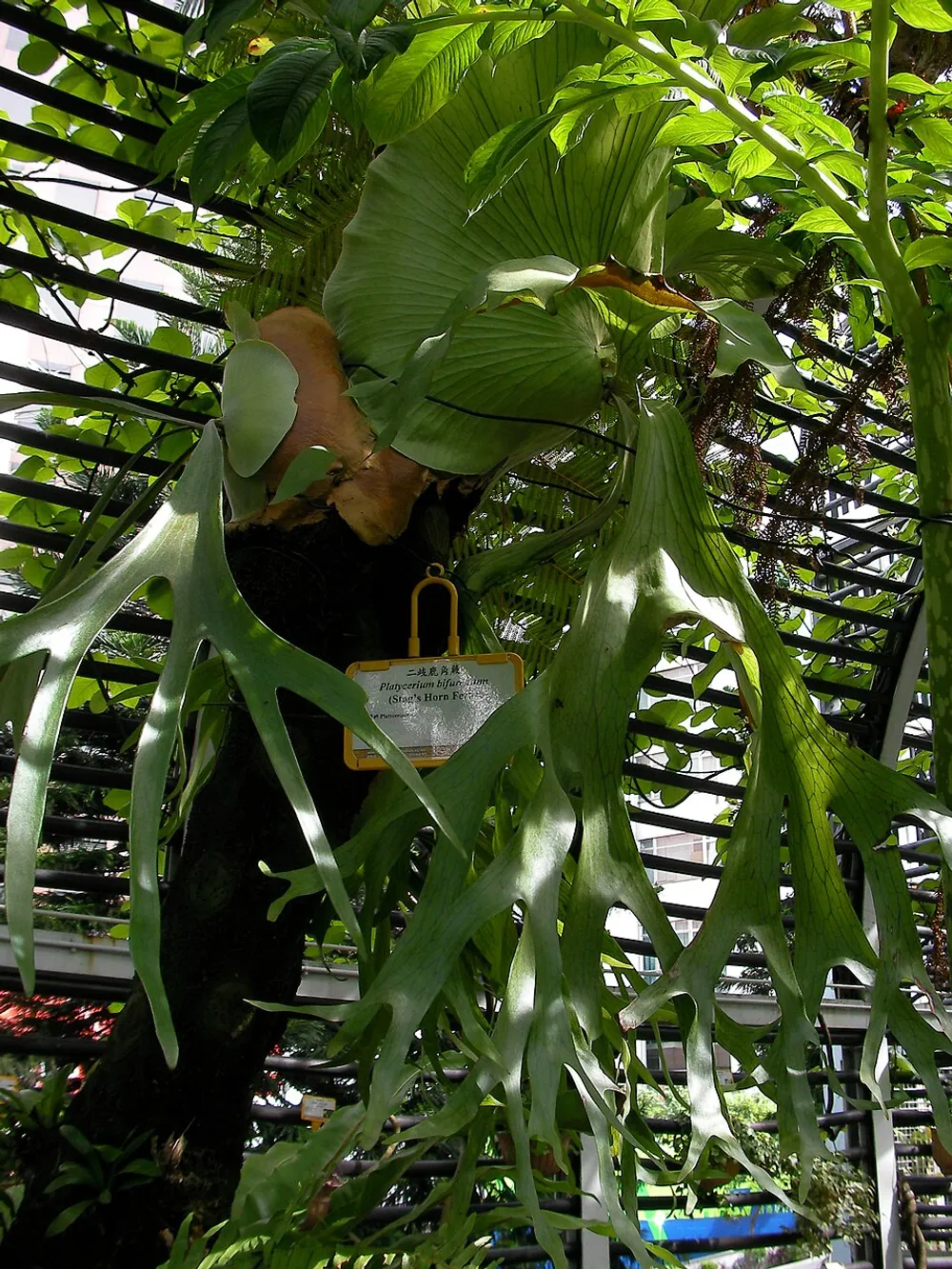
3. Position the plant. Slide the fern out of its pot and tease away as much soil as comes off easily without tearing roots. Set it on the moss with the shield frond facing the board — the shield is the round, papery frond that hugs the mount, while the antler-like fertile fronds drape forward and down. Rotate the plant so those fertile fronds cascade the direction you want.
4. Wrap and secure. Tie the line to one screw and criss-cross it over the root ball and moss, anchoring on alternate screws. Pull firm but not crushing — the moss should compress slightly, not turn into a brick. Six to eight passes holds a young plant; large specimens need a dozen or more. For heavy ferns, use coated copper wire on the inner wraps and fishing line on the outer wraps so the hardware disappears as fronds grow over it. The Pike Nurseries DIY mount tutorial demonstrates this hybrid technique.
5. Hang and soak. Fix the board to a wall stud or sturdy beam — a saturated mount weighs 5–10 lbs and gets heavier every year. Soak the finished mount in a tub for 20 minutes to fully hydrate the new moss bed.
[!IMPORTANT] Never wrap line over the green part of the shield frond — only over its brown, papery edge or the moss itself. Line cutting into living shield tissue leaves a permanent scar and an open door for rot.
How to Attach a Staghorn Fern to a Tree
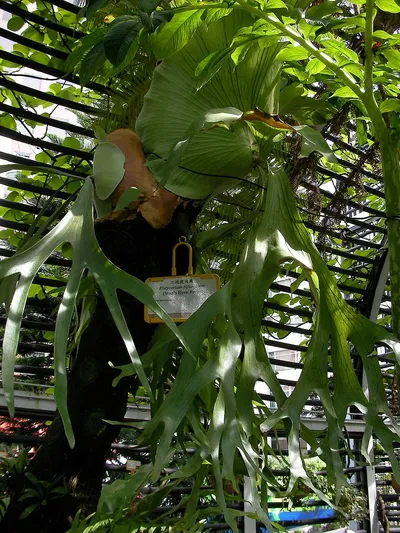
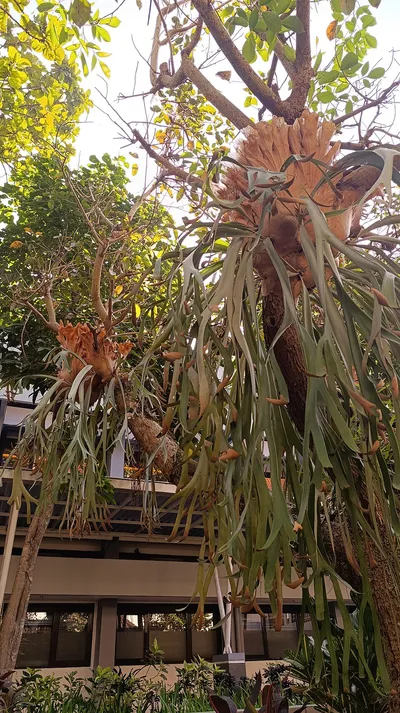
In frost-free gardens (roughly USDA zone 10 and up for most species, 9b for P. bifurcatum and P. veitchii), a living trunk is the best mount there is: it never rots out, and the plant will grip the bark on its own within one to two growing seasons. Tie it on, don’t nail it on. The method is the board method without the board:
- Pick the spot. Choose the shaded side of the trunk at eye height or above, with dappled light, out of afternoon sun and out of sprinkler spray that would keep the crown wet.
- Pad the bark. Press a flat layer of damp sphagnum against the trunk where the shield frond will sit.
- Set the plant with the shield frond flat against the moss and bark, the growing point facing out.
- Tie it loosely around the trunk with old pantyhose, soft plant tie or fishing line. Snug enough that the plant can’t rock, loose enough to slide a finger under.
- Remove the ties after about a year, once roots have gripped the bark. Anything left circling a growing trunk will eventually girdle it.
| Host tree | Verdict | Why |
|---|---|---|
| Live oak, other rough-barked oaks | Best | Stable, furrowed bark roots grip fast; dappled shade |
| Sabal / cabbage palm and other palms with rough “boots” | Very good | Old leaf bases hold moisture and moss; never screw or nail into a palm — palms can’t seal wounds |
| Mature citrus, banyan, ficus, mango | Good | Rough bark, filtered light |
| Eucalyptus, paperbark, sycamore, crepe myrtle | Avoid | They shed their bark, and the fern goes with it |
| Smooth-barked or toxic-sap trees | Avoid | Roots can’t grip; sap can burn fronds |
Does a staghorn fern hurt the tree? No. It is an epiphyte, not a parasite: it takes nothing from the tree’s sap or bark, only support. The real risks are mechanical. A mature specimen can weigh well over 100 lbs when wet, enough to break a weak branch, and forgotten wire can girdle a trunk. Mount big species on the main trunk, not on limbs.
Removing a staghorn fern from a tree means cutting it off. Its roots and old shield fronds cement to the bark. In spring, slide a long serrated knife or flat pry bar behind the shield frond and work around it, keeping as much root mass and old shield as you can. The shield underneath will tear; that is expected. Remount the plant on a board straight away, and keep it shaded and lightly watered for a month.
Our outdoor care guide covers which species survive your winters outside, and the temperature tolerance chart gives the cold limit for each one.
Watering and First-Month Care After Mounting
For the first three to four weeks the plant is rebuilding its root grip. Keep it in slightly lower light than its permanent spot, water on the light side, and don’t fertilize. When you see new fertile frond tips emerging or the shield frond starting to spread onto the board, it has settled in.
After that, a mounted fern is soaked rather than poured on — the whole mount goes into a sink or tub, then drains before rehanging.
| Season | Frequency | Method |
|---|---|---|
| Spring (active growth) | Once a week | 15-min soak, drain 30 min |
| Summer (heat) | 1–2× per week | 15–20 min soak |
| Fall | Every 10 days | 15-min soak |
| Winter (dormant) | Every 12–14 days | 10-min soak; let dry fully between |
Tropical species need the upper end of these ranges; cold-hardy species like P. veitchii and P. bifurcatum tolerate the lower end. For soaking technique on an established mount see our mounted staghorn fern care guide, and for how frequency shifts by species and season see the watering schedule guide.
When Should You Remount a Staghorn Fern?
Mounting is mildly traumatic — the plant has to rebuild its root grip, and the shield frond underneath almost always tears in the process. Remount only when one of three things is true:
- The shield frond has fully overgrown the board and is curling back on itself with nowhere to expand
- The moss has compacted into a hard mat that no longer absorbs water during a soak
- The wood is visibly rotting — soft to the touch, sloughing off in layers, or growing fungal fruiting bodies
For everything else, leave it alone. Many of the most impressive specimens on collector forums are 10–20 years on their original mount; the plant’s own root mass and accumulated old shield fronds become a substrate better than fresh moss.
When you do remount, the safer move is mounting the existing board onto a larger backing board rather than tearing the plant off. This “mount-on-mount” technique preserves the established root system and gives the shield frond fresh territory.
Mounting Mistakes That Cost You the Plant
- Pine boards — fine for a season, then they fall apart under an established plant. Spend the extra few dollars on cedar, oak, or cork.
- Un-desalted beach driftwood — the slowest, most misdiagnosed way to kill a mounted fern.
- Galvanized wire or steel screws — both rust within a year and stain the moss orange. Stainless or brass only.
- Burying the root ball — roots need air. The plant sits on the moss, not in it.
- Mounting in winter — wait for active growth so the plant re-anchors quickly. April through July is the ideal window; late summer still works if you keep humidity up.
- Tiny boards — a 6” board for a 4” plant leaves nowhere to grow. Always size up.
Build it well the first time and the mount outlasts the trend that got you into it. Pick a board that resists rot, cure it properly if it came off a beach, and give the shield frond more room than it currently needs — then leave the plant alone to do the rest.