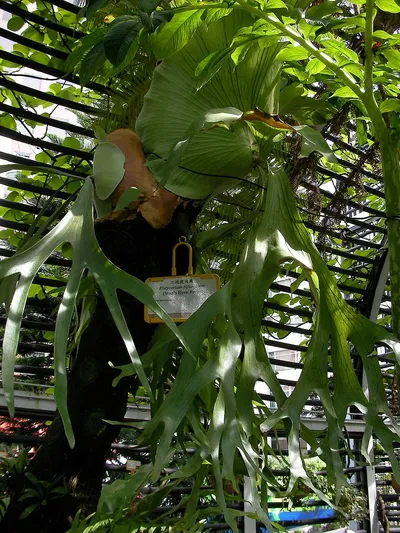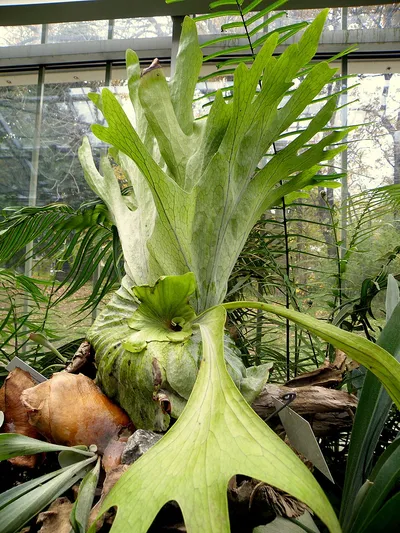
Most staghorn fern leaves turn yellow because the mount is staying wet too long — and you can rule that in or out in ten seconds. Press the base where the round shield meets the board. Cool, spongy or damp means overwatering. Firm and dry means the cause is light, heat or feeding instead.
There are only four causes worth investigating, and they look different from each other. This guide gives you the test that separates them, then the exact fix for each. One reassurance before you start: the flat round shield leaves at the back are supposed to yellow and then brown as they age. That is healthy maturation. The yellowing that matters is on the forked antler leaves — what botanists call fertile fronds, and what everyone else calls the staghorn part.
Why Are My Staghorn Fern Leaves Turning Yellow?
Where the yellow appears, and what it feels like, tells you the cause. Match your fern to a row, then read that cause below.
| What you see | Where the yellow is | Most likely cause | First action |
|---|---|---|---|
| Yellow spreading upward, base soggy or sour-smelling | Lower antler leaves | Overwatering / early root rot | Stop watering, dry out, check roots |
| Bleached, papery yellow patches | One side only — the side facing the light | Sun scorch | Move out of direct sun |
| Whole plant pale, limp, soft during a heatwave | Everywhere at once | Heat stress | Shade, ventilate, water at dawn |
| Uniform pale yellow-green, no new leaves for months | Everywhere, evenly | Nitrogen shortage | Resume diluted feeding |
| Yellow then papery brown, antlers still green | Only the flat round shield | Natural shield aging | Do nothing — this is healthy |
The 10-Second Test That Separates Overwatering From Everything Else
Overwatering is the cause people miss, because a yellow plant looks thirsty. Before you do anything else, run this:
- Press the base where the shield leaf meets the mount, firmly with your thumb. Healthy is firm and springy. Cool, spongy, or squelching means water is sitting there.
- Lift the mount. A recently watered staghorn is noticeably heavier than a dry one. If it still feels heavy several days after watering, it is not drying out between soaks.
- Smell the base. Sour or swampy is rot. Earthy or neutral is fine.
Firm, light, and neutral-smelling rules out overwatering entirely — go to sun scorch, heat, or feeding. Spongy, heavy, or sour and you have your answer, and you should stop watering today rather than at the next scheduled soak.
The Four Causes and How to Fix Each One
Overwatering — the most common cause year-round. Because Platycerium are epiphytes with small root systems, they rot far more readily than a potted plant. Warm, humid nights slow evaporation, so a mount that dried in two days in spring may stay damp for a week in late summer. Antler leaves yellow from the base upward, often going translucent or soft before they brown. The fix: let the mount dry almost completely before the next soak — use the lift test rather than a calendar. Most mounted ferns need water every 5–10 days indoors in warm weather, and far less once temperatures drop. Our watering guide covers the weight method in detail, and signs of overwatering shows what the early stages look like. Improve airflow while you are at it; stagnant humid air is what tips damp into root rot.
[!IMPORTANT] If antler leaves are yellow and soft, with a sour smell at the base, stop watering immediately and inspect the roots. Soft, blackening tissue is rot, not thirst — adding water makes it worse.
Sun scorch — yellow on one side only. An unshaded south or west window can bleach leaves in a single afternoon, and this is the classic failure after moving a fern outdoors. Scorch appears as pale-yellow to whitish patches specifically on the light-facing side, sometimes with crispy brown centres where tissue actually burned. The base stays firm and dry, which is what distinguishes it from overwatering. Platycerium want bright, indirect light; the Missouri Botanical Garden notes they grow best in part shade and burn in full sun (Missouri Botanical Garden). The fix: move the fern back from the glass or into dappled shade, and acclimate over 1–2 weeks rather than relocating in one step. The same shading rules in our outdoor care guide apply.
Heat stress — the whole plant pales at once. Above the mid-30s °C (95 °F), even a correctly watered, shaded fern can yellow and go limp, because it transpires faster than its small root system can replenish. The giveaway is that the paling is uniform and sudden, unlike the localized patches of scorch or the bottom-up progression of overwatering. Tough species such as P. bifurcatum and P. veitchii cope well given airflow and shade; it is heat plus direct sun plus dry wind that does damage. The fix: increase shade and air circulation, and water in the early morning so the plant is hydrated before the peak. Never mist a sun-exposed fern at midday.
Nitrogen shortage — uniform pale yellow-green, no new growth. Mounted ferns have no soil reservoir, so after several months they simply run out. If the colour is evenly washed-out across the whole plant and you cannot recall the last feed, this is it. The fix: resume a balanced liquid fertilizer at half or quarter strength, monthly through the growing season. Our free dilution calculator converts an NPK rating into grams per litre. Do not overcorrect — fertilizer salts build up fast on a mount and scorch roots. New leaves emerge green; the already-yellow ones stay yellow.
Staghorn Fern Leaves Turning Yellow and Brown Together
Yellow that has spread into brown usually means the cause has been running for weeks. The pattern still tells you which one:
| Pattern | What it means |
|---|---|
| Yellow then brown, base upward, mount soft | Overwatering progressing to root rot — act now |
| Yellow patches with dry crispy brown centres, one side | Sun scorch that burned through |
| Brown only at the leaf tips, rest of the leaf green | Low humidity or salt build-up — see brown tips |
| Flat round shield yellowing then papery brown | Normal aging — see shield leaf browning |
| Small yellow spots with dark centres, spreading | Fungal, not cultural — see black spots |
Discrete yellow spots are worth separating from general yellowing. Scattered pale spots that stay small and dry are usually early scorch or old pest damage; spots with dark or water-soaked centres that enlarge are fungal and need airflow plus removal of affected tissue, not a watering change.
Should I Cut Off Yellow Staghorn Fern Leaves?
Only the antler leaves, and only when they are fully yellow or brown through. A partly yellow leaf is still photosynthesising along its green portion, so leave it until it is clearly finished. Cut at the base with a sterile blade.
Never cut the shield leaves — the flat round ones hugging the mount. They are meant to yellow, brown, and dry into a papery layer that shields the rhizome and traps debris and moisture. Removing them exposes the growing point, and it is one of the most common ways a healthy plant gets set back. Only worry about a shield that has gone soft and black rather than firm and brown.
Why Ferns Yellow After You Bring Them Indoors in Autumn
If your fern summered outdoors, expect a yellow leaf or two within a few weeks of moving it in. Indoor light is a fraction of shaded outdoor light, and the plant sheds the leaves it can no longer support. This is normal adjustment, not a fault — but two things make it much worse and both are avoidable.
First, keep watering on the lift test, not the summer schedule. Indoor autumn conditions dry a mount far more slowly, and carrying a summer watering frequency indoors is the single most common route to the overwatering yellowing above. Second, inspect for pests before the plant comes in. Heat-stressed ferns are prime targets for spider mites, and a mite population that was held in check outdoors explodes in dry indoor air; our pest guide covers what to look for.
Move the plant to your brightest indoor spot and let it settle for a month before judging it. This is the more useful reading of the 2026 houseplant trend that industry forecasters have been calling intentional buying and “keeping what lasts” (Homes & Gardens) — a staghorn that yellows in September is almost always a plant worth diagnosing, not replacing. Read the colour, run the ten-second test, correct the one variable that is off, and you will get a flush of vivid green antlers. For ongoing care of wall-mounted specimens, see our mounted staghorn fern care guide. If the colour change is not clearly yellow — or the plant has several symptoms at once — work through the staghorn fern problem chart instead.