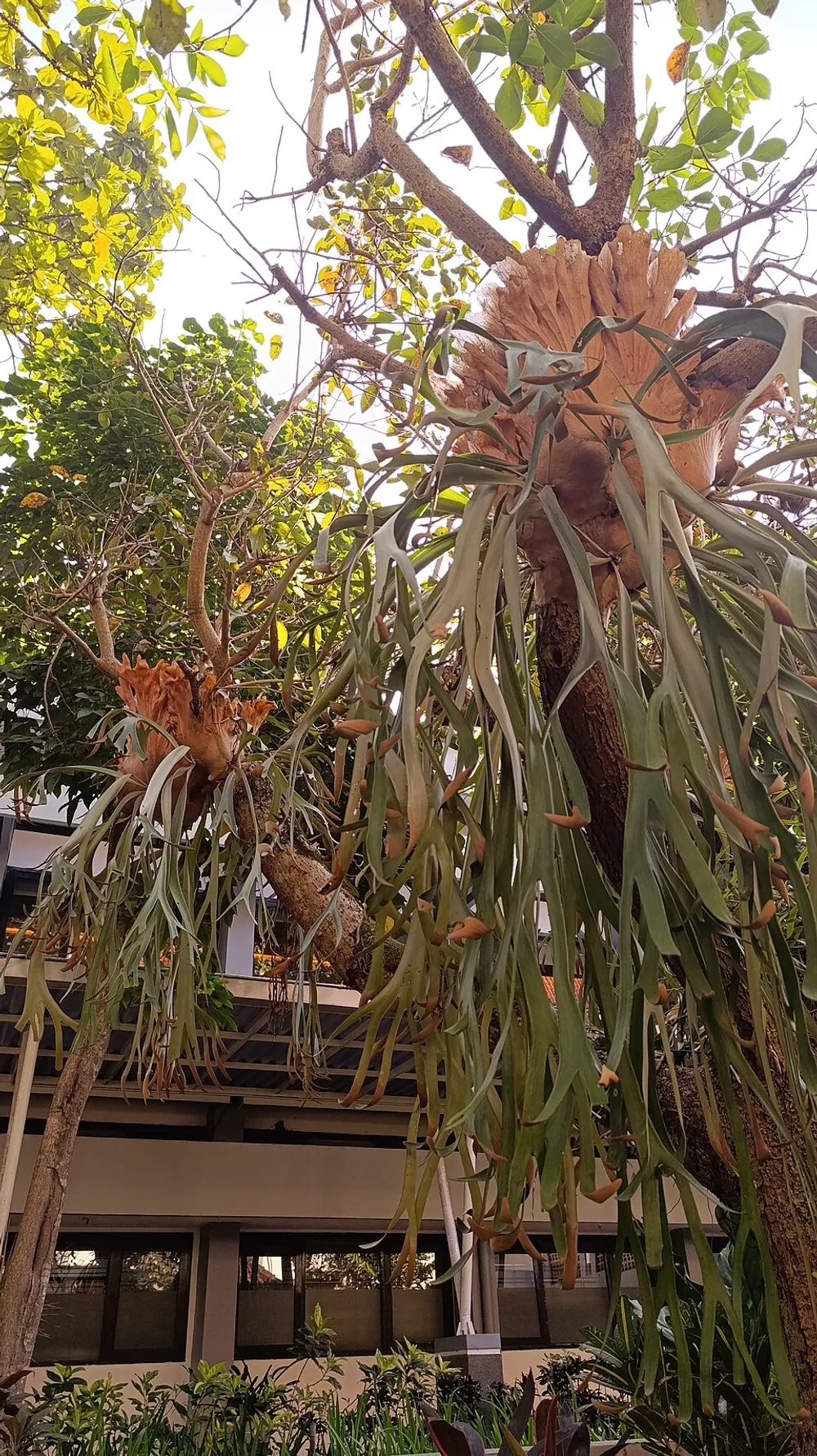
Most Platycerium cultivar names are not registered cultivars at all. The genus has almost no formally published names — nearly every label you will see is a grower selection, a hybrid, a trade description, or the common name of an entire species being sold as if it were a rare variety. This page sorts 38 of the most-searched names — the cultivars and “varieties” you see on listings — into those four categories, so you know what you are actually looking at before you pay a collector premium.
Care is not the issue here. Within a species, named selections share identical care requirements — the differences are frond width, trichome density, forking pattern and growth pace. The risk is paying a rare-cultivar price for a common plant, or buying a “silver” plant that needs the opposite of the care you are about to give it.
The Four Kinds of Name on a Listing
Before the tables, this is the framework that makes every listing readable:
| Kind of name | What it means | Example | Risk |
|---|---|---|---|
| Grower selection | A real, propagated clone with consistent traits | ’Jade Girl’, ‘Pakarang’ | Low — but unregistered, so seller-dependent |
| Hybrid | A cross with one parent from the species named | ’White Hawk’, ‘Akki’ | Priced as a rare species selection when it isn’t |
| Trade description | An adjective sellers attach to any qualifying plant | ’Silver Frond’ | No genetics behind it; two plants differ |
| Species common name | The everyday name of a whole species | ’Butterfly’, ‘Moose’ | Paying a cultivar premium for the plain species |
[!IMPORTANT] Because the genus has almost no registered names, two plants sold under the same name can differ, and the same plant can be sold under three names. The International Code of Nomenclature for Cultivated Plants exists precisely to prevent this — it has simply never been applied to Platycerium at scale.
Platycerium willinckii Selections
P. willinckii has more cultivar depth than the rest of the genus combined. Indonesian and Thai growers have spent thirty-plus years selecting standout forms.
| Name | Distinguishing feature | Tier |
|---|---|---|
| Standard (Bali type) | Long fine forking, moderate silver — the wild baseline | Entry |
| Bogor type | Broader fronds, more upright posture | Entry |
| Jade Girl | Compact, heavy silver trichomes, tight neat forking | High |
| Smurf | Blue-green tint, exceptionally narrow frond tips | High |
| Spur | Dramatic spurred growth points, fronds split unusually early | Very high |
| OMG | Extreme trichome density on broad fronds (DW hybrid line) | Very high |
| Bacteria | Very fine, almost grass-like fertile fronds | High |
| Masayu | Wide fronds, strong trichome coat, pronounced shields | Moderate |
| Nano | Dwarf form, roughly half standard size | Moderate |
| Silky White | Smooth even trichome coat — reads pure white, not silver-grey | Very high |
| Snow White | Broad fronds, bright white cast, heavier and less pendulous | High |
| Celso Tatsuta | Wide-frond Japanese selection with heavy silver | High |
All of these are identified side by side — with the hybrids separated out — in the Platycerium willinckii cultivar identification guide. If you are buying your first, start with the Bali type or ‘Jade Girl’ — both are forgiving and visually rewarding.
Names Sold as Willinckii That Are Not Willinckii
This is where most money gets wasted. These are hybrids or misapplied descriptions, sold side by side with true selections.
| Name | What it actually is |
|---|---|
| White Hawk | DW-line hybrid (P. diversifolium × P. willinckii); slightly more heat-tolerant |
| OMO / Pegasus | DW-line hybrids, siblings of ‘White Hawk’ |
| Snow Moon | Hybrid, Lewis × willinckii dwarf direction; compact, higher humidity need |
| Mew | Hybrid selection, not a willinckii cultivar |
| Silver Frond | Trade description — usually a willinckii selection, sometimes P. veitchii |
The practical rule: if a name is not in the table above this one, ask the seller for the parentage before paying a cultivar premium. A hybrid is not worse — several are more vigorous — but it should not be priced as a rare willinckii, and its care can drift from the montane profile willinckii wants.
Platycerium veitchii Selections
P. veitchii is the sun- and frost-tolerant silver species, and its naming is the messiest in the genus.
| Name | Origin | Distinguishing feature |
|---|---|---|
| ’Auburn River’ | Wild collection, Auburn River area, Queensland | Compact, extra-silver, dense forking; slightly more shade-tolerant |
| ’Lemoinei’ | French selection | Upright narrow fronds; sold as the “French staghorn fern“ |
| ‘Lisa’ | Grower selection | Wider, blunter frond tips |
| ’Pumilum’ | Dwarf form | Roughly half size at maturity; slightly more sun-sensitive |
| ’Braam’ | Grower selection | Broader shields, heavy silver |
| ’Sherry 12’ | Numbered grower line | Narrow upright habit |
| ’Akki’ | Hybrid (Veitchii Silver × Wild) | Extreme trichome density |
| Wild AUS | Wild-origin Australian stock (not one clone) | Variable, high-vigor parent stock |
| Living Lace™ ‘Ribbon Dance’ | Proven Winners 2026 release | Cascading ribbon-like habit |
‘Ribbon Dance’ is worth singling out as the exception that proves this page’s point: it is the first Platycerium to reach mass-market retail under a trademarked, standardised brand. Everything else in this guide is traded on a grower’s word. The other veitchii names (Auburn River, Lemoinei, Lisa, Wild) are sorted in the P. veitchii identification guide.
Platycerium ridleyi and alcicorne Selections
| Name | Species | Distinguishing feature |
|---|---|---|
| Standard | ridleyi | Classic cabbage shields, moderate spore spoons |
| Dwarf Silver | ridleyi | Compact shields (~25 cm), heavy silver; the practical indoor choice |
| Dwarf & Compact | ridleyi | Smallest forms, tight shields, slow growing |
| Pakarang (Coral) | ridleyi | Fertile fronds fork into fine coral-like projections — the “holy grail” |
| Monkey King | ridleyi | Broad, heavily textured shields, vigorous |
| Wide Form | ridleyi | Broader, flatter fertile fronds |
| Coral | ridleyi | Highly branched fertile fronds, similar to Pakarang |
| Slender Form | ridleyi | Narrow, elongated fertile fronds |
| var. dwarf | alcicorne | Compact; sold under both African and Madagascar lineages |
| Madagascar dwarf | alcicorne | Fuzzy and small; most humidity-sensitive of the group |
| cv. ‘Gorgon’ | alcicorne | Heavily divided, twisting fertile fronds |
| var. ‘Orchid Jungle’ | alcicorne | Long-circulating nursery selection from a Florida garden |
Two buying notes. For ridleyi, “Dwarf Silver”, “Silver Dwarf” and “Dwarf Silvery” are the same Southern Thai selection — don’t pay twice for what look like different plants. For alcicorne, care tracks the underlying form rather than the cultivar name: waxy and glossy means African, fuzzy and matte means Madagascar. See the P. ridleyi and P. alcicorne guides.
Names That Are Whole Species, Not Cultivars
These four turn up constantly in cultivar searches, and the common-name decoder covers the full set. Each is the common name of a species you can buy plainly, usually for far less than a “cultivar” price.
| Name searched | Actually the species |
|---|---|
| Butterfly | P. wallichii |
| Moose / moose horn | P. superbum |
| Silver staghorn | P. veitchii — every true veitchii is a silver staghorn |
| Elephant ear | P. elephantotis |
Where to Find Staghorn Fern Varieties With Pictures
Photographs are the only reliable way to tell these apart, and they are harder to find than the names. Two places worth knowing:
- For species-level varieties, the species directory has photographs of all 18 recognised Platycerium species. If your search was really about telling a bifurcatum from a veitchii, start there rather than with cultivar names
- For cultivar-level varieties, ask the seller for photographs of the mother plant. No public reference collection documents these selections, which is a direct consequence of the naming problem described above — there is no registration body holding a type specimen to photograph
When You Cannot Verify a Name
Plenty of names circulate that no reliable source documents — ‘Tiara’, ‘Konayuki’, ‘Rydeen’, ‘Pearl Queen’, ‘Golden Boy’, ‘Watchara’ and others appear in listings and collector chatter without published parentage. That does not make them fake; it makes them unverifiable at the point of sale, which is a different problem with the same remedy:
- Buy the plant, not the name. Ask for photographs of the mother plant, not stock images
- Ask for parentage in writing. A grower who selected the form can answer instantly
- Judge numbered lines by the specimen. ‘Sherry 12’ and similar are worth buying for a plant you have seen photographed, never on the assumption the name guarantees a trait
- Check the species first. Getting the species right matters far more than the cultivar — it determines whether the plant wants sun or shade
For where these named forms sit in the wider collecting scene, see the collectible staghorn ferns guide, and for choosing between species in the first place, the species comparison or the full species directory.