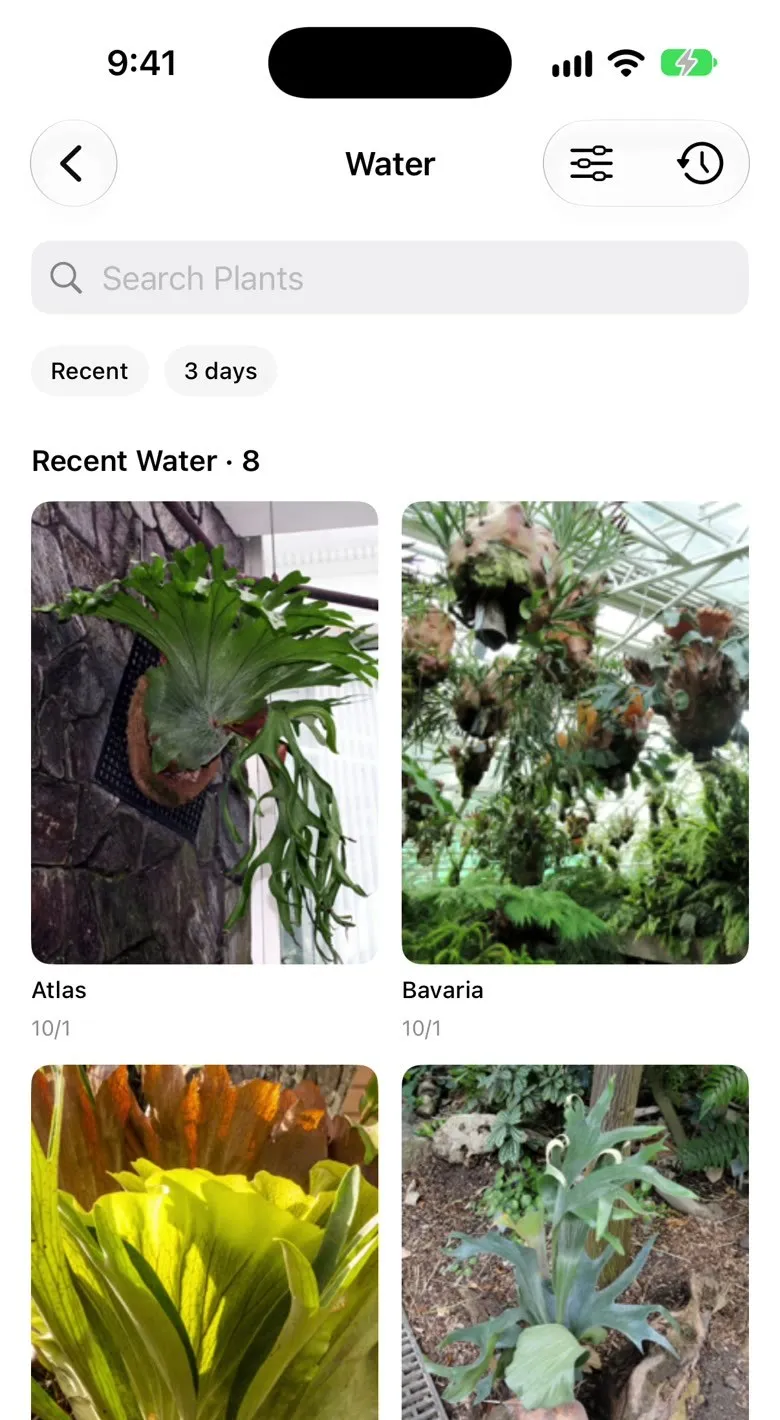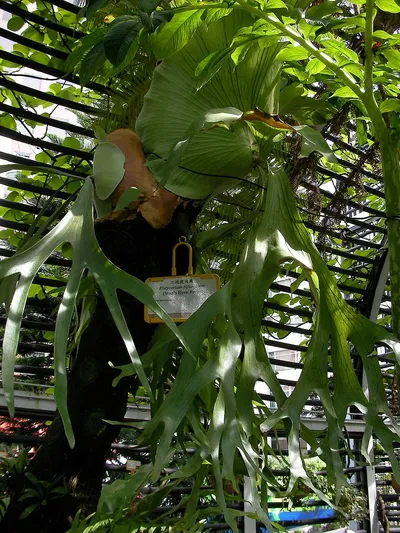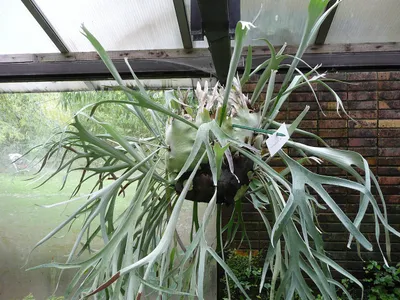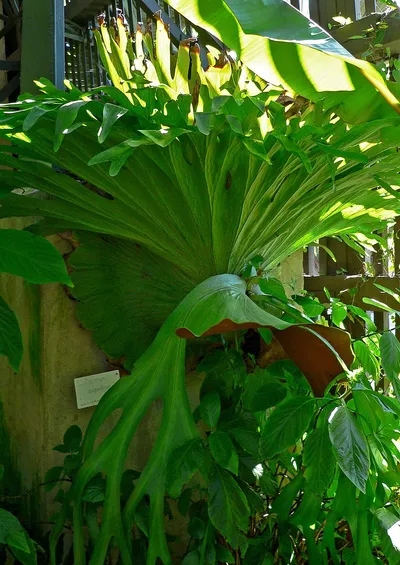
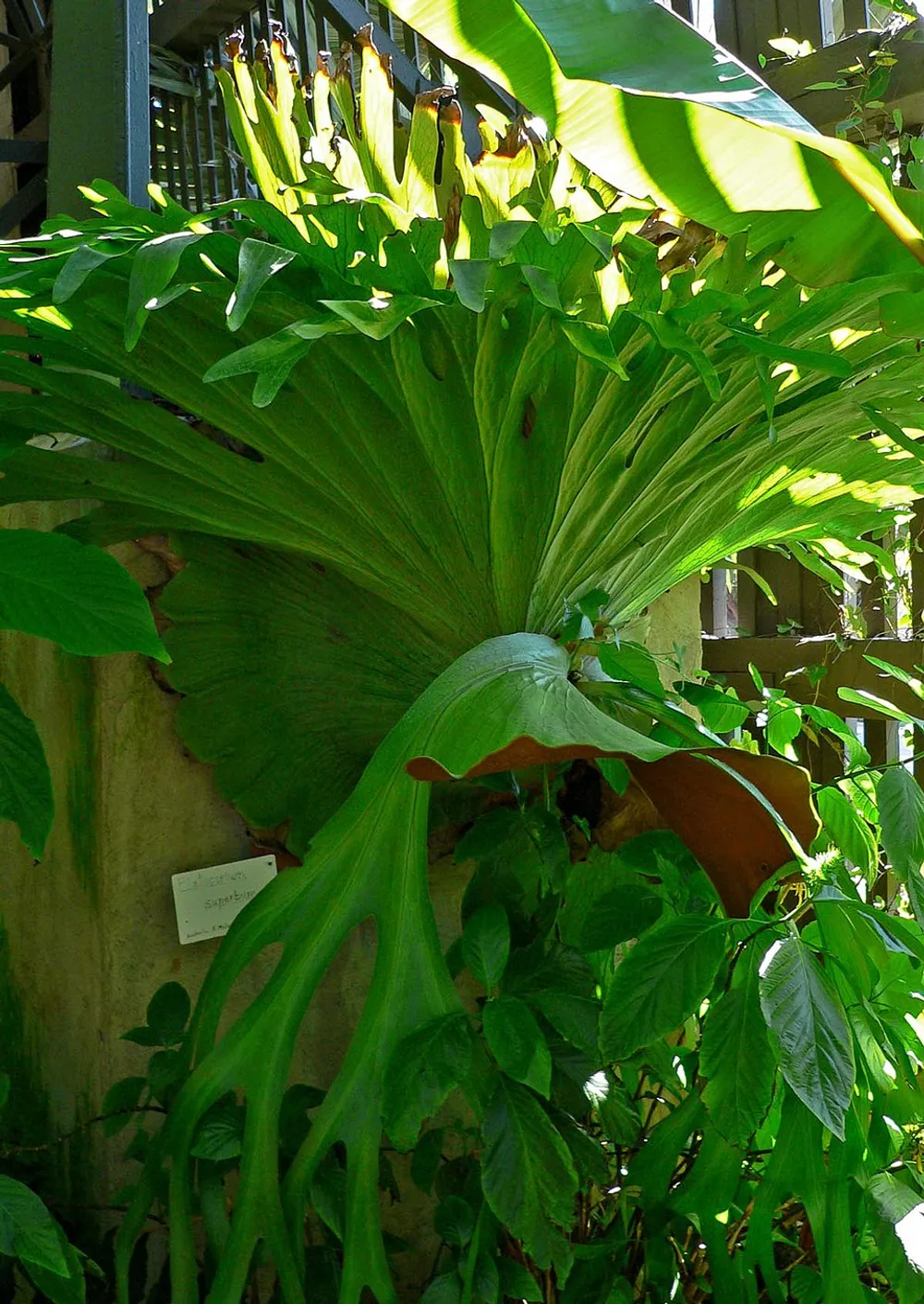
Soak the entire mount for 15–20 minutes, once a week in spring and summer and every 10–14 days in winter. Misting will not do it. The moss core has to saturate all the way through, and on a board-mounted fern that only happens by submersion.
That single habit is the difference between a mounted Platycerium that lives twenty years and one that quietly dries out in its second summer. Everything else on this page — placement, feeding, remounting — is secondary to getting the soak right.
This guide picks up where our how-to-mount guide leaves off. If you’re still deciding between a board and a pot, start with mounted vs potted staghorn ferns.
How to Water a Mounted Staghorn Fern
A potted staghorn fern lives in a buffered environment: the soil holds moisture, gravity pulls water through evenly, and humidity stays trapped around the root ball. A fern mounted on a board has none of that. The moss bed dries top-to-bottom in a single warm afternoon, the shield frond is exposed to wall-side air movement, and watering requires physically taking the plant down.
So you, not the pot, are now the moisture buffer. The technique is four steps and takes about 15 seconds of actual effort:
Step 1 — Take it down. Lift the mount off its hook. A saturated mount is heavy, so do this before watering, not after.
Step 2 — Submerge. Lay the mount face-up in a sink, bathtub, or large bin and fill with room-temperature water until the moss is covered. Let it sit for 15–20 minutes. The moss should saturate from the inside, which is impossible to achieve from a watering can.
Step 3 — Drip-dry. Lift the mount out and let it drain for 20–30 minutes. The shield frond traps water — give it time to release before rehanging, or you’ll have drips down the wall for hours.
Step 4 — Rehang. Put it back on the wall. Done.
The single best gauge of when to repeat this is mount weight. A freshly soaked mount feels noticeably heavier than a dry one, and within a week or two of mounting you’ll calibrate to it instinctively. When the mount feels light, soak it. For frequency across potted and mounted plants alike, see our watering schedule guide.
[!IMPORTANT] Never let water pool against the back of the shield frond after watering. If your mount drips for more than 30 minutes after taking it out, dry the back face with a towel before rehanging — sustained back-side moisture is the leading cause of board rot.
How Often Should You Soak a Mounted Fern?
| Season | Frequency | Soak Time | Notes |
|---|---|---|---|
| Spring | Weekly | 15 min | Resume fertilizing |
| Summer | Weekly (twice in heat waves) | 15–20 min | Watch for fast moss drying |
| Fall | Every 10 days | 15 min | Reduce as growth slows |
| Winter | Every 12–14 days | 10 min | Let dry fully between |
Treat these as starting points, not a schedule to defend. A mount in a bright, dry, air-conditioned room may need water twice as often as the same plant in a humid bathroom. Species matters too: the silver-frond species like P. willinckii and P. veitchii are built for drier air and tolerate a longer interval than thin-fronded tropical species.
If a full 20-minute soak no longer leaves the mount feeling heavy, the moss has compacted and stopped absorbing. That’s a remounting problem, not a watering problem — see the long-term care section below.
Where to Hang It: Light, Airflow, and Drip Control
The spot you hang the mount affects the plant more than people realize.
Light. Mounted ferns flatten against a wall, which means only one side of the shield frond gets light. Place mounts where the leafy side faces a bright window — east or filtered south is ideal for most species. Avoid corners where light comes from one narrow angle; the plant will grow lopsided over time. If you’re using grow lights, position them to wash across the entire mount surface. Our light requirements guide covers intensity targets by species.
Airflow. Stagnant air against a wet shield frond is a fungal-rot invitation. Avoid hanging mounts in tight nooks, behind heavy curtains, or in fully enclosed bathrooms. A ceiling fan on low, or simple cracked-window airflow, dramatically reduces rot risk.
Drip protection. A freshly soaked mount can drip for hours regardless of how long you let it drain. If hanging over wood floors, painted drywall, or art:
- Hang on a hook with a 1–2” wall standoff so airflow circulates behind
- Add a small saucer or cork mat below the mount
- Or simply rehang only after a full overnight drip-dry on a towel
The classic decorator mistake is hanging a heavy mount on a single drywall anchor without a stud — within a year, water seepage softens the drywall and the mount falls. Always anchor into a wall stud, or use a heavy-duty toggle rated for 25+ lbs.
Why Is My Mounted Staghorn Fern Turning Brown?
A mounted staghorn fern tells you exactly what’s wrong if you know what to read.
| Symptom | Likely Cause | Fix |
|---|---|---|
| Shield frond turning brown and papery | Normal aging | None — this is permanent and structural |
| Antler frond tips browning, crispy | Underwatering or low humidity | Increase soak frequency; check moss isn’t compacted |
| Antler fronds yellowing all over | Overwatering or insufficient light | Skip a soak; move to brighter spot |
| Black mush at frond base | Crown rot — water trapped in growing point | Stop watering 2 weeks; cut affected tissue with sterile blade |
| White fuzz on moss surface | Saprophytic fungus (harmless) | Improve airflow; usually self-resolves |
| Black spots on shield frond | Bacterial leaf spot — too wet, too still | Move to better airflow; reduce watering |
| Fronds drooping despite wet moss | Root suffocation from compacted moss | Remount with fresh long-fiber sphagnum |
| Loss of silver coating (willinckii, veitchii) | Overhead misting washed off trichomes | Water at base only, never spray fronds |
A common moment of panic is the first shield frond turning brown. This is not death — the brown shield is the permanent mounting structure of the plant. Every staghorn fern produces a series of green shields that gradually brown and overlap, building a thick, papery base over years. Never peel them off; they hold moisture, anchor roots, and protect the growing point. Our shield frond guide walks through the normal-versus-alarming distinction in detail.
If the base is going soft and black rather than dry and brown, you’re looking at root rot, which needs immediate intervention rather than a schedule change.
Feeding, Remounting, and Long-Term Care
Mounted staghorn fern care past the first year comes down to two things: feeding lightly, and knowing when to leave the plant alone.
Feeding. Mounted ferns lose nutrients faster than potted ones — every soak rinses some out the bottom of the moss. Light, regular feeding beats occasional heavy doses:
- Liquid fertilizer: Quarter-strength balanced (20-20-20 or similar) added to the soak water once a month, April through September. See our fertilizer guide for ratios.
- Banana peel method: A single banana peel tucked behind the shield frond once a year mimics natural decomposing leaf litter. Staghorns evolved to absorb exactly this kind of slowly decomposing organic matter.
- Skip winter: Dormant plants don’t use nutrients, and fertilizer salt buildup harms roots.
Avoid time-release pellets pressed into the moss surface — they concentrate salts at the root zone and frequently cause crown burn.
Remounting. Over 3–5 years, a well-cared-for mounted fern will gradually consume its mount. The shield frond expands outward and wraps the board edges, pups emerge at the base and form a spreading colony, and old shield layers stack into a thick papery cushion. This is exactly what should happen. Resist the urge to remount cosmetically — the layered old shields are a better growing medium than fresh moss.
Remount only when:
- The shield has fully wrapped the board and is curling back on itself with no room to expand
- The wood is visibly soft, sloughing, or growing fungal fruiting bodies
- The moss bed has compacted so completely that soaks no longer saturate it
When that day comes, the safest technique is mount-on-mount: screw the existing board onto a larger backing board rather than tearing the plant off. The original root mass stays intact and the shield gets fresh real estate. For dividing pups off a mature colony — a separate decision from remounting — see our pup separation guide.
Mounted P. bifurcatum and P. veitchii routinely live 20+ years this way; potted plants of the same species rarely make it past 5–7 before crown rot ends the run. NC State Extension notes the same epiphytic requirement — these plants evolved on bark, not in soil, and mounting simply gives them back the drainage and airflow they were built for.
The biggest shift for a new owner is moving from a daily-check, sip-water routine to a weekly-ritual, deep-soak routine. These are not high-maintenance plants; they’re maintained on a different rhythm. Once that rhythm clicks, a mounted staghorn fern becomes one of the lowest-effort, highest-reward houseplants you can keep.