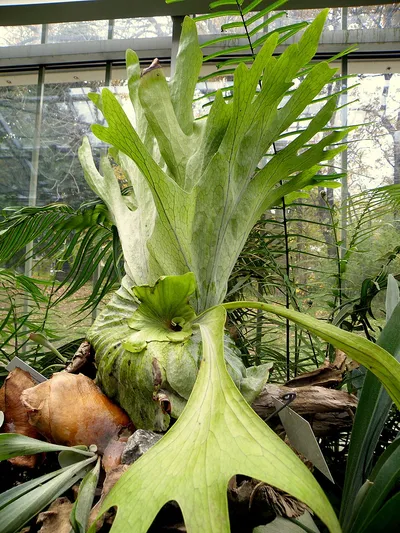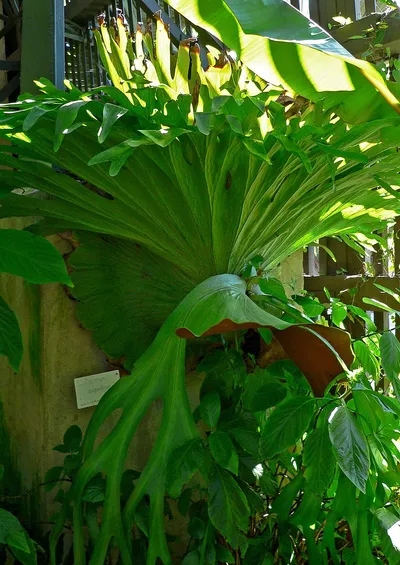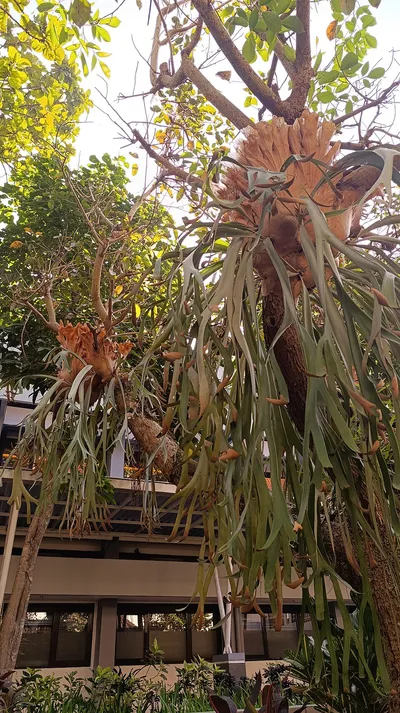
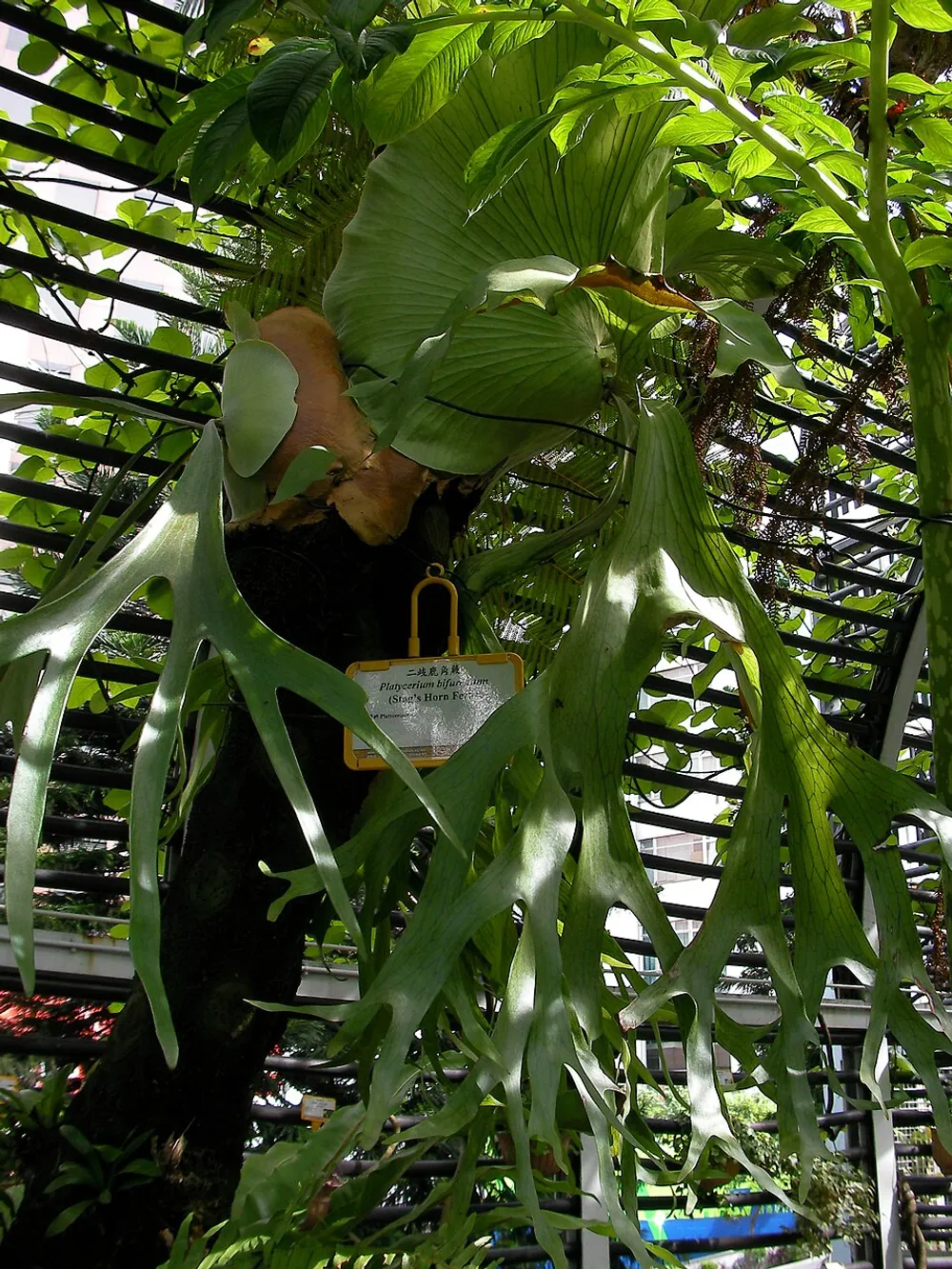
The short answer: soak a mounted staghorn fern every 7 days, and a potted one every 10. In fall and winter, stretch both to 12–14 days. Outdoors in summer heat, mounted ferns may need water twice a week.
That covers about 80% of staghorn ferns in about 80% of homes. The remaining 20% is what this guide is for — because mount type, airflow, humidity, and species each shift that number by days, and getting it wrong is the most common way a Platycerium dies.
How Often Should You Water a Staghorn Fern?
Use this table as your starting point, then adjust using the signs further down.
| Setup | Spring | Summer | Fall | Winter |
|---|---|---|---|---|
| Mounted, indoors | Every 7 days | Every 7 days | Every 10 days | Every 12–14 days |
| Mounted, outdoors | Every 7 days | 2× per week | Every 7 days | Every 10–14 days |
| Potted, indoors | Every 7–10 days | Every 7 days | Every 10–14 days | Every 2–3 weeks |
| Potted, outdoors | Every 7 days | Every 4–6 days | Every 7 days | Pause / rain only |
These are starting points, not commandments. A staghorn in a dim 65 °F apartment dries far slower than one near a sunny west-facing window — the same “weekly” cadence might mean rot in one and drought in the other.
Four variables decide how far your fern drifts from the chart:
1. Mount type. A mounted staghorn lives in a thin layer of sphagnum moss exposed to air on every side. That moss dries in 5–7 days at room temperature. A potted staghorn sits in a thicker, contained substrate that holds water 2–3× longer. Same plant, very different rhythm.
2. Temperature and airflow. Heat and moving air pull moisture out of moss. A fern under a ceiling fan dries roughly twice as fast as one in still air. Outdoor ferns in 85 °F+ heat can crisp in 3 days; the same fern indoors at 70 °F is fine for 7.
3. Humidity. Above 60% humidity — bathrooms, kitchens, terrariums — the moss holds moisture longer and you water less. Below 40%, typical of winter homes with central heating, you’ll need to soak more often or compensate with higher ambient humidity.
4. Species. The cold-hardy P. veitchii tolerates drought between waterings; tropical P. ridleyi wants near-constant moisture and browns at the antler tips after a single missed soak.
How to Water a Mounted Staghorn Fern
A mounted staghorn is watered by submersion, not by pouring. This matters more than the schedule itself: water poured from above runs down the face of the shield frond and off the board, leaving the root mass behind it completely dry. Growers who water this way often think they’re on a weekly schedule while the plant has effectively been in drought for months.
The soak ritual, in about 30 minutes:
- Lift the mount off the wall before adding water. A saturated mount can double in weight, and wall hardware rarely accounts for that.
- Submerge it in a sink, bathtub, or large bin of room-temperature water. The moss should be fully covered — not just splashed. Let it sit 15–20 minutes.
- Drain face-up for 20–30 minutes, until the shield frond stops dripping.
- Rehang and move on with your week.
The mount-weight test replaces the calendar. Within two weeks of mounting you’ll calibrate to what a wet mount versus a dry mount feels like in your hand. Lift it: if it feels light, soak. If it still feels heavy, wait two more days. This one habit is more accurate than any schedule in this article, because it measures the actual variable — how much water is left in the moss.
If the mount stays heavy for more than 10 days, that’s not thriftiness, it’s a drainage problem. Too much moss, a non-porous backing board, or a spot with no airflow will hold water long enough to start root rot. For mount construction and hanging placement, see how to mount a staghorn fern and the mounted staghorn fern care guide.
How to Water a Potted Staghorn Fern
A potted staghorn doesn’t need the soak ritual — it needs the drench-and-drain method common to all epiphytic houseplants.
Pour room-temperature water across the surface of the substrate until it runs freely from the drainage holes. Let it drain completely for 5–10 minutes, then dump anything left in the saucer. Never let a potted staghorn sit in standing water — Platycerium roots are adapted to grip bark and rotting leaf litter, not to swim.
Wait until the top inch of substrate is dry before watering again. In a typical home that’s roughly 7–10 days in spring and summer. Stick a finger an inch deep: if it comes out clean and dry, water. If it comes out cool or with substrate clinging to it, wait two more days.
Not sure which setup you have, or which you should have? Mounted vs. potted staghorn fern covers the trade-offs.
How the Watering Schedule Changes by Season
The biggest mistake growers make is watering on the same schedule year-round. Staghorn ferns run a clear seasonal cycle and your rhythm has to follow it.
Spring (Mar–May): scale up. As temperatures rise and daylight lengthens, growth accelerates. Resume whatever you cut back over winter and begin adding a quarter-strength balanced fertilizer once a month. May is when new antler fronds push out — a sign the plant is drinking faster.
Summer (Jun–Aug): peak demand. The highest-water window of the year. Outdoor ferns may need water twice weekly. Watch for mid-afternoon wilting on hot days: a temporary droop is normal, but persistent drooping past sunset means you’re behind. Summer is also when heat stress and sunburn get mistaken for underwatering — scorched fronds have hard, bleached patches, while thirsty fronds curl inward evenly.
Fall (Sep–Nov): scale down. As nights cool, growth slows. Stretch intervals by 2–3 days and stop fertilizing by mid-September. Outdoor ferns coming in for winter should be moved to the low end of their range immediately.
Winter (Dec–Feb): minimum maintenance. This is when most staghorns die — from overwatering, not underwatering. Cut frequency 30–50% depending on indoor temperature. A staghorn at 60–65 °F in dim winter light may need water only every 14 days. For ferns staying outside, outdoor staghorn fern care and temperature tolerance cover cold-season protection.
Signs You’re Watering Too Much or Too Little
The plant tells you what it needs. Learn these six signals and the calendar becomes optional.
Underwatering:
- Antler fronds curl inward or fold like a closed book
- Frond tips go crispy brown — distinct from normal shield-frond browning
- New fronds emerge smaller than the previous generation
- The mount or pot feels noticeably lighter than usual
Overwatering:
- Black, mushy, or sour-smelling tissue at the base of the antler fronds — crown rot, the most dangerous failure mode
- A persistently soggy mount that never seems to dry
The shield frond turning brown is not a symptom of either problem: that frond is supposed to go brown and woody as it ages. See shield frond turning brown if you’re unsure which you’re looking at. It’s the antler (fertile) fronds that report hydration status. For a full diagnostic walkthrough, signs of overwatering a staghorn fern goes deeper than the list above.
[!IMPORTANT] If crown rot is already in progress, stop watering immediately, move the plant to bright shade with maximum airflow, and let it dry completely for 7–10 days before resuming a reduced schedule. Most rot is reversible if you catch it within the first week.
How Watering Differs by Species
The schedules above assume Platycerium bifurcatum, the most common species. Others drink differently.
| Species | Water demand | Notes |
|---|---|---|
| P. bifurcatum | Average | The forgiving default; tolerates short droughts |
| P. veitchii | Low | Adapted to drier Australian conditions — wait longer between soaks |
| P. willinckii | Average–high | The wax coating slows transpiration; wet feet still risk rot |
| P. ridleyi | High | Tropical; wants near-constant humidity and frequent soaks |
| P. grande | High | Large specimens hold more water but need it more often |
| P. superbum | Average | Treat like a slightly thirstier P. bifurcatum |
For full per-species care, see the deep-dives on P. willinckii, P. ridleyi, P. veitchii, and P. superbum. If you’re not sure which species you have, the species comparison guide works through the identifying features.
What Water to Use, and What Mistakes to Skip
Tap water is fine for most staghorn ferns, with one caveat: heavily chlorinated or softened water builds up mineral salts in the moss over months. If white crust forms on the shield frond or moss, switch to filtered, rain, or aquarium-discharge water once a month to flush it.
Avoid cold water straight from the tap — let it come to room temperature before soaking. A 50 °F shock stresses fronds, especially in tropical species.
Spring and summer is also when many collectors mix a quarter-strength balanced fertilizer (20-20-20) into the soak water once a month. The University of Florida’s IFAS Extension confirms this 1:1:1 ratio for staghorns and notes that ferns benefit from waiting until the substrate is dry to the touch before watering again — a slight wilt is normal and helps prevent the rot that comes from forced moisture.
Five traps that shorten a fern’s life:
- Misting in place of soaking. Misting wets the surface and leaves the moss core dry. It’s a humidity supplement, never a watering session.
- Watering on a strict calendar regardless of conditions. A “weekly” schedule that ignores a heat wave or a cold snap will eventually kill the plant.
- Rehanging a mount that’s still dripping. Standing water behind the shield frond causes board rot, invisible until the plant falls off the wall.
- Treating winter like summer. Most rot deaths happen December through February because growers keep summer frequency on a dormant plant.
- Ignoring species differences. A schedule that keeps a P. veitchii thriving will drown a P. ridleyi — and the reverse leaves the veitchii sitting wet.
Watering is less a rule than a conversation between you and the plant. Get the rhythm right and the rest of staghorn care — light, feeding, mounting — falls into place around it.
External reference: UF/IFAS Gardening Solutions — Staghorn Fern.