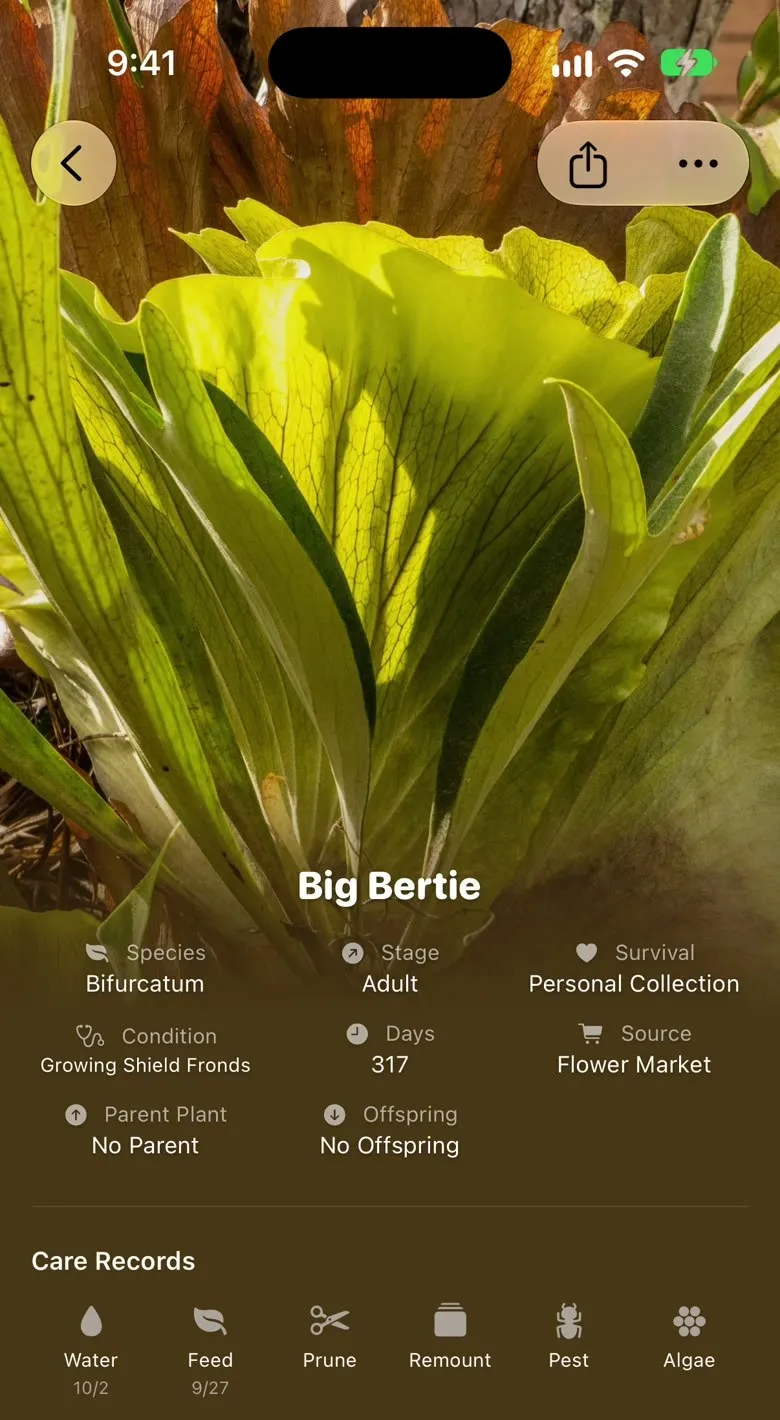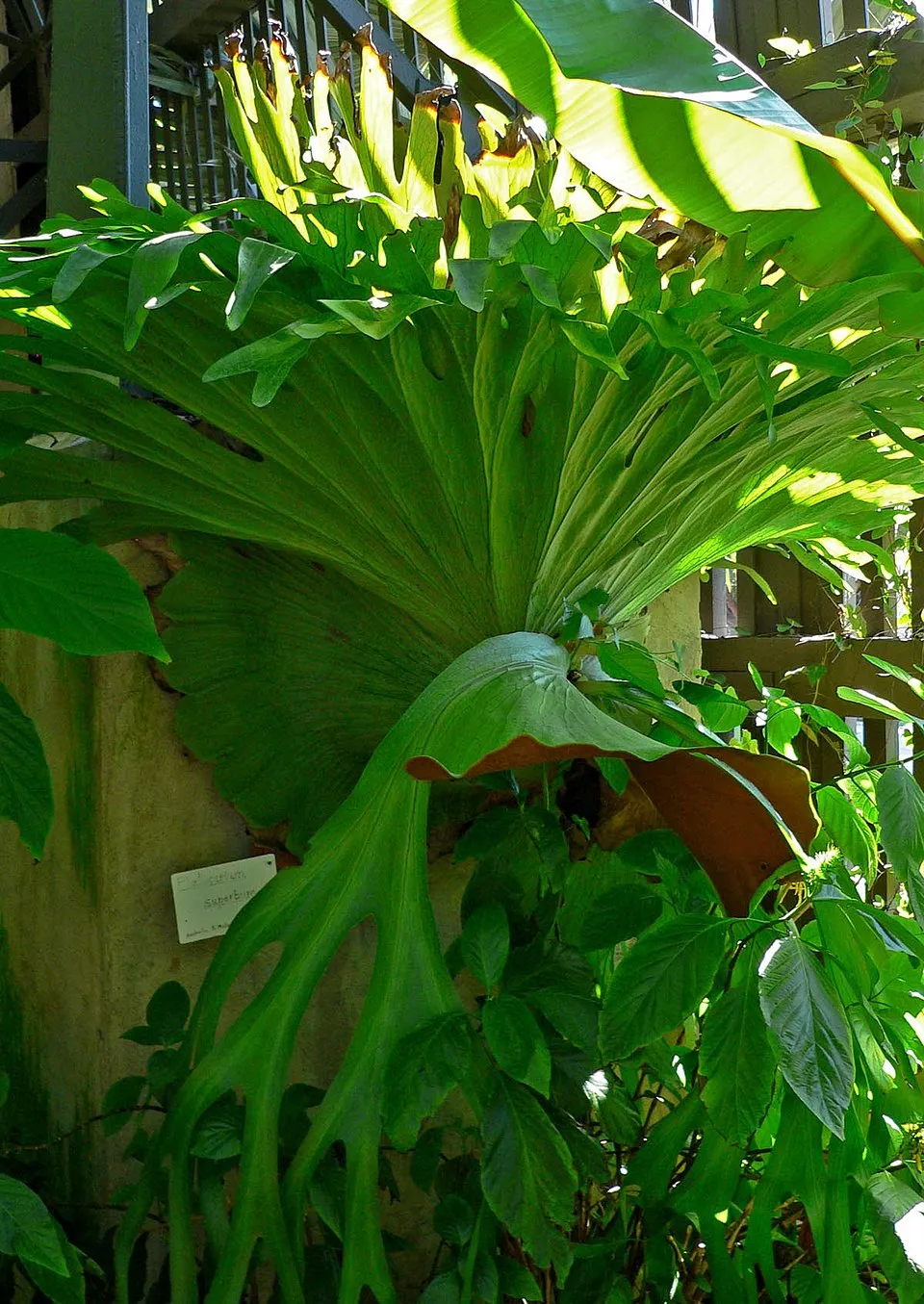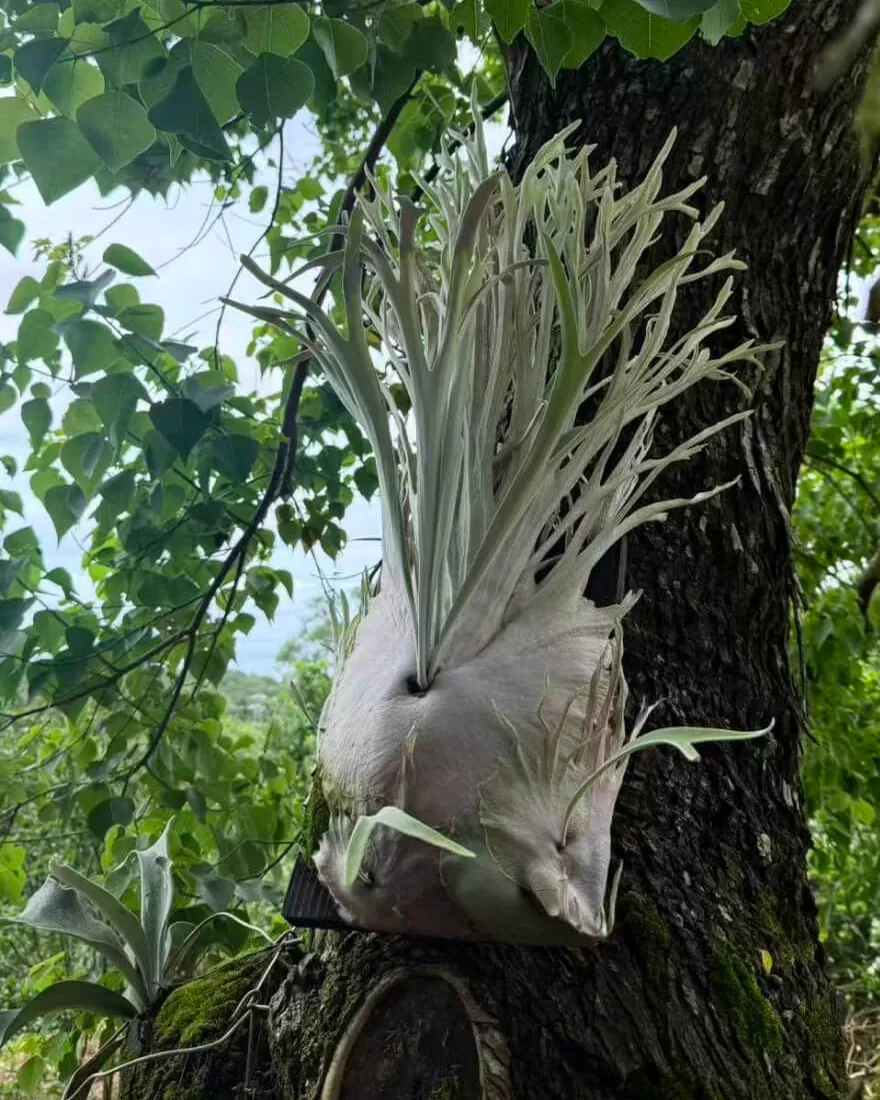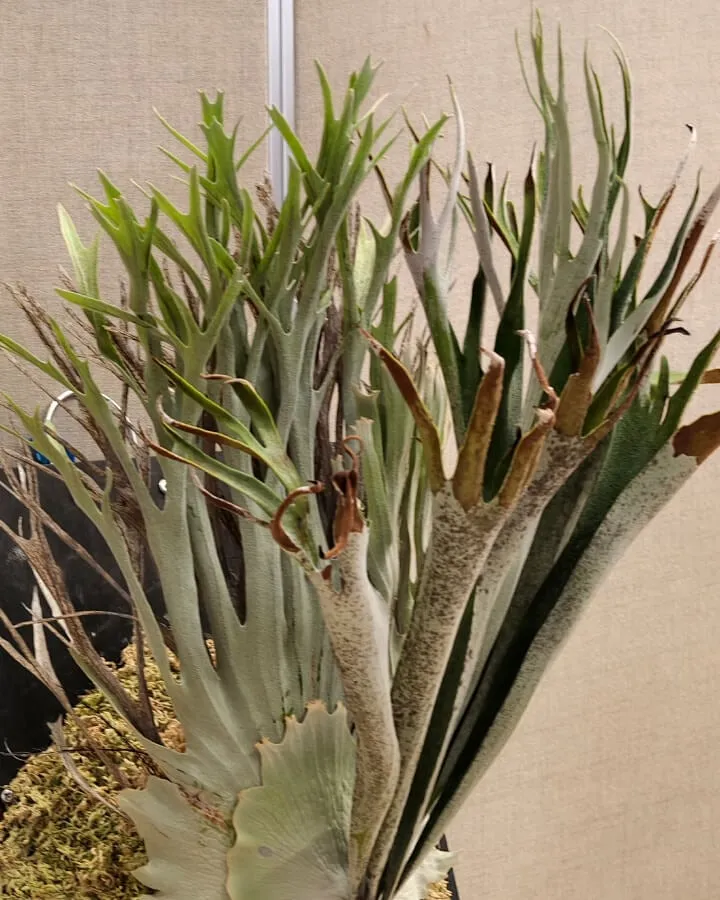
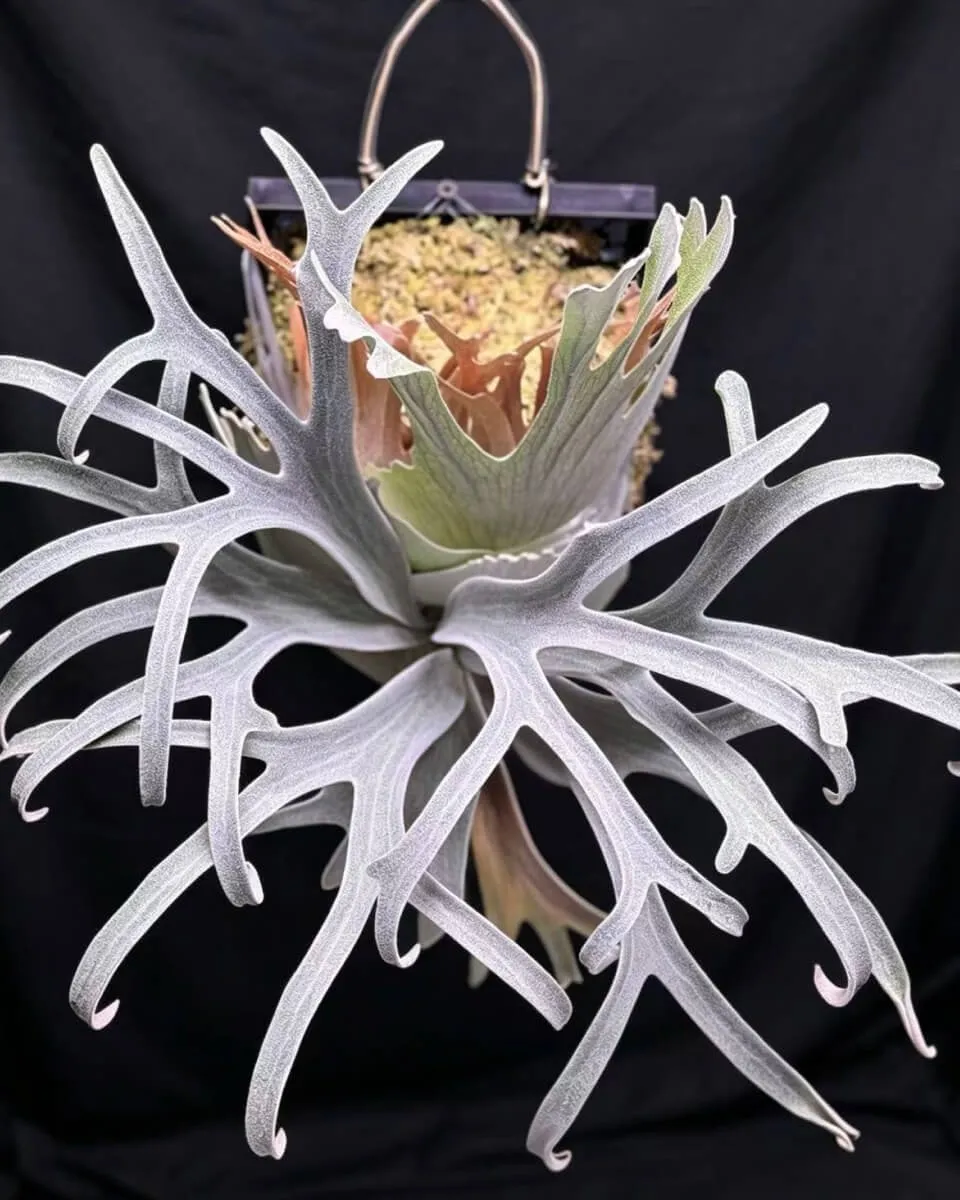
Moosehorn fern is Platycerium superbum. Elkhorn fern is P. bifurcatum. Elephant ear staghorn fern is P. elephantotis. All three are staghorn ferns — the same genus, sold under different names because their fertile fronds are shaped differently.
Common names in this genus are regional, unregulated, and frequently wrong on the label. Below is every name in circulation, what species it actually refers to, and the handful that do not map to anything verifiable at all.
Every Staghorn Fern Common Name and What It Actually Is
| Common name | Actual species | Note |
|---|---|---|
| Staghorn fern | Whole genus (US/EU) — P. superbum (Australia) | The single biggest source of confusion. See below. |
| Elkhorn fern | P. bifurcatum | In the Australian trade also applied to P. hillii |
| Common staghorn | P. bifurcatum | The species most people own |
| Moosehorn fern | P. superbum | Also moose horn, moosehead, moose antler fern, moose ear plant |
| Regal elkhorn fern | P. superbum | Older nursery name for the same plant |
| Elephant ear staghorn fern | P. elephantotis | Also elephant staghorn fern, elephant ear fern |
| Butterfly staghorn | P. wallichii | A species name, not a cultivar |
| Silver staghorn | P. veitchii | Named for the dense white frond hairs |
| Java staghorn | P. willinckii | Long pendulous fertile fronds |
| Giant staghorn | P. grande | Constantly mislabelled — most plants sold as grande are superbum |
| Queen staghorn | P. wandae | The largest species in the genus |
| Crown staghorn | P. coronarium | |
| Triangle staghorn | P. stemaria | Named for its V-shaped fertile fronds |
| Round shield staghorn | P. alcicorne | |
| Green staghorn | P. hillii | Glossy, near-hairless fronds |
| Ridley’s staghorn | P. ridleyi | |
| Holttum’s staghorn | P. holttumii | |
| Madagascar staghorn | P. madagascariense | Deeply corrugated shield |
| Andean staghorn | P. andinum | The only species from the Americas |
| Ellis’s staghorn | P. ellisii | |
| Four-fork staghorn | P. quadridichotomum | |
| Dutch staghorn fern | Not a species | A growing origin, not a plant |
| Dwarf staghorn fern | Not a species | A size descriptor applied to several species |
Moosehorn Fern vs Staghorn Fern
They are the same category of plant. “Moosehorn fern” is a common name for one species inside it, P. superbum.
You will also see it listed as moose horn plant, moose antler plant or simply moose fern. The name comes from frond shape. A typical staghorn fern forks its fertile fronds into narrow tines, like a deer’s antlers. P. superbum keeps them broad and paddle-shaped, closer to a moose’s palmate antler — so growers gave it its own name.
Three practical differences follow from having a moosehorn rather than a common staghorn:
| Moosehorn (P. superbum) | Common staghorn (P. bifurcatum) | |
|---|---|---|
| Pups | Never — single-bud species | Freely, forms clumps |
| Propagation | Spore only, 3–5 years | Divide the pups |
| Mature spread | Up to 2 m (6 ft) | 60–90 cm (2–3 ft) |
| Spore patches | One per frond lobe | Under the frond tips |
That first row is the one that costs money. A moosehorn fern will never produce a division, so the plant you buy is the plant you keep — buy the size you actually want. Full detail in the P. superbum care guide.
Is Elephant Ear Fern a Staghorn Fern?
It depends entirely on what is on the label, and this is the one naming collision that leads people to kill a plant.
If the label says Platycerium elephantotis, yes. It is a true staghorn fern, and the only one whose fertile fronds stay broad and completely unforked — which is exactly why it picked up an elephant name. It mounts on a board, takes no soil, and wants a pronounced dry rest from September to March.
If the label just says “elephant ear”, almost certainly not. Most plants sold under that name are Alocasia or Colocasia — flowering plants in the arum family (Araceae), not ferns. They grow from tubers in potting soil, want constant moisture, and will rot if you mount them on a board the way you would a staghorn. The University of Wisconsin–Madison Horticulture Extension treats them as an entirely separate group of plants, and it is right to.
The quick test: staghorn ferns produce a flat shield frond that presses against the mount and browns as it ages. Alocasia never does. If your plant has that shield, it is a Platycerium.
Elkhorn vs Staghorn: Why Australia and America Disagree
This is not a case of one region being wrong. The two conventions are genuinely different.
In Australia, where both species are native, the names are specific: the Australian Native Plants Society records “the elkhorn (Platycerium bifurcatum) and the staghorn (Platycerium superbum)” as two distinct plants. Elkhorn means the clumping one. Staghorn means the giant solitary one.
In North America and Europe, “staghorn fern” became the catch-all name for the whole genus, and “elkhorn” survives mainly as a nursery synonym. Neither usage is incorrect — but it means an Australian grower and an American grower can use the same word for two different plants.
If you are trying to work out which of the two you own, the staghorn vs elkhorn comparison walks through frond shape, pupping behaviour and cold tolerance side by side.
Species Names Sold as if They Were Cultivars
A recurring trap at the point of sale: a plain species gets listed under its common name with a premium attached, as though it were a rare named selection.
| Sold as | Actually |
|---|---|
| Platycerium ‘Butterfly’ | The species P. wallichii |
| Platycerium ‘Moose’ | The species P. superbum |
| Platycerium ‘Elephant’ | The species P. elephantotis |
None of these are cultivars. They are the ordinary species under a shortened common name, and they should be priced as such. The Platycerium cultivar directory sorts the genuine grower selections from the trade names.
Names That Do Not Map to Anything Verifiable
Some names circulate widely and still cannot be pinned to a species or a registered selection. Listings pairing “moose” with P. hillii or P. ridleyi, for instance, appear in search suggestions but correspond to no documented cultivar of either species — “moose” belongs to P. superbum.
Staghorn fern cultivars are essentially never formally registered, so a name on a tag carries no guarantee. When a name cannot be verified, the useful question is not “how do I care for this cultivar” but “what species is underneath it” — because the species is what determines whether it pups, how large it gets, and whether it needs a dry season.
How to Identify Which Species You Actually Have
Work through these in order; the first two settle most cases.
- Do the fertile fronds fork? Unforked and broad points to elephantotis, wandae or grande/superbum. Forked and narrow points to bifurcatum, willinckii or veitchii.
- Are there pups? Clumping means bifurcatum, hillii, veitchii or alcicorne. A solitary crown means superbum, grande, wandae, coronarium or ridleyi.
- Is the frond surface hairy or glossy? Dense white hair suggests veitchii or willinckii; a glossy, near-bare surface suggests hillii.
- Where does the spore patch sit? Under the frond tips, in the fork, or as a discrete patch on a lobe — the placement is species-specific and is the most reliable single character.
The species directory has photographs for all 18, and the species comparison guide ranks the popular ones by difficulty, size and light needs.
Once you know the species, the common name on the tag stops mattering. Care converges quickly: get watering, mounting and light right and the rest is detail.