Platycerium superbum, the moosehorn fern, needs bright indirect light, a soak every 5–10 days, and a 2-meter clear wall zone. It never produces pups — it is a single-bud species, so the plant you buy is the plant you keep. One spore patch per frond lobe separates it from P. grande, which has two.
Those four facts cover most of what goes wrong with this species. Everything below is the detail behind them, including how to tell superbum from the P. grande it is constantly mislabelled as.
What Platycerium Superbum Needs at a Glance
| Parameter | Requirement |
|---|---|
| Light | Bright indirect — morning sun acceptable |
| Watering | Soak 10–15 min, then dry down; roughly every 5–10 days |
| Humidity | 50–70% ideal, tolerates 40% |
| Temperature | Above 15°C (60°F), no frost |
| Mounting | Board or basket 60 cm+; plan for a 2 m spread |
| Fertilizer | Monthly half-strength liquid, or pellets every 4–6 months |
| Division | Not possible — single-bud species |
| Mature size | Shield fronds ~1 m, fertile fronds up to 2 m |
| Difficulty | Intermediate |
Is a Moosehorn Fern the Same as a Staghorn Fern?
Yes — a moosehorn fern is a staghorn fern. It is the common name for Platycerium superbum, one species within the roughly 18-species Platycerium genus. The name causes confusion because people meet the plant before they meet the botanical label, so it is worth being explicit about the aliases you will run into:
| Name you’ll see | What it actually is |
|---|---|
| Moosehorn fern / moose horn fern | P. superbum — the standard common name |
| Moosehead fern / moose antler fern | Same plant, informal variants |
| Moose antler plant / moose fern | Same plant |
| Moose ear plant | Usually P. superbum, but sometimes misapplied to P. elephantotis, the elephant ear staghorn — check the frond shape |
| Elkhorn fern | A different plant — usually P. bifurcatum. See our staghorn vs elkhorn guide |
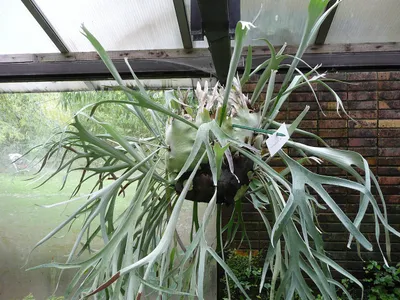
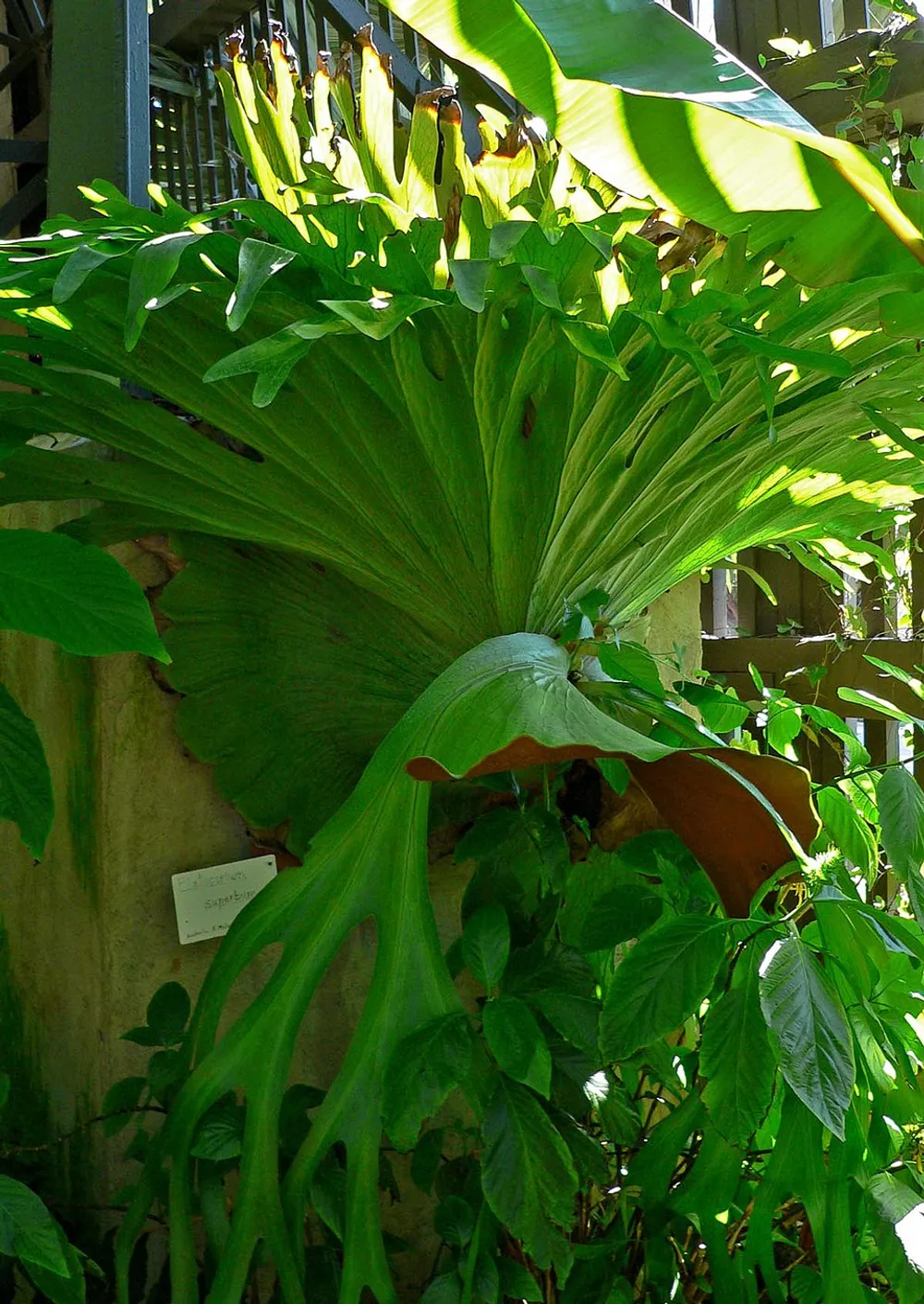
Other species carry their own aliases in the same way — the staghorn fern common-name decoder maps every one of them to a species. The distinction is about antler shape. Most staghorn ferns fork their fertile fronds into narrow, tined projections — a deer’s antlers. P. superbum instead produces fertile fronds that are wide, solid and gently lobed, closer to the broad palmate antlers of a moose. When one unfurls to its full 1–2 meter span, the effect is a green moose head mounted on the wall, without the taxidermy.
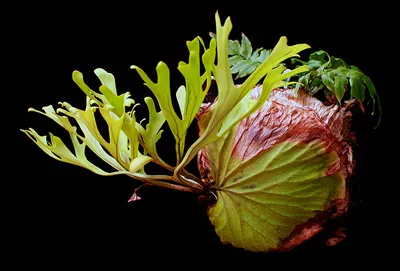
If you are trying to identify a plant you already own, the fastest check is the underside of a mature fertile frond: superbum carries a single large fuzzy brown spore patch in each lobe’s notch.
How Much Light and Water Does Superbum Need?
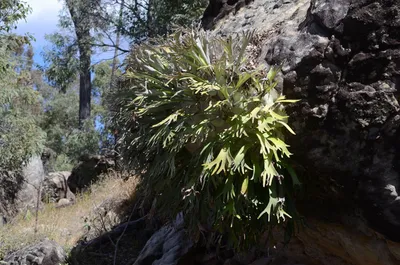
P. superbum grows in the filtered light of Australian rainforest canopies, clinging to trunks where dappled sun reaches through the foliage above. Indoors that translates to an east-facing window with morning sun, or a south/west window behind a sheer curtain. Direct afternoon sun scorches the fronds. Bleached, pale fronds mean too much sun; elongated leggy growth and slow shield development mean too little.
Superbum is noticeably more forgiving here than P. ridleyi. If your space has enough light for a monstera, it has enough for superbum.
Watering is where most superbum die, and the failure is almost always too much rather than too little. Epiphytes evolved for wet-dry cycles — rain drenches them, then air dries them out. Mimic that:
- Soak the root ball thoroughly — submerge mounted plants for 10–15 minutes, or drench with a hose until water runs clear through the moss
- Let it drain completely — the sphagnum should be saturated, not dripping
- Wait until the moss surface feels dry before watering again — usually 5–10 days indoors, faster in summer or dry air
- Never let the moss go bone dry — superbum handles mild drought better than constant wetness, but prolonged dryness stalls growth
The lift test settles it. Pick the mount up before and after watering to learn the weight difference; a light mount needs water, a heavy one does not. Our watering guide covers the schedule in more depth, and signs of overwatering covers what it looks like when you get it wrong.
What Temperature and Humidity Does It Tolerate?
P. superbum is native to tropical and subtropical eastern Australia — warm rainforest where temperatures rarely fall below 10°C.
| Temperature Range | Effect |
|---|---|
| 18–30°C (64–86°F) | Ideal — active growth |
| 15–18°C (59–64°F) | Slow growth, no damage |
| 10–15°C (50–59°F) | Growth stops, stress begins |
| Below 10°C (50°F) | Cold damage likely |
| Frost | Fatal |
It is more cold-tolerant than truly tropical species like P. ridleyi or P. coronarium, but less hardy than P. veitchii or P. bifurcatum. In USDA zones 10–11 it lives outdoors year-round; everywhere else it comes inside before night temperatures drop below 15°C. If you summered yours outdoors, late summer is the moment to start watching the overnight lows and to inspect for pests before the plant joins your indoor collection. Our temperature guide covers cold protection in detail.
Humidity is the easy part. Those large, robust fronds lose water far more slowly than the thin foliage of species like P. elephantotis, so superbum copes with ordinary household air (40–50%) better than most of the genus. Aim for 50–70% if you can — a bright bathroom, a cluster of grouped plants, or a humidifier in dry winter air all work. Avoid misting the fronds directly: droplets that sit where shield frond layers overlap invite fungal problems. See our humidity guide for indoor strategies.
How Do You Mount a Plant That Gets 2 Meters Wide?
The single most common superbum mistake is underestimating the final size. That tidy 30 cm nursery fern will eventually push fertile fronds up to 2 meters across, and it cannot be divided down later.
| Method | Pros | Cons |
|---|---|---|
| Large wooden board (cedar, redwood) | Dramatic display, easy wall mounting | Heavy when wet, needs sturdy hardware |
| Wire basket | All-around airflow, lighter | Less visually striking |
| Cork bark slab | Natural appearance, good drainage | Expensive at large sizes |
| Tree trunk outdoors | Natural habitat conditions | Zones 10+ only |
Choose a mount at least 60 cm (2 feet) across — larger is better. Build a mound of long-fiber sphagnum 5–8 cm thick in the center, position the root ball with the fuzzy growing crown at 12 o’clock, and secure it with fishing line, wire or staples; the shield fronds will grow over and hide all the hardware within a season or two. Hang it at eye level or higher so the fertile fronds can cascade. Our mounting guide has the step-by-step with substrate choices.
[!IMPORTANT] Unlike P. bifurcatum and P. willinckii, superbum is a single-bud species — it will never produce pups. What you mount is what you get, and the plant cannot be split if it outgrows the spot. Buy the size you can house long-term.
How Often Should You Fertilize Superbum?
P. superbum is a moderate feeder. In the wild, leaf litter and debris collect in the nest formed by its shield fronds and break down into slow-release nutrition. Two ways to mimic that:
- Liquid — half-strength balanced fertilizer (10-10-10 or similar), monthly through spring and fall, dropping to every 6–8 weeks in winter
- Slow-release pellets — 5–10 Osmocote pellets (14-14-14) tucked under the shield fronds every 4–6 months, which matches the natural gradual breakdown more closely
Keep fertilizer off the fronds themselves; it leaves burn marks. Our fertilizer guide covers dosing and application.
How Do You Tell Platycerium Superbum from P. grande?
These two are confused constantly and mislabelled almost as often in the trade.
| Feature | P. superbum | P. grande |
|---|---|---|
| Spore patches | One per fertile frond lobe | Two per fertile frond lobe |
| Native range | Eastern Australia | Philippines (Mindanao) |
| Conservation status | Common in cultivation | Critically endangered |
| Availability | Easy to find | Very rare in trade |
| Shield fronds | Tighter, more upright | Wider, more cascading |
| Fertile fronds | Slightly thicker texture | Broader, more curved |
The spore patch count is definitive. Turn a mature fertile frond over and count the fuzzy brown patches on each lobe — one means superbum, two means grande. Kew’s Plants of the World Online records superbum’s native range as Queensland and New South Wales, which is the other reliable tell: an Australian provenance is superbum, a Philippine one is grande.
In practice, almost everything sold as “grande” is superbum. True P. grande is rare enough to command collector prices, and its export is restricted. Care requirements are identical either way — warmth, space, and patience.
Why Are the Fronds Yellowing, Browning or Not Growing?
Yellowing fronds. Old fertile fronds yellow and brown naturally as new growth replaces them — that is normal and needs no action. If young fronds yellow, check the root ball for soggy moss or a sour smell, which means overwatering or root rot. Improve drainage and stretch the interval between soakings. Our yellowing guide walks the full diagnosis.
Brown frond tips. Usually low humidity, underwatering, or fertilizer burn. Raise humidity toward 50%, water more consistently, and flush the moss with plain water if you have been feeding heavily. See brown tips.
Scale insects. The most common pest on mounted staghorns, hiding in the crevices between overlapping shield fronds where sprays cannot reach. Systemic granules (imidacloprid) worked into the sphagnum are the most reliable fix; for light infestations, dab each insect with an alcohol-soaked cotton swab. Our scale treatment guide and general pest guide cover identification.
No new growth. Cold, low light, or transplant shock. Keep temperatures consistently above 18°C, brighten the position, and be patient — superbum can take several months to settle after mounting before it resumes growth.
Is Superbum Right for You?
Superbum belongs to the Clade B (Australia–Asia) lineage alongside P. bifurcatum, P. veitchii and P. hillii. Its single-bud habit means spore is the only propagation route, and a spore-grown plant takes 3–5 years to reach mountable size — see our spore propagation guide if you want to try. For the whole genus, our species comparison covers all 18 species.
It is a good choice if you have the wall space for a 2-meter spread, want a single statement specimen rather than a collection you can divide and share, and can keep it above 15°C through winter. That “one large specimen” appeal is squarely in line with the collectible-houseplant trend consumer analysts named for 2026, where a few rare, character-heavy plants replace a shelf of common ones.
If you are new to staghorn ferns, P. bifurcatum is the more forgiving start — smaller, hardier, and it produces pups you can share. But if you have the space and want something that will still be making an impression in twenty years, superbum delivers.