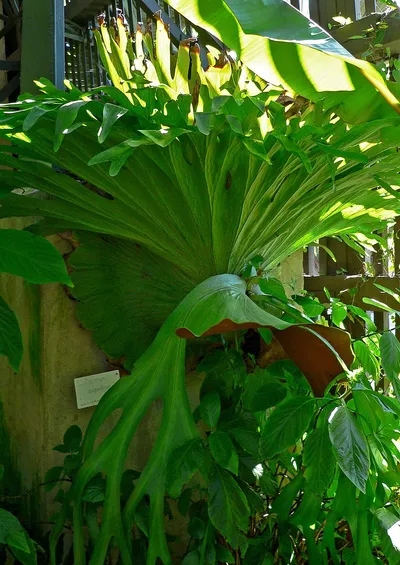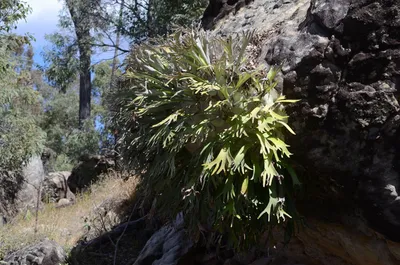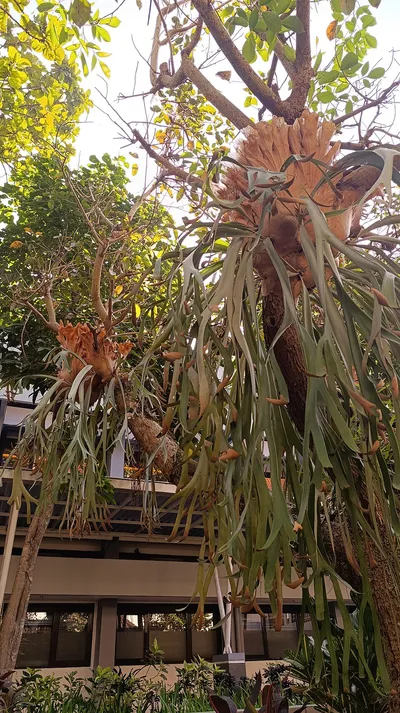
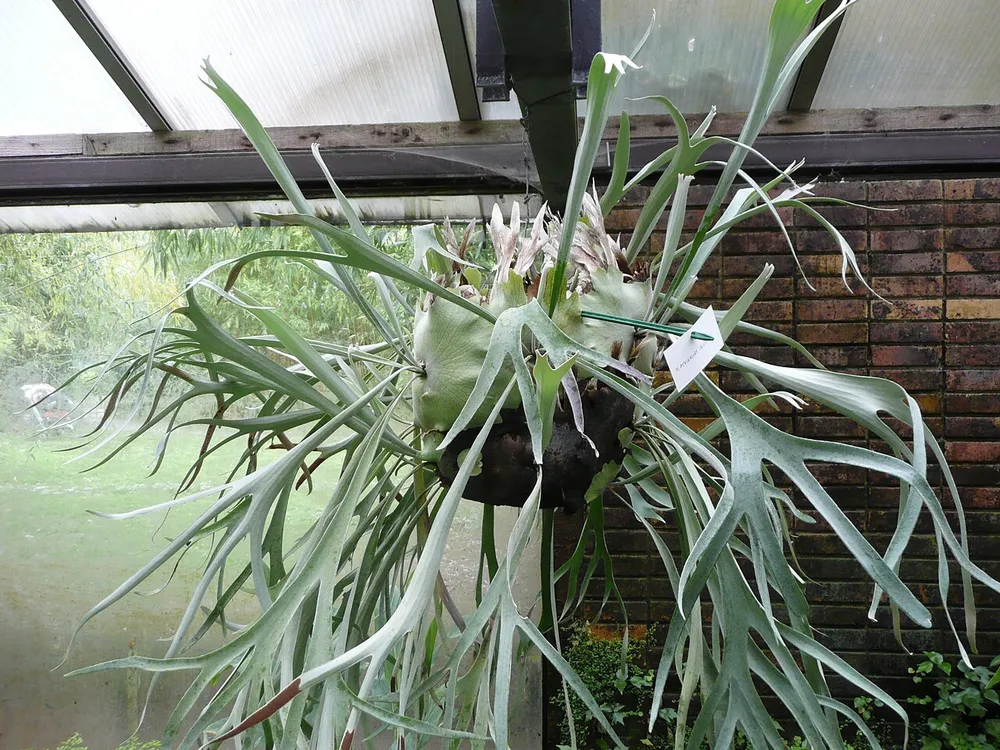
Platycerium alcicorne is one of the easiest African staghorn ferns to grow, but it exists in two distinct forms — African and Madagascar — and they do not want identical care. The African form is waxy and smooth; the Madagascar form is densely fuzzy. Tell them apart before you set a watering routine, because the fuzzy one is the fussier one.
Beyond that split, the species is genuinely forgiving: it handles ordinary household humidity, tolerates a wide temperature range, and asks for one thing most staghorn growers get wrong — a real dry-season rest.
For the botanical profile and range data, see our P. alcicorne species page. This guide covers growing it.
Platycerium Alcicorne Care at a Glance
| Factor | Requirement | Notes |
|---|---|---|
| Light | Bright indirect | Tolerates more shade than most African species |
| Water (growing season) | Every 7–10 days | Let medium approach dryness first |
| Water (dry season) | Every 2–3 weeks | A genuine rest, not neglect |
| Humidity | 40–60% | Unusually moderate — ordinary room air works |
| Temperature | 10–35°C | Ideal 18–30°C; keep dry if it gets cold |
| Mounting | Board or basket | Multi-bud — leave room to spread |
| Difficulty | Easy | One of the best Clade A entry species |
Africa vs Madagascar: Which Form Do You Have?
P. alcicorne is unusual among staghorn ferns in having two geographically separate populations. Its range runs from Mozambique and Zimbabwe on the East African mainland across to Madagascar, the Comoros, and the Seychelles — and the two ends of that range produced visibly different plants.
| African form | Madagascar form | |
|---|---|---|
| Frond surface | Waxy cuticle, essentially no stellate hairs | Dense, highly branched trichomes |
| Appearance | Smooth, glossy green | Fuzzy, matte, silvered |
| Adapted for | Drier East African conditions | Wind resistance and moisture retention |
| Humidity in cultivation | More tolerant of dry air | Prefers the upper end of 40–60% |
| Overhead water | Tolerated | Avoid — strips the trichomes |
The practical consequence is the last row. Those trichomes on the Madagascar form are a living structure, not dust, and wiping or misting the fronds overhead removes them permanently — the same mistake growers make with P. willinckii and P. veitchii. Water the Madagascar form at the base, or soak the mount from below, and leave the fronds alone.
[!IMPORTANT] Do not confuse P. alcicorne Madagascar with P. madagascariense. They are separate species. Confusingly, P. madagascariense’s closest relative genuinely is P. alcicorne rather than any geographically closer Asian or Australian species — but the plants look nothing alike. P. madagascariense has the deeply corrugated, waffle-textured shield that gives it its nickname.
How to Water P. Alcicorne (and Why the Dry-Season Rest Matters)
Most staghorn fern care advice assumes a tropical rainforest species that never really stops growing. P. alcicorne is not that plant. It evolved in a wet/dry seasonal climate and goes genuinely dormant when conditions get cool and dry.
During the warm growing season, water when the medium is nearly dry — typically every 7–10 days. If it’s mounted, use the soak method: submerge for 15–20 minutes, drip-dry, rehang. Our mounted watering guide covers the full technique, and the watering schedule guide covers frequency across species.
Then, from roughly late fall through winter, cut back hard — every 2–3 weeks is enough. The plant is not sulking; it’s doing what it does at home. Its sponge-like fertile frond tissue and shallow-lobed shield fronds are water-storage adaptations, which is exactly why it survives a rest that would stress a tropical species.
The most common way growers kill this species is watering it through the dormant window on a summer schedule. The plant isn’t drinking, the medium stays wet, and the crown rots. If you see blackening at the base of the fertile fronds in January, that is almost always the cause — see our root rot guide for the rescue procedure.
Light, Humidity, Temperature, and Mounting
Light. Bright indirect. P. alcicorne tolerates a wider range than most African Platycerium, from partial shade through bright filtered light. Avoid prolonged direct afternoon sun, which dries the fronds faster than the plant can replace the moisture.
Humidity. 40–60% is sufficient — remarkably moderate for an African species, and the main reason this one succeeds in ordinary homes where P. stemaria and P. elephantotis struggle. Higher humidity helps during active growth but is not required.
Temperature. 10–35°C tolerated, 18–30°C ideal. The African form will take occasional nights down to 10°C if kept dry — the combination of cold and wet is what does damage, not cold alone.
Mounting. Board or basket both work. The wavy-edged fertile fronds hang attractively when given room, and as a multi-bud species P. alcicorne throws offsets steadily, so allow space for a spreading colony rather than mounting it tight to the board edge. Our mounting guide covers the build.
Dwarf Forms and Named Cultivars
Several P. alcicorne selections circulate in the collector trade, and the naming is inconsistent enough that it’s worth knowing what you’re buying:
- ‘Dwarf’ / var. dwarf — compact selections that stay markedly smaller than the type. Sold under both the African and Madagascar lineages, so confirm which parent form you’re getting; care follows that form, not the dwarf label.
- Madagascar dwarf — the compact Madagascar-form selection. Fuzzy and small. The most humidity-sensitive of the group.
- cv. ‘Gorgon’ — a named cultivar selected for heavily divided, twisting fertile fronds.
- var. ‘Orchid Jungle’ — a long-circulating nursery selection, named for the Florida garden it was distributed from rather than for a wild variety.
Care for all of them tracks the underlying form — African or Madagascar — rather than the cultivar name. When a seller lists only a cultivar name and no form, look at the fronds: waxy and glossy means African, fuzzy and matte means Madagascar.
Platycerium Alcicorne vs Bifurcatum
These two get compared constantly because they occupy the same slot: the easy, forgiving, beginner-appropriate staghorn.
| P. alcicorne | P. bifurcatum | |
|---|---|---|
| Origin | East Africa / Madagascar | Australia / New Guinea |
| Cold tolerance | To ~10°C, dry | Better — handles brief near-freezing |
| Drought tolerance | Better — stores water, rests dry | Prefers steadier moisture |
| Dormancy | Real dry-season rest needed | Slows but doesn’t truly rest |
| Humidity floor | 40% | 40% |
| Shield frond | Shallow-lobed, rounded | Taller, more upright lobing |
| Fails when | Watered through winter | Left dry too long |
The honest verdict: they’re comparably easy, and the right pick depends on your failure mode. If you overwater, buy bifurcatum — it can absorb the mistake. If you forget to water, buy alcicorne — the dry rest it wants looks a lot like neglect. For a broader side-by-side across the genus, see our species comparison guide and the P. bifurcatum species page.
Common Problems
| Symptom | Likely cause | Fix |
|---|---|---|
| Black mush at frond base in winter | Watered on a summer schedule through dormancy | Stop watering 2–3 weeks; cut rotted tissue with a sterile blade |
| Fuzzy coating gone patchy (Madagascar form) | Overhead misting or wiping stripped trichomes | Water at base only; the affected fronds won’t recover |
| Fronds limp despite wet medium | Compacted moss suffocating roots | Remount in fresh long-fiber sphagnum |
| Crispy frond tips in summer | Underwatering or direct afternoon sun | Increase soak frequency; move out of direct sun |
| No new growth for months in winter | Normal dormancy | Nothing — resume feeding in spring |
That last row is worth internalizing. A stalled P. alcicorne in December is a healthy P. alcicorne. Growers who respond to winter dormancy by watering and feeding more are the ones who lose the plant.
Range and morphology data drawn from our species profile; general Platycerium cultivation requirements per NC State Extension and Platycerium alcicorne — Wikipedia.