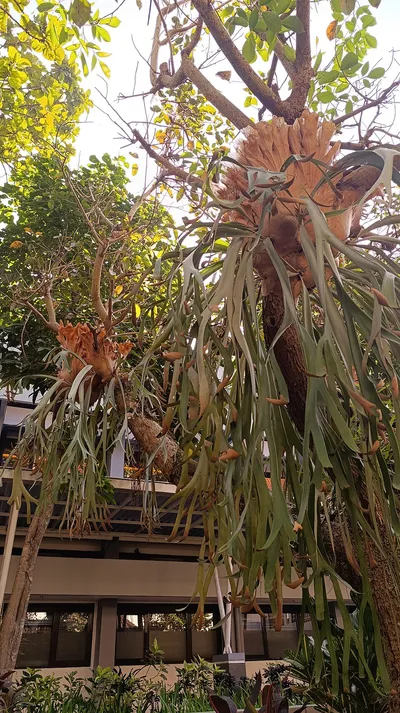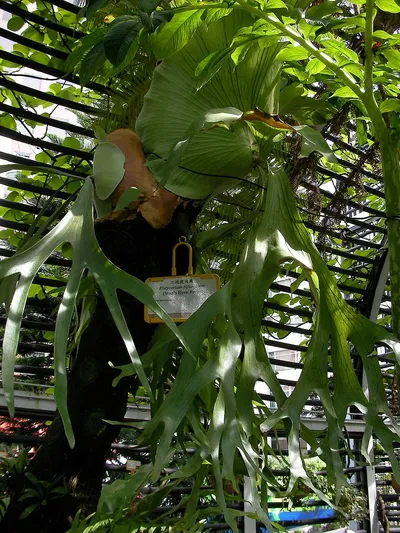
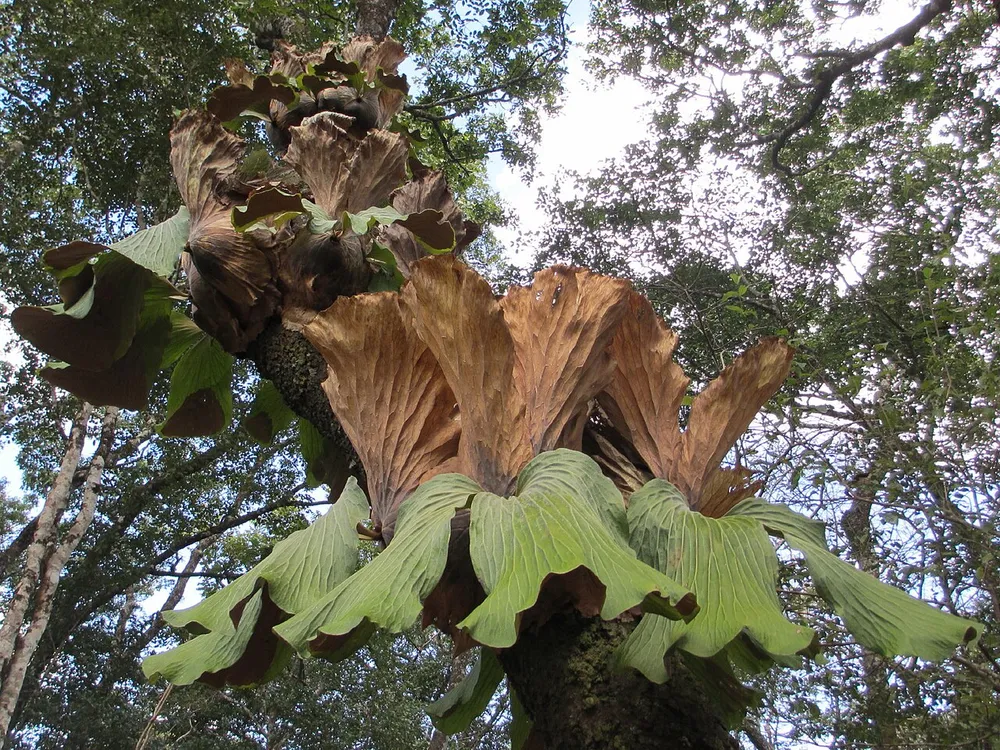
Ask ten staghorn fern owners about humidity and you’ll get ten different answers — most of them involving a spray bottle. Humidity genuinely is one of the most important factors in keeping Platycerium healthy, especially through a hot, dry summer. But the single most common piece of advice — “mist it daily” — is also the least effective. This guide covers exactly how much humidity a staghorn fern needs, why bathrooms work so well, how to actually raise humidity, and why misting is largely a waste of your time.
Staghorn ferns are having a real moment this year — Martha Stewart’s hanging specimen was recently called “the most controversial statement your terrace can make in 2026” — and more first-time growers than ever are discovering that the humidity piece is where most care advice goes sideways.
How Much Humidity Does a Staghorn Fern Need?
Staghorn ferns are epiphytes native to tropical and subtropical forests, where they grow mounted on tree trunks in consistently moist air. That heritage sets their comfort zone. As the New York Botanical Garden’s research guide on Platycerium notes, these are humidity-loving forest plants, not desert survivors.
| Relative humidity | What happens |
|---|---|
| 70–80% | Ideal — lush, fast growth, especially for tropical species |
| 60–70% | Very comfortable for nearly all species |
| 50–60% | Fine for hardy species like P. bifurcatum and P. veitchii |
| 40–50% | Tolerable but slower; watch for browning frond tips |
| Below 40% | Stress zone — crispy edges, stalled growth, spider mite risk |
The hardy species tolerate drier air better than the tropical ones. A P. bifurcatum will shrug off average household humidity, while a thin-fronded P. ridleyi or P. elephantotis really does want a humid microclimate to look its best.
How to tell your fern wants more humidity
- Brown, crispy edges on otherwise healthy fronds
- Fronds that feel papery or curl slightly inward
- A shield (basal) frond that dries and cracks unusually fast
- Fine webbing or stippling — a classic sign of spider mites, which explode in dry air
[!IMPORTANT] Crispy brown tips usually mean low humidity or underwatering. Soft, blackened bases mean the opposite — too much water sitting against the root ball. Don’t confuse the two. If the damage is at the base, see our guide on staghorn fern root rot before adding any moisture.
Why Summer Is the Riskiest Season for Humidity
It seems backwards — summer air feels humid — but indoor humidity often drops in summer, and outdoor ferns face a brutal combination. Air conditioning strips moisture from indoor air, frequently pulling it below 40%. Outdoors, heat and wind wick water out of the moss faster than the plant can absorb it.
This is why humidity and heat protection go hand in hand. Moist air slows the rate at which fronds and moss dry out, buying your plant time during hot spells. If you’re battling summer heat, read this alongside our staghorn fern sunburn and heat stress guide — the two problems compound each other, and dry air makes every hot day more dangerous.
Dry summer air also triggers the season’s worst pest. Spider mites thrive in hot, dry conditions and can infest a stressed staghorn fern within days. Raising humidity is one of the cheapest forms of prevention — see staghorn fern pests for the full rundown.
The Misting Myth
Here’s the uncomfortable truth: misting barely works. When you spray a fern, you raise the humidity around the fronds for a few minutes at most. Then the water evaporates and the air is dry again. To meaningfully change the humidity a plant experiences, you’d have to mist it a dozen times a day — which no one actually does.
Misting can even backfire. Water pooling on the fronds and in the crown of the shield frond, especially overnight when it evaporates slowly, creates the damp, still conditions that fungal leaf-spotting loves. A light misting won’t kill your fern, but it gives a false sense of security while doing almost nothing for the humidity that matters.
If you enjoy misting as a ritual, fine — just don’t count it as your humidity strategy. Do these instead.
How to Actually Raise Humidity
| Method | Effort | Effectiveness |
|---|---|---|
| Move it to a bathroom or kitchen | One-time | High — free and permanent |
| Run a humidifier nearby | Low (refills) | Very high — full control |
| Group plants together | One-time | Moderate — plants transpire on each other |
| Pebble tray under a potted specimen | Low | Low–moderate |
| Misting | Daily, repeated | Very low |
Move it somewhere naturally humid. A bathroom with a window is close to ideal — showers keep the air moist all day, which is exactly what Platycerium wants. Kitchens and laundry rooms work too. The only rule: there must be enough light. A windowless bathroom is too dark, no matter how humid.
Run a humidifier. For a serious tropical species, a small cool-mist humidifier near the plant is the single most reliable fix. Aim for 60%+ and let a cheap hygrometer tell you the truth rather than guessing.
Group your plants. Plants release moisture as they transpire, so a clustered collection creates its own humid pocket. This is one reason a wall of mounted ferns often looks better than a single lonely specimen.
Water correctly. Humidity and watering are linked — a properly hydrated moss ball humidifies the air around itself as it slowly dries. Getting your soak-and-dry rhythm right does more than any spray bottle. See how often to water a staghorn fern and, for wall-mounted plants, mounted staghorn fern care.
Don’t Overcorrect
Chasing humidity has a failure mode: stagnant, saturated air with no movement, which invites fungal and bacterial problems. Staghorn ferns want humid air, but they also want it moving. A gently circulating fan in a humid room, or simply not sealing the plant into a closed box, keeps that balance. High humidity plus good airflow is the sweet spot — not a swamp.
Get the humidity right and most other staghorn fern problems get easier: growth speeds up, frond edges stay clean, heat stress eases, and spider mites lose their favorite conditions. It’s the quiet foundation of a thriving Platycerium — and it has almost nothing to do with a spray bottle.