Platycerium elephantotis is the one staghorn fern that does not look like a staghorn. Its fertile fronds stay broad, flat, and completely undivided — elephant ears rather than antlers. And it is the one staghorn that needs a genuine dry-season dormancy, which is where nearly every cultivation failure with this species comes from.
If you have found this page in late summer, the timing matters: the wet-to-dry transition begins in early autumn, and getting that handover wrong is what kills otherwise healthy plants. This guide covers the seasonal cycle first, then light, mounting, growth rate, and the hybrid names you will run into when shopping.
Quick Care Reference
| Parameter | Requirement |
|---|---|
| Light | Filtered to bright indirect — no direct sun on the broad fronds |
| Watering | Seasonal: consistently moist in summer, near-dry in winter |
| Humidity | 50–70% in growth; low is fine during dormancy |
| Temperature | 15–35 °C; tolerates down to 12 °C only if kept dry |
| Mounting | Board or basket — fronds need room to hang 60–90 cm |
| Fertilizer | Growing season only; stop completely at dormancy |
| Difficulty | Intermediate — easy care, hard timing |
Why Elephantotis Looks Nothing Like Other Staghorn Ferns
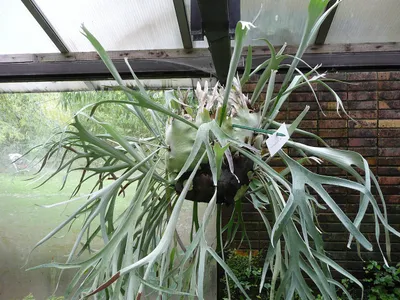
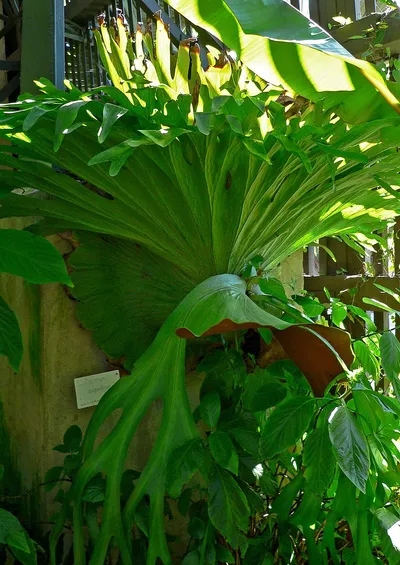
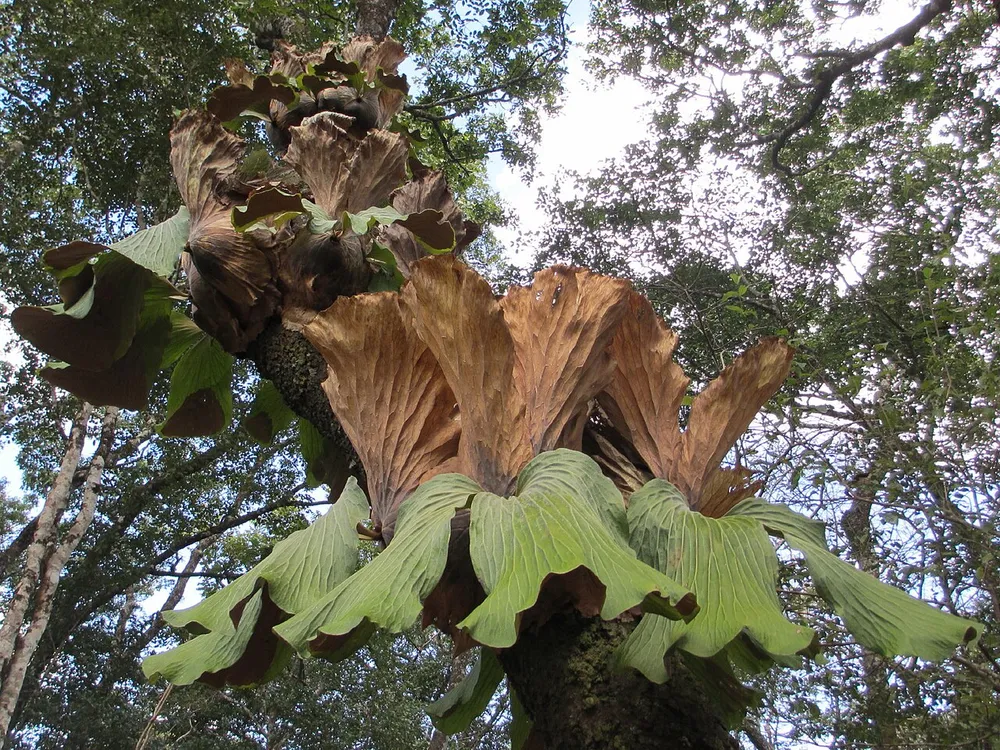
Every other Platycerium forks its fertile fronds into the antler shape the genus is named for. P. elephantotis does not. Its fertile fronds grow as broad, undivided paddles that can reach 60–90 cm long and 20–30 cm wide, hanging in heavy overlapping sheets.
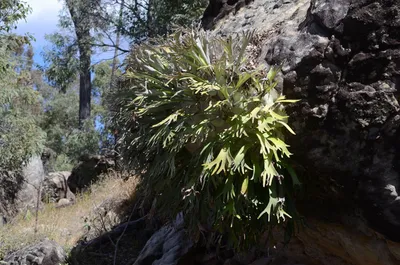
This is an adaptation, not a defect. The species comes from the Congo River basin and was first described from Angola — subtropical savanna, not rainforest. In a habitat with a short, intense wet season, maximising flat surface area captures as much light as possible in the months when growth is actually possible. Forked fronds are an advantage in the dappled, permanently humid canopies where species like P. ridleyi live; they are a liability where the growing window is short.
Two practical consequences follow from those broad fronds:
- They scorch easily. A wide, thin frond has nowhere to hide from direct sun. This species wants filtered light, full stop.
- They collect water. Water pooling on a horizontal paddle frond invites fungal spotting in a way it does not on a narrow forked frond. Water the root ball, not the plant.
For where this species sits relative to the rest of the genus, see the species comparison guide and the P. elephantotis species profile.
The Wet/Dry Cycle: Elephantotis Dormancy
This is the section that matters. Everything else about elephantotis care is ordinary staghorn care.
P. elephantotis has one of the most pronounced dormancy mechanisms in the genus. In its native savanna it can desiccate almost completely through the dry season and regenerate when the rains return — closer to a resurrection plant than to a typical houseplant. Growers who treat it like a P. bifurcatum and water it year-round rot the crown in winter.
| Season | Water | Fertilizer | What the plant does |
|---|---|---|---|
| Spring (Mar–May) | Resume gradually as new growth appears | Restart at quarter strength | Breaks dormancy, pushes new fronds |
| Summer (Jun–Aug) | Keep the medium consistently moist | Every 3–4 weeks, half strength | Peak growth |
| Autumn (Sep–Nov) | Taper sharply — this is the critical handover | Stop entirely by mid-September | Sheds older fertile fronds |
| Winter (Dec–Feb) | Near-dry; a light misting every 3–4 weeks at most | None | Dormant — little to no visible growth |
How to taper. Do not cut water off in one step. From early September, lengthen the interval by roughly 50% every two weeks until you are down to a monthly light watering by late November. An abrupt cut-off stresses a plant that is still holding active fronds; a gradual one lets it shut down on its own schedule.
What dormancy looks like. Fertile fronds yellow and drop, sometimes all of them. The shield fronds stay on and go papery. The plant looks, to a new grower, like it is dying. It is not — provided the base stays firm. If the base goes black and soft rather than dry and papery, that is root rot, and the cause is almost always water continuing through dormancy.
[!IMPORTANT] The 12 °C cold tolerance for this species applies only to a dry, dormant plant. A wet elephantotis at 12 °C will rot. Cold and dry is survivable; cold and wet is not. Compare with the rest of the genus in the temperature tolerance guide.
Light, Temperature and Humidity
Light. Filtered or bright indirect. An east window, or a south window behind a sheer curtain. Those broad fronds scorch faster than any other staghorn’s — see sunburn and heat stress for what damage looks like versus underwatering.
Temperature. 15–35 °C in growth. The savanna origin makes it more heat-tolerant than most tropical Platycerium, and it handles a hot summer better than P. willinckii does.
Humidity. 50–70% while growing. During dormancy, low humidity is not just tolerated but preferred — this is the opposite of what most staghorn advice tells you, and it is the second most common way people get this species wrong. Do not run a humidifier for a dormant elephantotis. See the humidity guide for the general case.
How to Mount an Elephant Ear Staghorn Fern
Mounting is standard, with one sizing consideration: those fronds get long and heavy.
- Board size: allow for 60–90 cm of frond drop. A board that looks generous for a young plant will be swamped in three years. Mount higher on the wall than feels necessary.
- Substrate: long-fibre sphagnum, kept lean. A thick moss pad holds moisture into the dry season, which is exactly what you are trying to avoid with this species.
- Orientation: growth point at 12 o’clock so water drains away from the crown rather than pooling behind the shield.
- Baskets work well too and suit the heavy pendulous habit.
Full technique is in how to mount a staghorn fern; ongoing care for a mounted plant is in mounted staghorn fern care.
Because elephantotis is multi-bud, it produces pups and forms colonies over time. You can leave them attached for a fuller display or divide them — see separating staghorn fern pups.
Growth Rate: What to Expect
Elephantotis grows in bursts, not steadily, and the annual total is modest:
- Established plant: two to four new fertile fronds per growing season
- Young plant: three to four years before the first full-size 60–90 cm fronds
- Dormancy: effectively zero growth for three to four months
The trap is trying to compress this. Feeding or watering harder during dormancy does not extend the growing season — the plant is not photosynthesising enough to use it, and the surplus moisture rots the crown. If you want faster growth, put the effort into maximising light and feeding during the actual growth window.
Varieties and Hybrids You Will See for Sale
| Name | What it is | Notes |
|---|---|---|
| P. elephantotis (standard) | The species | Sometimes sold as “elephant ear” or “elephant ear elk fern” |
| var. mammuthus | Large-form selection | Broader, longer fronds; same care |
| ”An Xiang” | elephantotis × andinum | Hybrid — narrower fronds, some antler tendency |
| ”Xiang Zhua” | elephantotis × willinckii | Hybrid — inherits some silver trichomes |
| ”Neptune” | A different hybrid line entirely | Frequently compared to elephantotis but not a form of it |
Hybrids generally inherit a weaker dormancy requirement than the pure species — which makes them more forgiving, but also means you should not apply the strict dry-winter regime above to a hybrid without checking its parentage. Ask the seller what the cross is. For why these named forms carry the prices they do, see the collectible staghorn ferns guide.
Common Problems
Fronds yellowing and dropping in autumn — normal dormancy. Check the base is firm; if so, do nothing except reduce water.
Fronds yellowing in summer — not normal. Usually overwatering or insufficient light. See staghorn fern turning yellow.
Brown scorched patches — direct sun. Move to filtered light; the damage will not heal but new fronds will come in clean.
Black, soft crown — root rot, nearly always from watering through dormancy. Act immediately.
Fungal spotting on the broad fronds — water pooling on the frond surface plus stagnant air. Water the root ball only and add gentle air movement. Late summer humidity is also when pests establish, so check the undersides while you are there.
External reference: UF/IFAS Gardening Solutions — Staghorn Fern.